
儿童肾移植受者抗体介导排斥反应的发病率、危险因素、管理策略及结局——欧洲儿科肾移植合作倡议(CERTAIN)的多中心分析
Incidence, risk factors, management strategies, and outcomes of antibody-mediated rejection in pediatric kidney transplant recipients-a multicenter analysis of the Cooperative European Paediatric Renal Transplant Initiative (CERTAIN).
作者信息
Fichtner Alexander, Gauché Laura, Süsal Caner, Tran Thuong Hien, Waldherr Rüdiger, Krupka Kai, Guzzo Isabella, Carraro Andrea, Oh Jun, Zirngibl Matthias, Weitz Marcus, König Jens, Büscher Anja, Berta Laszlo, Simon Thomas, Awan Atif, Rusai Krisztina, Topaloglu Rezan, Peruzzi Licia, Printza Nikoleta, Kim Jon Jin, Weber Lutz T, Melk Anette, Pape Lars, Rieger Susanne, Patry Christian, Höcker Britta, Tönshoff Burkhard
机构信息
Heidelberg University, Medical Faculty Heidelberg, Department of Pediatrics I, University Children's Hospital, Im Neuenheimer Feld 430, 69120, Heidelberg, Germany.
Heidelberg University, Medical Faculty Heidelberg, Institute of Immunology, Transplantation Immunology, Heidelberg, Germany.
出版信息
Pediatr Nephrol. 2025 Feb;40(2):491-503. doi: 10.1007/s00467-024-06487-2. Epub 2024 Sep 16.
BACKGROUND
This study by the Cooperative European Paediatric Renal Transplant Initiative (CERTAIN) was designed to determine the incidence, risk factors, current management strategies, and outcomes of antibody-mediated rejection (ABMR) in pediatric kidney transplant recipients (pKTR).
METHODS
We performed an international, multicenter, longitudinal cohort study of data reported to the Cooperative European Paediatric Renal Transplant Initiative (CERTAIN) registry. Three hundred thirty-seven pKTR from 21 European centers were analyzed. Clinical outcomes, including kidney dysfunction, rejection, HLA donor-specific antibodies, BK polyomavirus-associated (BKPyV) nephropathy, and allograft loss, were assessed through 5 years post-transplant.
RESULTS
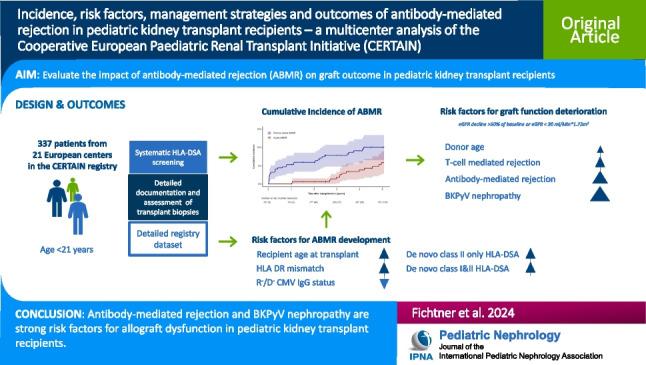
The cumulative incidence of de novo donor-specific class I HLA antibodies (HLA-DSA) post-transplant was 4.5% in year 1, 8.3% in year 3, and 13% in year 5; the corresponding data for de novo class II HLA-DSA were 10%, 22.5%, and 30.6%, respectively. For 5 years post-transplant, the cumulative incidence of acute ABMR was 10% and that of chronic active ABMR was 5.9%. HLA-DR mismatch and de novo HLA-DSA, especially double positivity for class I and class II HLA-DSA, were significant risk factors for ABMR, whereas cytomegalovirus (CMV) IgG negative recipient and CMV IgG negative donor were associated with a lower risk. BKPyV nephropathy was associated with the highest risk of graft dysfunction, followed by ABMR, T-cell mediated rejection, and older donor age.
CONCLUSIONS
This study provides an estimate of the incidence of de novo HLA-DSA and ABMR in pKTR and highlights the importance of BKPyV nephropathy as a strong risk factor for allograft dysfunction.
背景
欧洲儿科肾脏移植合作倡议(CERTAIN)开展的这项研究旨在确定小儿肾移植受者(pKTR)中抗体介导性排斥反应(ABMR)的发生率、危险因素、当前管理策略及预后情况。
方法
我们对向欧洲儿科肾脏移植合作倡议(CERTAIN)登记处报告的数据进行了一项国际多中心纵向队列研究。分析了来自21个欧洲中心的337例pKTR。通过移植后5年评估临床结局,包括肾功能障碍、排斥反应、HLA供者特异性抗体、BK多瘤病毒相关性(BKPyV)肾病和移植肾丢失情况。
结果
移植后第1年、第3年和第5年,新发供者特异性I类HLA抗体(HLA-DSA)的累积发生率分别为4.5%、8.3%和13%;新发II类HLA-DSA的相应数据分别为10%、22.5%和30.6%。移植后5年,急性ABMR的累积发生率为10%,慢性活动性ABMR的累积发生率为5.9%。HLA-DR错配和新发HLA-DSA,尤其是I类和II类HLA-DSA双阳性,是ABMR的显著危险因素,而巨细胞病毒(CMV)IgG阴性受者和CMV IgG阴性供者的风险较低。BKPyV肾病与移植肾功能障碍的风险最高相关,其次是ABMR、T细胞介导的排斥反应和供者年龄较大。
结论
本研究提供了pKTR中新发HLA-DSA和ABMR发生率的估计,并强调了BKPyV肾病作为移植肾功能障碍的重要危险因素的重要性。



 Zotero 插件