Department of Chemistry, The University of Chicago, 5735 S Ellis Avenue, Chicago, Illinois 60637, United States.
Laboratoire International Associé Centre National de la Recherche Scientifique et University of Illinois at Urbana-Champaign, Université de Lorraine, Unité Mixte de Recherche n7019, B.P. 70239, 54506 cedex Vandœuvre-lès-Nancy, France.
J Phys Chem B. 2024 Sep 26;128(38):9183-9196. doi: 10.1021/acs.jpcb.4c05020. Epub 2024 Sep 16.
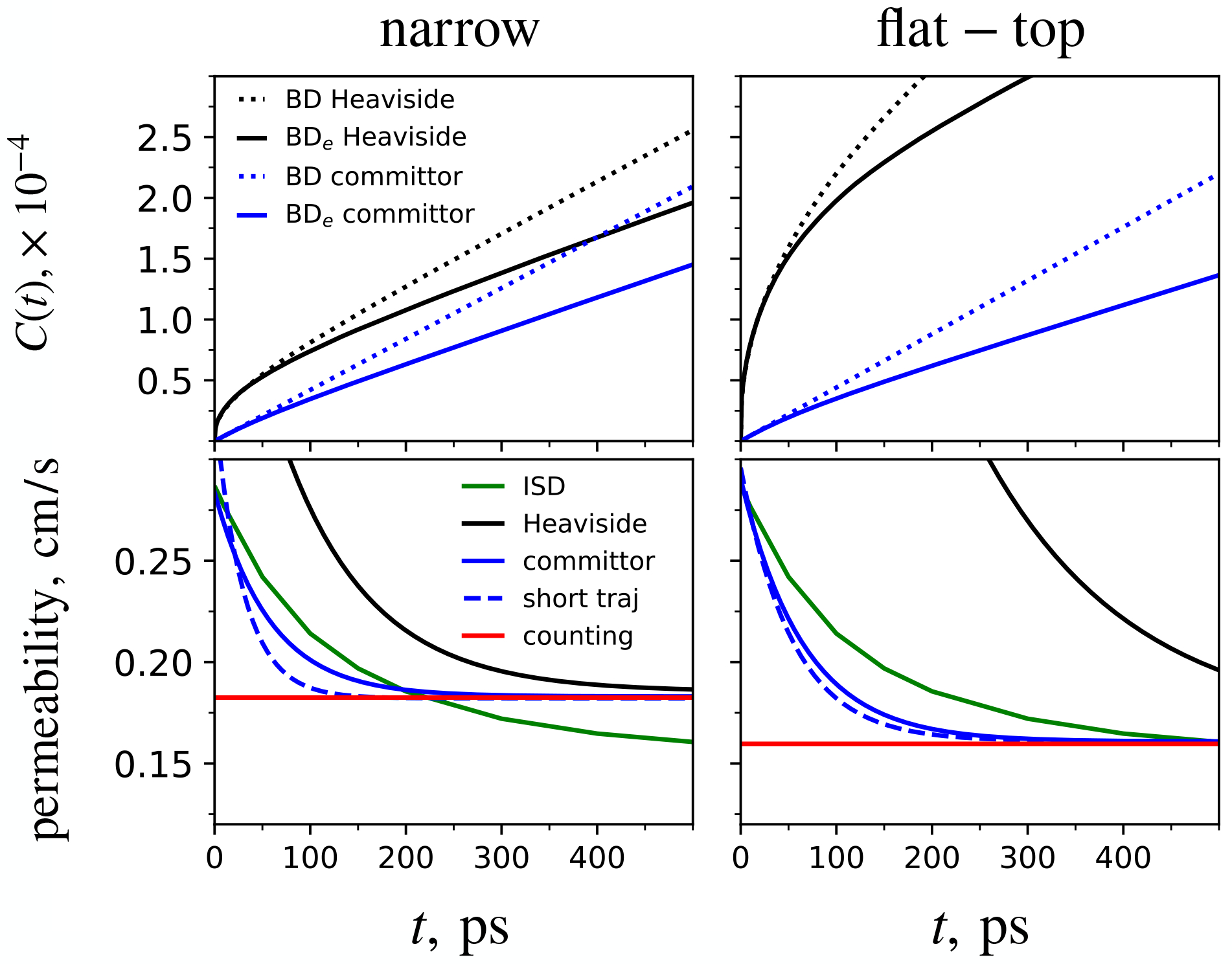
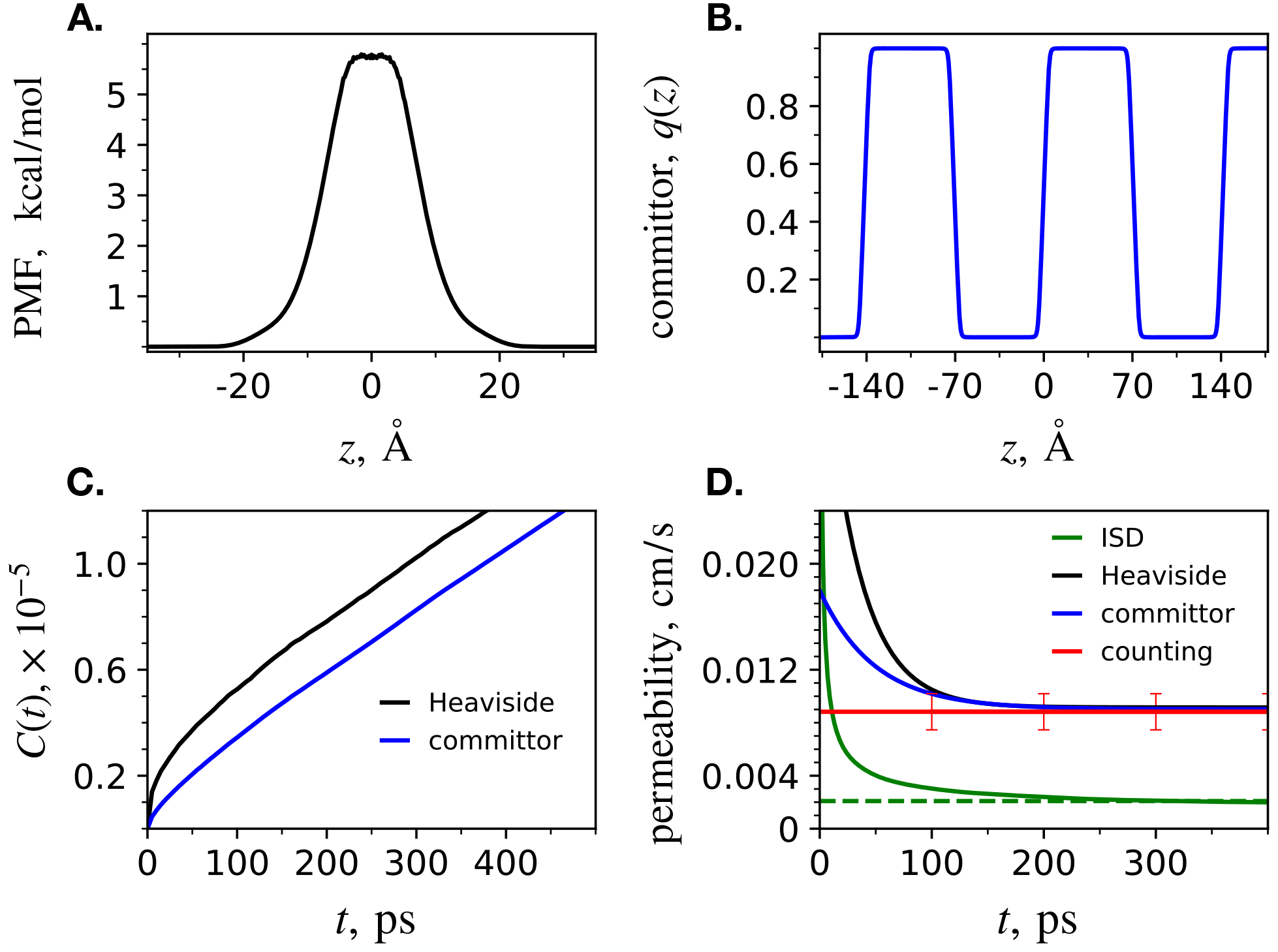
A popular theoretical framework to compute the permeability coefficient of a molecule is provided by the classic Smoluchowski-Kramers treatment of the steady-state diffusive flux across a free-energy barrier. Within this framework, commonly termed "inhomogeneous solubility-diffusion" (ISD), the permeability, , is expressed in closed form in terms of the potential of mean force and position-dependent diffusivity of the molecule of interest along the membrane normal. In principle, both quantities can be calculated from all-atom MD simulations. Although several methods exist for calculating the position-dependent diffusivity, each of these is at best an estimate. In addition, the ISD model does not account for memory effects along the chosen reaction coordinate. For these reasons, it is important to seek alternative theoretical formulations to determine the permeability coefficient that are able to account for the factors ignored by the ISD approximation. Using Green-Kubo linear response theory, we establish the familiar constitutive relation between the flux density across the membrane and the difference in the concentration of a permeant molecule, = Δ. On this basis, we derive a time-correlation function expression for the nonequilibrium flux across a membrane that is reminiscent of the transmission coefficient in the reactive flux formalism treatment of transition rates. An analysis based on the transition path theory framework is exploited to derive alternative expressions for the permeability coefficient. The different strategies are illustrated with stochastic simulations based on the generalized Langevin equation in addition to unbiased molecular dynamics simulations of water permeation of a lipid bilayer.
一个流行的理论框架来计算分子的渗透率是由经典的斯莫卢霍夫斯基-克拉默斯处理稳态扩散通量通过自由能屏障。在这个框架内,通常称为“非均匀溶解-扩散”(ISD),渗透率, ,以封闭的形式表示的平均力势能和位置相关的扩散感兴趣的分子沿膜法向。原则上,这两个量都可以从全原子 MD 模拟中计算出来。虽然有几种方法可以计算位置相关的扩散系数,但每一种方法都是最好的估计。此外,ISD 模型没有考虑到沿选定反应坐标的记忆效应。由于这些原因,寻求替代的理论公式来确定渗透率是很重要的,这些理论公式能够解释 ISD 近似忽略的因素。我们使用格林-库珀线性响应理论,建立了膜两侧通量密度与可渗透分子浓度差之间的熟悉本构关系, = Δ。在此基础上,我们推导出了一种非平衡膜通量的时相关函数表达式,它类似于反应通量形式处理跃迁率的传输系数。基于转移路径理论框架的分析被用来推导出渗透率的替代表达式。不同的策略是通过基于广义朗之万方程的随机模拟以及脂质双层水渗透的无偏分子动力学模拟来演示的。