Department of Urology, Tianjin First Central Hospital, Tianjin, China.
Department of Urology, First People's Hospital of Yunnan Province, Kunming, China.
Front Endocrinol (Lausanne). 2024 Sep 2;15:1374282. doi: 10.3389/fendo.2024.1374282. eCollection 2024.
To compare nonfunctional adrenal incidentalomas (NFAI) in individuals with and without a history of COVID-19 infection, while also establishing predictive models for distinguishing between benign and malignant adrenal incidentalomas (AI).
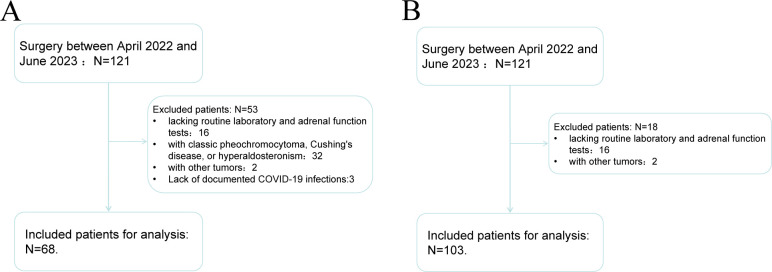
A retrospective collection of data from patients with AI who underwent surgery and were verified in our hospital between April 2022 and June 2023 was conducted. A total of 121 patients were included in the study. Demographic information, tumor characteristics, functional indicators, and complications were compared among the patients. Statistical analyses utilized the t-test for continuous variables and Pearson chi-square test or Fisher's exact test for categorical variables.
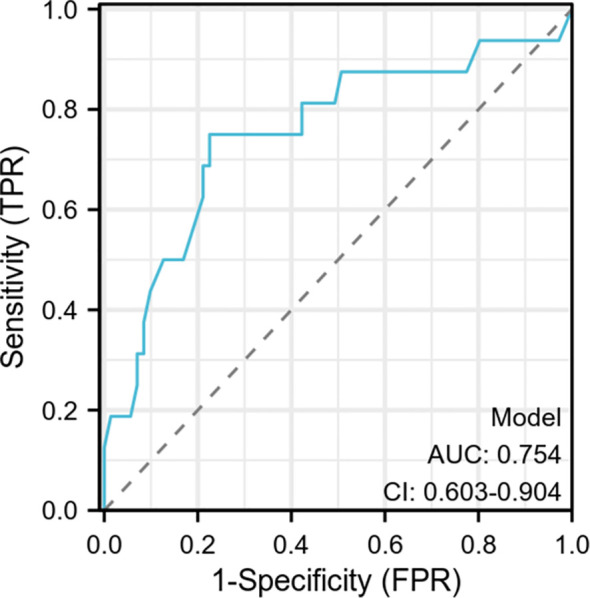
Patients with COVID-19 exhibited a higher prevalence of obesity (84.2% vs. 63.3%, P=0.048) and elevated direct bilirubin (DBIL) levels (44.1% vs. 19.2%, P=0.043) compared to those without COVID-19. Moreover, patients with Malignant AI, in contrast to Benign AI, showed higher normal total protein (TP) levels (28.8% vs. 57.1%, P=0.016) and larger tumor sizes (20 vs. 32.5mm, P=0.009). Univariate analysis identified low TP (OR=0.303, 95% CI=0.111-0.825, P=0.020) and tumor size (OR=1.045, 95% CI=1.011-1.080, P=0.009) as potential risk factors for multivariate analysis. A predictive model comprising clinical risk factors (tumor size and low TP) demonstrated an AUC of 0.754 (95% CI, 0.603-0.904) with a sensitivity of 0.75 and specificity of 0.775. The calibration curve revealed a bias-corrected AUC of 0.77.
No discernible differences in the clinical manifestations of adrenal incidentalomas were observed between cases with and without a history of COVID-19 infection. However, AI with larger tumor diameters and lower than normal levels of total protein exhibited a more pronounced malignant potential.
比较有和无 COVID-19 感染史的个体中的无功能性肾上腺意外瘤(NFAI),同时建立鉴别良恶性肾上腺意外瘤(AI)的预测模型。
对 2022 年 4 月至 2023 年 6 月在我院接受手术并经证实的 AI 患者进行回顾性数据收集。共纳入 121 例患者。比较患者的人口统计学信息、肿瘤特征、功能指标和并发症。连续变量采用 t 检验,分类变量采用 Pearson 卡方检验或 Fisher 确切检验。
与无 COVID-19 感染的患者相比,COVID-19 感染的患者表现出更高的肥胖患病率(84.2% vs. 63.3%,P=0.048)和直接胆红素(DBIL)水平升高(44.1% vs. 19.2%,P=0.043)。此外,与良性 AI 相比,恶性 AI 患者的总蛋白(TP)水平正常(28.8% vs. 57.1%,P=0.016)和肿瘤体积更大(20 vs. 32.5mm,P=0.009)。单因素分析确定低 TP(OR=0.303,95%CI=0.111-0.825,P=0.020)和肿瘤大小(OR=1.045,95%CI=1.011-1.080,P=0.009)是多因素分析的潜在危险因素。包含临床危险因素(肿瘤大小和低 TP)的预测模型的 AUC 为 0.754(95%CI,0.603-0.904),敏感性为 0.75,特异性为 0.775。校准曲线显示校正后 AUC 为 0.77。
无 COVID-19 感染史和有 COVID-19 感染史的肾上腺意外瘤患者的临床表现无明显差异。然而,肿瘤直径较大且总蛋白水平低于正常的 AI 表现出更明显的恶性潜能。