J Clin Invest. 2024 Sep 17;134(18):e184112. doi: 10.1172/JCI184112.
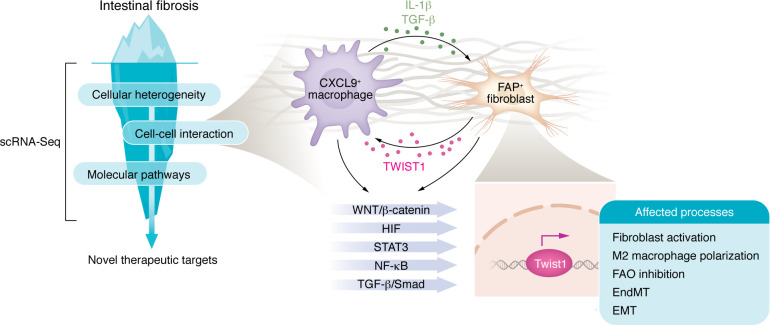
Intestinal fibrosis is a severe complication of Crohn's disease, often requiring surgical intervention. Despite extensive research efforts, an effective treatment to prevent or reverse intestinal fibrosis remains elusive. In this issue of the JCI, Zhang, Wang, and colleagues employed single-cell RNA sequencing to uncover mechanisms of the fibrotic process. They identified a key fibroblast subset of TWIST1+FAP+ cells that interacts with CXCL9+ macrophages. TWIST1 emerged as a central regulator of the fibrotic microenvironment, representing a promising therapeutic target for effectively treating intestinal fibrosis.
肠纤维化是克罗恩病的严重并发症,常需手术干预。尽管研究力度很大,但仍缺乏有效的治疗方法来预防或逆转肠纤维化。在本期 JCI 中,Zhang、Wang 和同事们采用单细胞 RNA 测序揭示了纤维化过程的机制。他们鉴定出 TWIST1+FAP+成纤维细胞的一个关键亚群,该亚群与 CXCL9+巨噬细胞相互作用。TWIST1 是纤维化微环境的核心调节因子,为有效治疗肠纤维化提供了一个有希望的治疗靶点。