Department of Bioengineering and Therapeutic Sciences, University of California, San Francisco, San Francisco, California, USA.
Center for Tuberculosis Research, Department of Medicine, Johns Hopkins University School of Medicine, Baltimore, Maryland, USA.
Antimicrob Agents Chemother. 2024 Oct 8;68(10):e0061524. doi: 10.1128/aac.00615-24. Epub 2024 Sep 17.
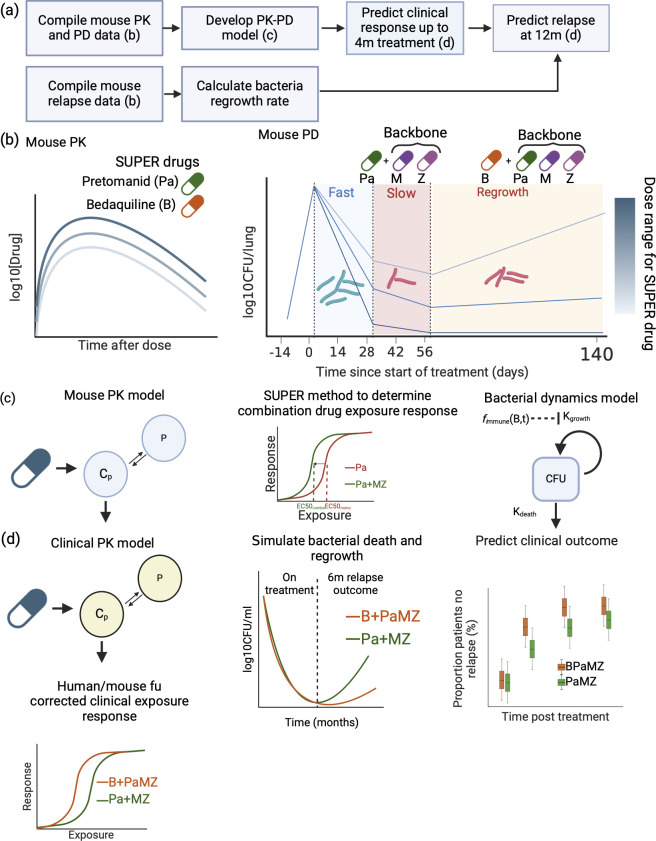
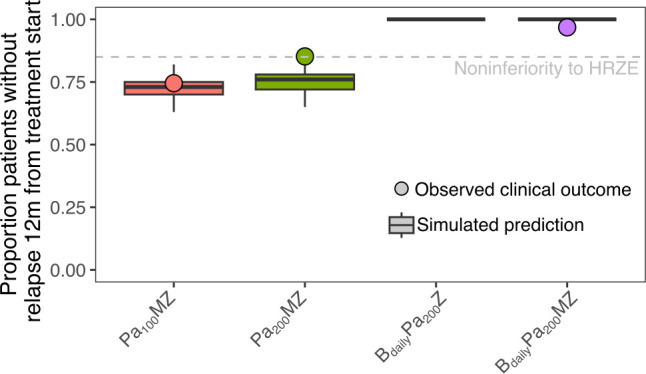
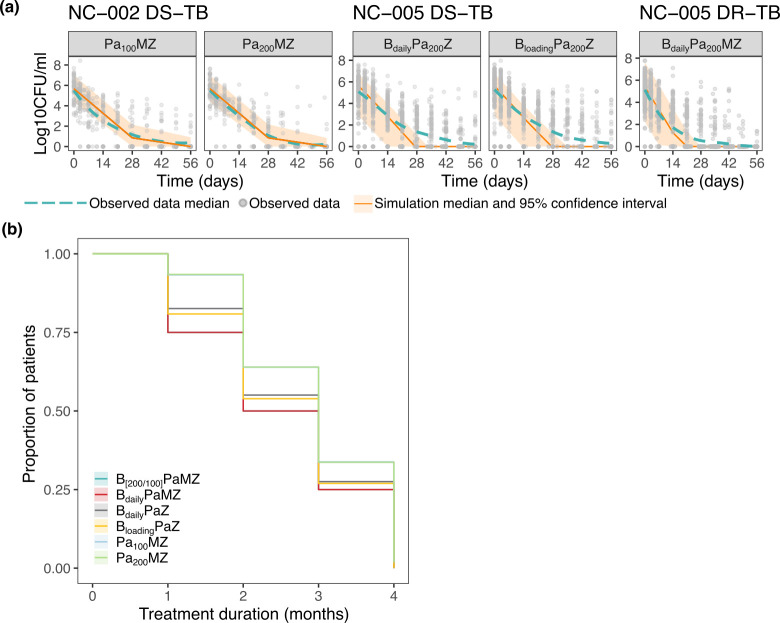
Despite known treatments, tuberculosis (TB) remains the world's top infectious killer, highlighting the pressing need for new drug regimens. To prioritize the most efficacious drugs for clinical testing, we previously developed a PK-PD translational platform with bacterial dynamics that reliably predicted short-term monotherapy outcomes in Phase IIa trials from preclinical mouse studies. In this study, we extended our platform to include PK-PD models that account for drug-drug interactions in combination regimens and bacterial regrowth in our bacterial dynamics model to predict cure at the end of treatment and relapse 6 months post-treatment. The Phase III STAND trial testing a new regimen comprised of pretomanid (Pa), moxifloxacin (M), and pyrazinamide (Z) (PaMZ) was suspended after a separate ongoing trial (NC-005) suggested that adding bedaquiline (B) to the PaMZ regimen would improve efficacy. To forecast if the addition of B would, indeed, benefit the PaMZ regimen, we applied an extended translational platform to both regimens. We predicted currently available short- and long-term clinical data well for drug combinations related to BPaMZ. We predicted the addition of B to PaMZ to shorten treatment duration by 2 months and to have similar bacteriological success to standard HRZE treatment (considering only treatment success but not withdrawal from side effects and other adverse events), both at the end of treatment for treatment efficacy and 6 months after treatment has ended in relapse prevention. Using BPaMZ as a case study, we have demonstrated our translational platform can predict Phase II and III outcomes prior to actual trials, allowing us to better prioritize the regimens most likely to succeed.
尽管已有已知的治疗方法,结核病(TB)仍然是全球头号传染病致死原因,这突显了迫切需要新的药物治疗方案。为了优先选择最有效的药物进行临床测试,我们之前开发了一个具有细菌动力学的 PK-PD 转化平台,该平台能够可靠地预测临床前小鼠研究的 IIa 期试验中的短期单药治疗结果。在这项研究中,我们扩展了我们的平台,包括考虑药物相互作用的 PK-PD 模型和细菌动力学模型中的细菌再生长,以预测治疗结束时的治愈和治疗结束后 6 个月的复发。正在测试新方案的 III 期 STAND 试验包括普托马尼德(Pa)、莫西沙星(M)和吡嗪酰胺(Z)(PaMZ),在另一个正在进行的试验(NC-005)表明,在 PaMZ 方案中添加贝达喹啉(B)会提高疗效后暂停。为了预测添加 B 是否确实会使 PaMZ 方案受益,我们将扩展的转化平台应用于两种方案。我们很好地预测了与 BPaMZ 相关的药物组合的当前可用短期和长期临床数据。我们预测 B 加至 PaMZ 会将治疗时间缩短 2 个月,并且在治疗结束时(仅考虑治疗成功,而不考虑因副作用和其他不良事件而停药)和治疗结束后 6 个月(考虑到预防复发)的细菌学成功率与标准 HRZE 治疗相似。以 BPaMZ 为例,我们已经证明我们的转化平台可以在实际试验之前预测 II 期和 III 期结果,从而使我们能够更好地优先选择最有可能成功的方案。