Academic Trials Promoting Team, Institut Jules Bordet, Université Libre de Bruxelles (U.L.B.), Hôpital Universitaire de Bruxelles (HUB), Brussels, Belgium.
U.O. Epidemiologia Clinica, IRCCS Ospedale Policlinico San Martino, Genoa, Italy.
ESMO Open. 2024 Oct;9(10):103714. doi: 10.1016/j.esmoop.2024.103714. Epub 2024 Sep 16.
Young women with breast cancer (BC) have an increased chance of carrying germline BRCA pathogenic variants (PVs). Limited data exist on the prognostic impact of tumor histology (i.e. ductal versus lobular) in hereditary breast cancer.
This multicenter retrospective cohort study included women aged ≤40 years with early-stage breast cancer diagnosed between January 2000 and December 2020 and known to carry germline PVs in BRCA1/2. Histology was locally assessed in each center. The Kaplan-Meier method and Cox regression analysis were used to assess disease-free survival and overall survival.
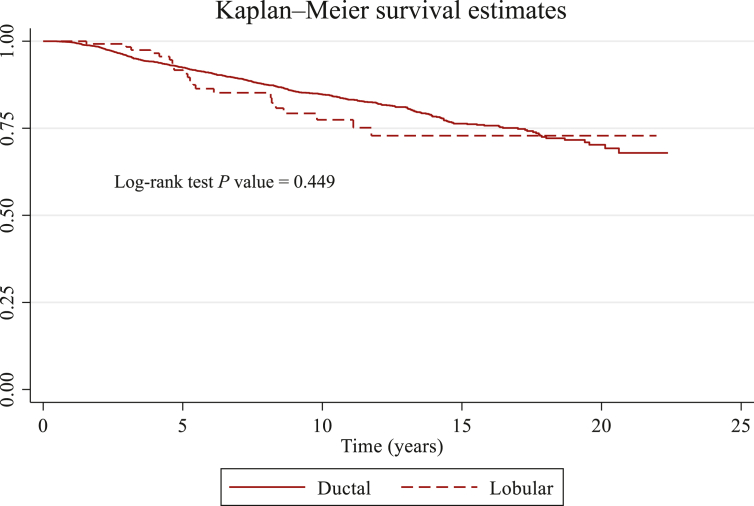
Of 4628 patients included from 78 centers worldwide, 3969 (86%) had pure ductal, 135 (3%) pure lobular, and 524 (11%) other histologies. Compared with ductal tumors, lobular tumors were more often grade 1/2 (57.7% versus 22.1%), stage III (29.6% versus 18.5%), and luminal A-like (42.2% versus 12.2%). Lobular tumors were more often associated with BRCA2 PVs (71.1% BRCA2), while ductal tumors were more often associated with BRCA1 PVs (65.7% BRCA1). Patients with lobular tumors more often had mastectomy (68.9% versus 58.3%), and less often received chemotherapy (83.7% versus 92.9%). With a median follow-up of 7.8 years, no significant differences were observed in disease-free survival (adjusted hazard ratio 1.01, 95% confidence interval 0.74-1.37) or overall survival (hazard ratio 0.96, 95% confidence interval 0.62-1.50) between patients with ductal versus lobular tumors. No significant survival differences were observed according to specific BRCA gene, breast cancer subtype, or body mass index.
In this large global cohort of young BRCA carriers with breast cancer, the incidence of pure lobular histology was low and associated with higher disease stage at diagnosis, luminal-like disease and BRCA2 PVs. Histology did not appear to impact prognosis.
患有乳腺癌(BC)的年轻女性携带种系 BRCA 致病性变异(PVs)的机会增加。遗传性乳腺癌中肿瘤组织学(即导管性与小叶性)的预后影响数据有限。
本多中心回顾性队列研究纳入了 2000 年 1 月至 2020 年 12 月期间诊断为早期乳腺癌且携带 BRCA1/2 种系 PVs 的年龄≤40 岁的女性。每个中心均对组织学进行局部评估。采用 Kaplan-Meier 法和 Cox 回归分析评估无病生存率和总生存率。
来自全球 78 个中心的 4628 例患者中,3969 例(86%)为单纯导管性,135 例(3%)为单纯小叶性,524 例(11%)为其他组织学类型。与导管性肿瘤相比,小叶性肿瘤更常为 G1/G2 级(57.7% vs. 22.1%)、III 期(29.6% vs. 18.5%)和 luminal A 样(42.2% vs. 12.2%)。小叶性肿瘤更常与 BRCA2 PVs 相关(71.1% BRCA2),而导管性肿瘤更常与 BRCA1 PVs 相关(65.7% BRCA1)。小叶性肿瘤患者更常接受乳房切除术(68.9% vs. 58.3%),而接受化疗的比例较低(83.7% vs. 92.9%)。中位随访 7.8 年后,导管性肿瘤患者与小叶性肿瘤患者在无病生存率(调整后的危险比为 1.01,95%置信区间为 0.74-1.37)或总生存率(危险比为 0.96,95%置信区间为 0.62-1.50)方面均无显著差异。根据特定的 BRCA 基因、乳腺癌亚型或体重指数,未观察到生存差异。
在这项针对携带 BRCA 基因的年轻乳腺癌患者的大型全球队列研究中,纯小叶性组织学的发生率较低,与诊断时较高的疾病分期、管腔样疾病和 BRCA2 PVs 相关。组织学似乎并未影响预后。