
中性粒细胞在 感染重症患者中的特征和预后价值。
Distinctive features and prognostic utility of neutrophil in severe patients with infection.
机构信息
Department of Pulmonary and Critical Care Medicine, Peking University Third Hospital, Beijing, China.
Center of Infectious Disease, Peking University Third Hospital, Beijing, China.
出版信息
Front Cell Infect Microbiol. 2024 Sep 3;14:1406168. doi: 10.3389/fcimb.2024.1406168. eCollection 2024.
BACKGROUND
Neutrophil plays a pivotal role in the management of infection. Delineate the clinical characteristics and prognostic utility of neutrophil in severe patients with infection are crucial for clinical management and prognostic assessment.
METHODS
patients with different infection sites were enrolled from Medical Information Mart for Intensive Care IV and eICU Collaborative Research Database. Temporal variations of neutrophil counts within 30 days of clinical onset were examined using locally weighted scatterplot smoothing curves. Logistic regression analysis was performed to assess the relationship between neutrophil counts and hospital mortality.
RESULTS
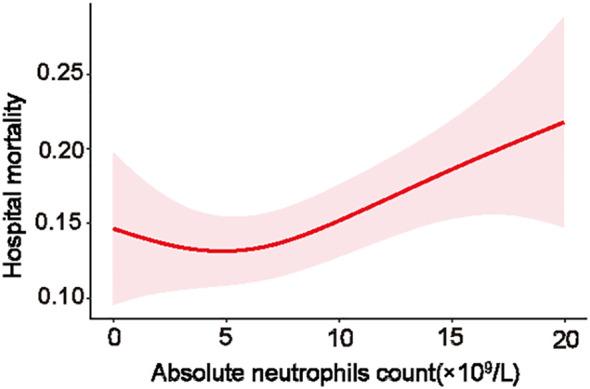
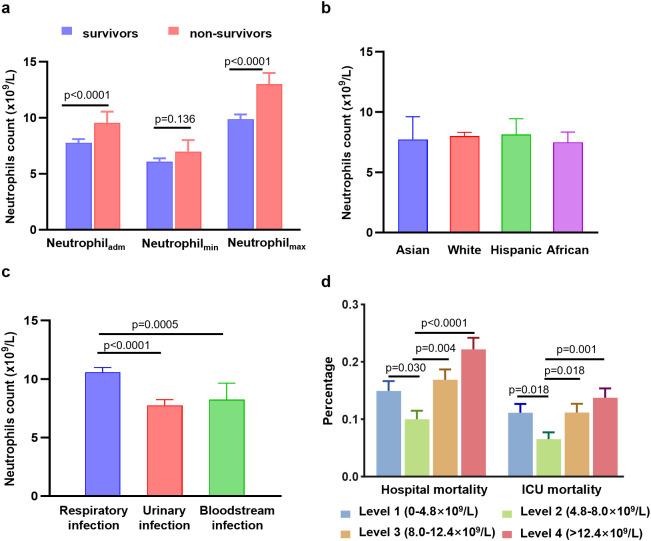
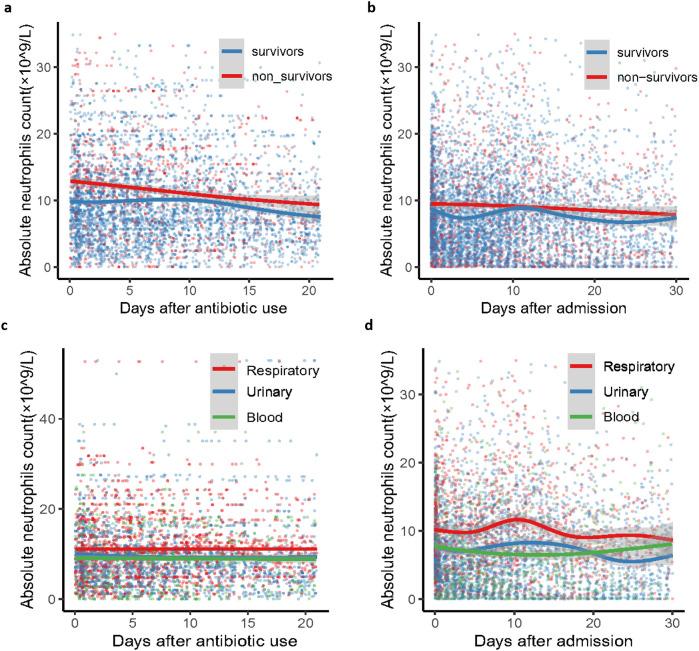
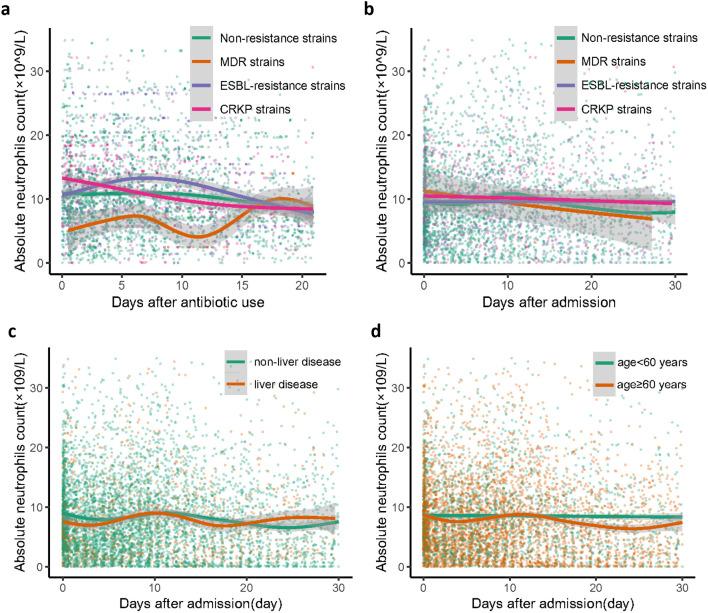
A total of 1,705 patients caused by were included in the study. The non-survivor group exhibited a comparatively older age and a higher proportion of infections originating from respiratory and bloodstream sources compared to the survivor group (38.4% vs 21.1%, p<0.0001, and 15.1% vs 10.3%, p=0.021). Patients combined with multiple drug resistance strains, respiratory infection, liver disease, and above 60 years exhibited a specific dynamic process of neutrophil levels. Neutrophils counts peaked at admission and 1-2 weeks later. There was a 'U'-shaped relationship between neutrophil counts and hospital mortality.
CONCLUSIONS
Neutrophils in infected patients have distinctive features and dynamic clinical trajectories. Close monitoring of severe patients infected with upon admission and during the first 1-2 weeks after admission is of utmost importance, particularly for patients with a neutrophil count exceeding 8.0×10/L.
背景
中性粒细胞在感染的治疗中起着关键作用。阐明严重感染患者中性粒细胞的临床特征和预后价值,对于临床管理和预后评估至关重要。
方法
从 Medical Information Mart for Intensive Care IV 和 eICU 协作研究数据库中招募了不同感染部位的患者。使用局部加权散点平滑曲线检查中性粒细胞计数在临床发病后 30 天内的时间变化。使用逻辑回归分析评估中性粒细胞计数与住院死亡率之间的关系。
结果
本研究共纳入 1705 例由 引起的感染患者。与幸存者组相比,非幸存者组年龄较大,且呼吸道和血流来源的感染比例较高(38.4%比 21.1%,p<0.0001,和 15.1%比 10.3%,p=0.021)。合并多种耐药菌株、呼吸道感染、肝病和年龄超过 60 岁的患者,中性粒细胞水平表现出特定的动态过程。中性粒细胞计数在入院时和 1-2 周后达到峰值。中性粒细胞计数与住院死亡率之间存在“U”形关系。
结论
感染患者的中性粒细胞具有独特的特征和动态的临床轨迹。密切监测入院时和入院后 1-2 周内严重感染的患者,尤其是中性粒细胞计数超过 8.0×10/L 的患者,尤为重要。
 Zotero 插件