
在急性卒中患者中使用左西孟旦治疗高血压的急诊科和重症监护应用
Emergency Department and Critical Care Use of Clevidipine for Treatment of Hypertension in Patients With Acute Stroke.
作者信息
Brehaut Scott S, Roche Angelina M
机构信息
From Mohawk Valley Health System, Utica, NY.
出版信息
Crit Pathw Cardiol. 2025 Mar 1;24(1):e0375. doi: 10.1097/HPC.0000000000000375. Epub 2025 Feb 21.
BACKGROUND AND PURPOSE
Clevidipine is a parenteral dihydropyridine calcium channel blocker that received Food and Drug Administration approval in 2008 for the reduction of blood pressure (BP) when oral therapy is not feasible or not desirable. Soon after approval, our institution incorporated clevidipine into protocols for the management of hypertension among acute stroke patients, based on the drug's rapid onset of action and straightforward titration to goal. A subsequent retrospective review of its use in otherwise alteplase-eligible ischemic stroke patients with BP greater than 185/110 mm Hg (n = 32, in 2014) revealed that clevidipine in that setting demonstrated the shortest median time to BP control, the shortest median door-to-alteplase administration time, and the lowest administered volume of any parenteral antihypertensive used. As a result, clinical protocols in our institution were modified to make clevidipine first-line antihypertensive in both ischemic and hemorrhagic acute stroke. In this study, we report our institution's experience with clevidipine in acute stroke, comprising the largest such report to date.
METHODS
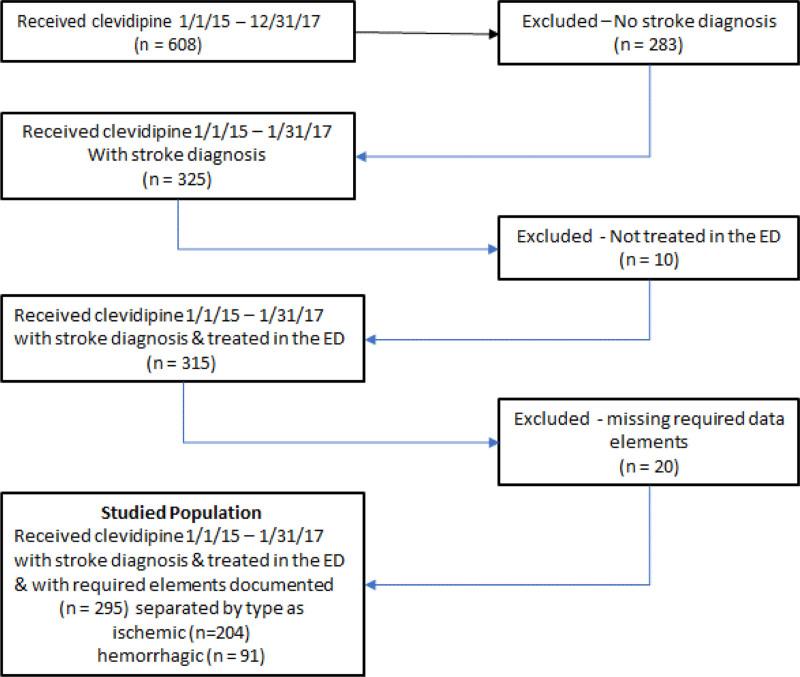
We conducted a retrospective chart review of all acute stroke patients who received clevidipine in the emergency department (ED) or intensive care unit (ICU) (n = 295) for the management of clinically significant hypertension between January 1, 2015, and December 31, 2017. Metrics analyzed included target (goal) BP for thrombolysis eligibility among patients intended for lytic therapy according to stroke management guidelines in effect at the time of care.
RESULTS
The median time for initial parenteral antihypertensive dose to goal (DTG) BP for all ischemic stroke patients (both those intended for and those not intended for lytic therapy) with complete data (n = 71 of 204) was 15 minutes; median time for door-to-IV-alteplase administration for ischemic stroke patients with complete data (n = 14 of 34 treated patients) was 59 minutes. The median time for initial parenteral antihypertensive DTG BP for all hemorrhagic stroke patients with complete data (n = 33 of 91 treated patients) was 39 minutes.
CONCLUSIONS
We conclude that the salutary findings of the initial small study are valid across a larger patient sample of all acute stroke types. Based on these data, clevidipine is shown to be safe, consistent, and effective in the treatment of acute hypertension in ischemic and hemorrhagic stroke events, and is a reasonable first-line treatment option for acute hypertension in this setting.
背景与目的
氯维地平是一种胃肠外给药的二氢吡啶类钙通道阻滞剂,2008年获得美国食品药品监督管理局批准,用于在口服治疗不可行或不理想时降低血压(BP)。获批后不久,基于该药起效迅速且可直接滴定至目标血压,我们机构将氯维地平纳入急性卒中患者高血压管理方案。随后对2014年32例符合阿替普酶治疗条件但血压高于185/110 mmHg的缺血性卒中患者使用氯维地平的情况进行回顾性分析,结果显示,在该情况下,氯维地平达到血压控制的中位时间最短,从入院到给予阿替普酶的中位时间最短,且使用的任何胃肠外抗高血压药物的给药量最低。因此,我们机构的临床方案进行了修改,将氯维地平作为缺血性和出血性急性卒中的一线抗高血压药物。在本研究中,我们报告了我们机构使用氯维地平治疗急性卒中的经验,这是迄今为止最大规模的此类报告。
方法
我们对2015年1月1日至2017年12月31日期间在急诊科(ED)或重症监护病房(ICU)接受氯维地平治疗以控制具有临床意义的高血压的所有急性卒中患者(n = 295)进行了回顾性病历审查。分析的指标包括根据治疗时有效的卒中管理指南,拟接受溶栓治疗的患者溶栓合格的目标(血压)。
结果
所有有完整数据的缺血性卒中患者(包括拟接受和不拟接受溶栓治疗的患者)(204例中的71例),初始胃肠外抗高血压药物剂量达到目标血压(DTG)的中位时间为15分钟;有完整数据的缺血性卒中患者(34例接受治疗患者中的14例)从入院到静脉给予阿替普酶的中位时间为59分钟。所有有完整数据的出血性卒中患者(91例接受治疗患者中的33例),初始胃肠外抗高血压药物DTG血压的中位时间为39分钟。
结论
我们得出结论,最初小型研究的有益发现适用于所有急性卒中类型的更大患者样本。基于这些数据,氯维地平在缺血性和出血性卒中事件中治疗急性高血压方面显示出安全、稳定且有效,是这种情况下急性高血压合理的一线治疗选择。



 Zotero 插件