Kalapurakal George, Chau Vinh Q, Imamura Teruhiko, Tolia Sanika, Sciamanna Chris, Macaluso Gregory P, Joshi Anjali, Pillarella Jessica, Pauwaa Sunil, Dia Muhyaldeen, Kabbany Tarek, Monaco James, Dela Cruz Mark, Cotts William G, Pappas Patroklos, Tatooles Antone J, Narang Nikhil
Advocate Heart Institute, Advocate Christ Medical Center, Oak Lawn, Illinois, USA.
Second Department of Internal Medicine, University of Toyama, Toyama, Japan.
ESC Heart Fail. 2025 Feb;12(1):316-325. doi: 10.1002/ehf2.15083. Epub 2024 Sep 18.
Intra-aortic balloon pump (IABP) devices are commonly used in patients with heart failure related cardiogenic shock (HF-CS), including those with out-of-proportion right ventricular (RV) dysfunction. Pulmonary artery pulsatility index (PAPi) is a haemodynamic surrogate for RV performance. We aimed to assess short-term haemodynamic changes in patients with HF-CS following IABP support stratified by baseline PAPi.
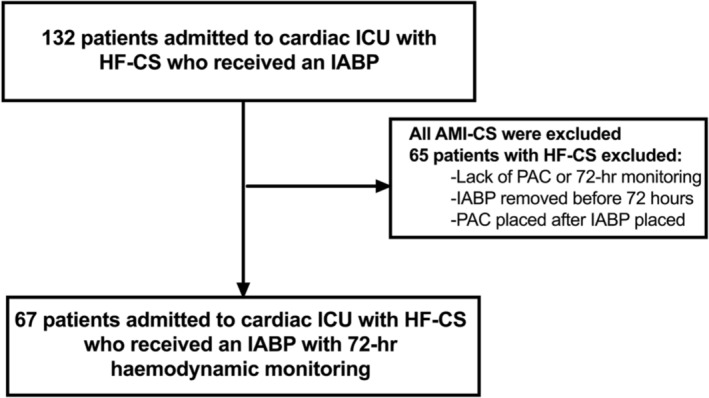
This is a single-centre study of 67 consecutive patients with HF-CS who underwent IABP placement between 2020 and 2022. The primary aim was haemodynamic changes of specific variables on pulmonary artery catheter monitoring over 72 h following IABP placement. Secondary aims were clinically significant changes in diuretic regimens, changes in inotropes or vasopressors at 72 h following IABP, along with clinical outcomes. Prior to IABP placement, 57% of the total cohort (median age 59 years [48, 69], 31% female) had Society of Cardiovascular Angiography and Interventions Stage C HF-CS. Thirty-eight (56%) patients had a PAPi <2.0. Following 72 h of IABP support, the PAPi <2.0 group had an observed significant decrease in central venous pressure (CVP; 20 to 12 mmHg, P < 0.001) and mean pulmonary artery pressure (mPAP; 37.5 to 28.5 mmHg, P = 0.001), and an increase in PAPi (1 to 1.6, P = 0.001). No significant change in cardiac index (CI; 2 to 2.1 L/min/m, P = 0.31) was observed. The PAPi ≥2.0 group (N = 29) had no observed significant change in CVP (10 to 8 mmHg, P = 0.47), or PAPi (2.6 to 2.8, P = 0.92), but there was a significant improvement in CI (1.9 to 2.5 L/min/m, P = 0.004) along with reduction in mPA (37 to 29 mmHg, P = 0.03). The PAPi <2.0 group had a significant increase in diuretic requirement (52.6% vs. 20.7%, P = 0.01) and numerically greater addition of inotropes/vasopressors (47.3% vs. 34.4%, P = 0.07) compared with the PAPi ≥2.0 group at 72 h following IABP placement. Significantly more patients in the PAPi ≥2.0 group underwent left ventricular assist device (55.2% vs. 26.3%, P = 0.02), with no overall significant differences observed in escalation to veno-arterial extracorporeal membrane oxygenation, 30-day mortality, renal replacement therapy post-IABP, or rates of heart transplantation.
IABP devices in those with HF-CS and low or abnormal PAPi may provide modest short-term haemodynamic benefits without significant improvement in CI, along with greater need for adjustment in medical therapeutics to achieve haemodynamic optimization.
主动脉内球囊反搏(IABP)装置常用于心力衰竭相关的心源性休克(HF-CS)患者,包括那些伴有不成比例的右心室(RV)功能障碍的患者。肺动脉搏动指数(PAPi)是右心室功能的血流动力学替代指标。我们旨在评估根据基线PAPi分层的HF-CS患者在IABP支持后的短期血流动力学变化。
这是一项单中心研究,纳入了2020年至2022年间连续67例接受IABP置入的HF-CS患者。主要目的是观察IABP置入后72小时内肺动脉导管监测的特定变量的血流动力学变化。次要目的是利尿剂治疗方案的临床显著变化、IABP置入72小时时血管活性药物的变化以及临床结局。在IABP置入前,整个队列的57%(中位年龄59岁[48,69],31%为女性)患有心血管造影和介入学会C期HF-CS。38例(56%)患者的PAPi<2.0。在IABP支持72小时后,PAPi<2.0组的中心静脉压(CVP;从20降至12mmHg,P<0.001)和平均肺动脉压(mPAP;从37.5降至28.5mmHg,P=0.001)显著降低,PAPi升高(从1升至1.6,P=0.001)。未观察到心脏指数(CI;从2升至2.1L/min/m,P=0.31)有显著变化。PAPi≥2.0组(N=29)的CVP(从10降至8mmHg,P=0.47)或PAPi(从2.6升至2.8,P=0.92)未观察到显著变化,但CI有显著改善(从1.9升至2.5L/min/m,P=0.004),同时mPA降低(从37降至29mmHg,P=0.03)。与IABP置入72小时后的PAPi≥2.0组相比,PAPi<2.0组的利尿剂需求显著增加(52.6%对20.7%,P=0.01),血管活性药物的添加量在数值上更高(47.3%对34.4%,P=0.07)。PAPi≥2.0组接受左心室辅助装置的患者明显更多(55.2%对26.3%,P=0.02),在升级为静脉-动脉体外膜肺氧合、30天死亡率、IABP后肾脏替代治疗或心脏移植率方面未观察到总体显著差异。
HF-CS且PAPi低或异常的患者使用IABP装置可能在短期内提供适度的血流动力学益处,但CI无显著改善,同时需要更多地调整药物治疗以实现血流动力学优化。