
立体定向放射治疗后联合贝伐单抗和替莫唑胺治疗复发性胶质母细胞瘤的疗效:一例报告
The efficacy of stereotactic radiotherapy followed by bevacizumab and temozolomide in the treatment of recurrent glioblastoma: a case report.
作者信息
Zhong Wangyan, Mao Jiwei, Wu Dongping, Peng Jianghua, Ye Wanli
机构信息
Department of Radiation Oncology, Shaoxing People's Hospital, Shaoxing, Zhejiang, China.
Department of General Practice, Shaoxing People's Hospital, Shaoxing, Zhejiang, China.
出版信息
Front Pharmacol. 2024 Sep 4;15:1401000. doi: 10.3389/fphar.2024.1401000. eCollection 2024.
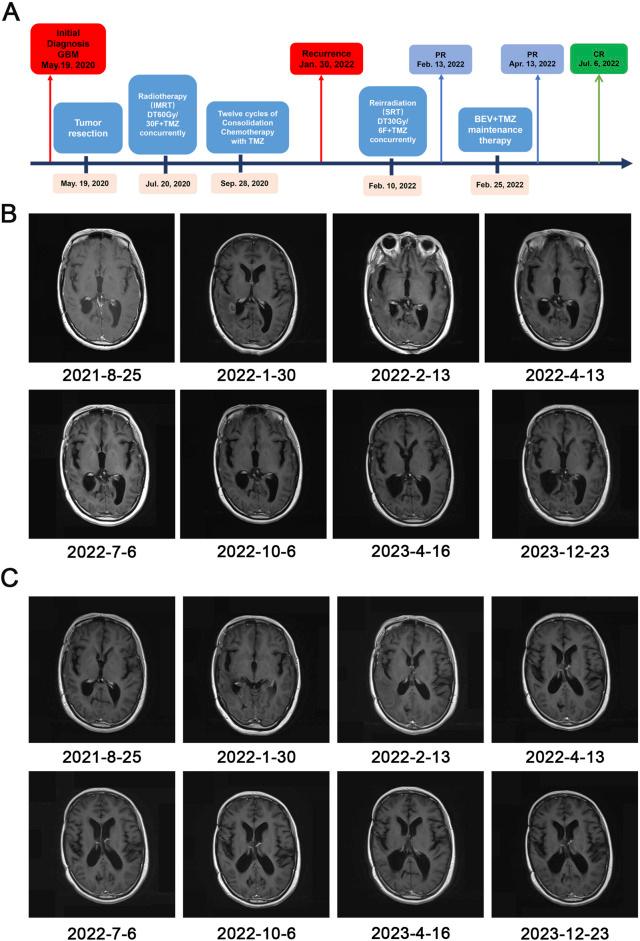
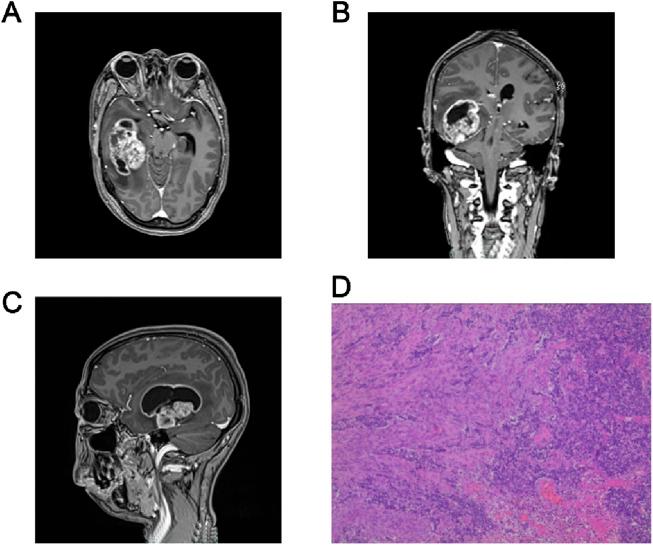
Glioblastoma (GBM) is the most common and aggressive malignant brain tumor among adults. Despite advancements in multimodality therapy for GBM, the overall prognosis remains poor, with an extremely high risk of recurrence. Currently, there is no established consensus on the optimal treatment option for recurrent GBM, which may include reoperation, reirradiation, chemotherapy, or a combination of the above. Bevacizumab is considered a first-line treatment option for recurrent GBM, as is temozolomide. However, in recurrent GBM, it is necessary to balance the risks and benefits of reirradiation in combination with bevacizumab and temozolomide. Herein, we report the case of a patient with recurrent GBM after standard treatment who benefited from stereotactic radiotherapy followed by bevacizumab and temozolomide maintenance therapy. Following 16 months of concurrent chemoradiotherapy (CCRT), the patient was diagnosed with recurrent GBM by a 3-T contrast-enhanced magnetic resonance imaging (MRI). The addition of localized radiotherapy to the ongoing treatment regimen of bevacizumab, in combination with temozolomide therapy, prolonged the patient's disease-free survival to over 2 years, achieving a significant long-term outcome, with no notable adverse effects observed. This clinical case may provide a promising new option for patients with recurrent GBM.
胶质母细胞瘤(GBM)是成人中最常见且侵袭性最强的恶性脑肿瘤。尽管GBM的多模态治疗取得了进展,但其总体预后仍然很差,复发风险极高。目前,对于复发性GBM的最佳治疗方案尚无定论,可能包括再次手术、再次放疗、化疗或上述方法的联合应用。贝伐单抗和替莫唑胺均被视为复发性GBM的一线治疗选择。然而,在复发性GBM中,有必要权衡再次放疗联合贝伐单抗和替莫唑胺的风险与益处。在此,我们报告1例标准治疗后复发性GBM患者的病例,该患者受益于立体定向放疗,随后接受贝伐单抗和替莫唑胺维持治疗。在进行16个月的同步放化疗(CCRT)后,该患者经3-T增强磁共振成像(MRI)诊断为复发性GBM。在持续的贝伐单抗治疗方案中加入局部放疗,并联合替莫唑胺治疗,将患者的无病生存期延长至2年以上,取得了显著的长期疗效,且未观察到明显的不良反应。该临床病例可能为复发性GBM患者提供一个有前景的新选择。
 Zotero 插件