Das Rupesh, Faruque Md Hasan, Sakib Sadman, Ahmad Md Taslim, Seba Rubaia Nishat, Zahid Md Al, Yeasmin Most Nilufa, Islam Md Mazharul
Water Quality and Fisheries Management Laboratory, Department of Fisheries, Faculty of Biological Sciences, University of Dhaka, Dhaka 1000, Bangladesh.
Department of Fisheries, Faculty of Biological Sciences, University of Dhaka, Dhaka 1000, Bangladesh.
Heliyon. 2024 Sep 3;10(17):e37331. doi: 10.1016/j.heliyon.2024.e37331. eCollection 2024 Sep 15.
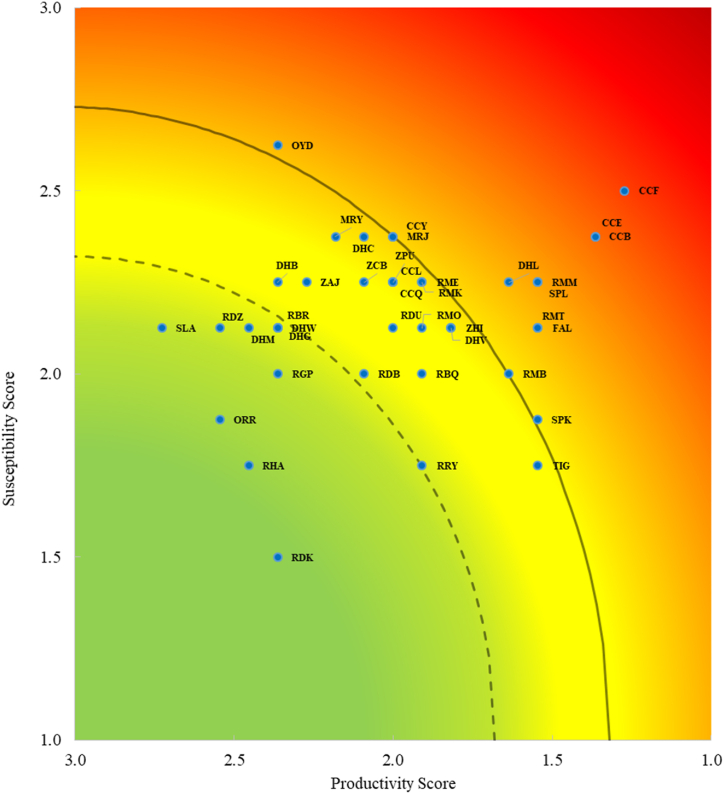
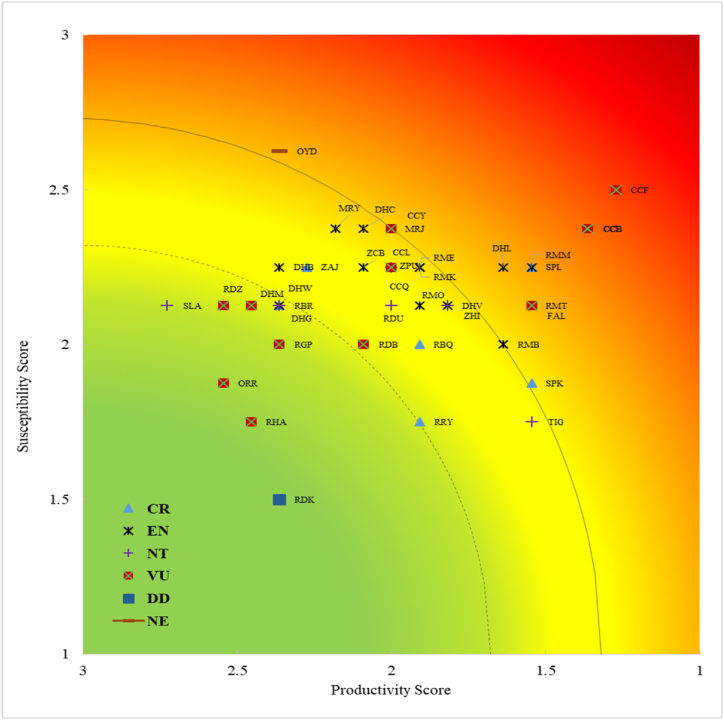
The elasmobranch population is declining in the Bay of Bengal of Bangladesh due to large-mesh gill net fishing, locally known as the Lakkha net, which primarily targets Indian threadfin (). This study was the first attempt to identify megafaunal bycatch in Lakkha fishing and assess its vulnerability using Productivity Susceptibility Analysis. A total of 40 elasmobranch bycatch species were identified, with sharks comprising 13 species from three families, while 27 rays belonged to six families, with the majority belonging to the Myliobatiformes order (60 %). Productivity and susceptibility scores were assigned to all identified species, with values ranging from 1.27 to 2.73 and 1.50 to 2.63, respectively. The target Lakkha fish exhibited the highest susceptibility score, followed by several pelagic sharks and eagle rays. Vulnerability assessment revealed that 31.7 % (n = 13) of species were highly vulnerable, while 43.9 % (n = 18) were classified as moderate, and 24.4 % (n = 10) were considered to have low vulnerability. All the high-risk megafauna species (n = 13) are classified as threatened by the global IUCN Red List. Sensitivity analysis highlighted susceptibility as a major contributor to species' vulnerability. Alterations in susceptibility scores led to significant changes in the vulnerability status of many species. The overall data quality assessment indicated moderate data quality across species, with variability observed between productivity (76 % of species received a poor data quality score) and susceptibility attributes. However, vulnerability of these species can be reduced through adequate gear modification, shorter net deployment periods, adoption of safe discharge techniques, identification of critical habitats, and establishment of marine protected areas within this region. This study provides valuable insights into the species composition and vulnerability of elasmobranchs in the Lakkha gill net fishery, emphasizing the need for conservation measures to mitigate bycatch impacts on threatened species.
由于使用大网目刺网捕鱼(当地称为拉克哈网),孟加拉湾的板鳃亚类种群数量正在下降,这种网主要捕捞印度金线鱼。本研究首次尝试确定拉克哈捕鱼中的大型动物兼捕物,并使用生产力易感性分析评估其脆弱性。共识别出40种板鳃亚类兼捕物物种,其中鲨鱼有13种,分属3个科,而27种鳐鱼分属6个科,大多数属于鲼形目(60%)。为所有识别出的物种赋予了生产力和易感性分数,其值分别为1.27至2.73和1.50至2.63。目标拉克哈鱼的易感性分数最高,其次是几种远洋鲨鱼和鹰鲼。脆弱性评估显示,31.7%(n = 13)的物种高度脆弱,43.9%(n = 18)被归类为中度脆弱,24.4%(n = 10)被认为脆弱性较低。所有高风险大型动物物种(n = 13)均被世界自然保护联盟(IUCN)红色名录列为受威胁物种。敏感性分析突出了易感性是物种脆弱性的主要因素。易感性分数的变化导致许多物种的脆弱性状况发生显著变化。总体数据质量评估表明,各物种的数据质量中等,生产力(76%的物种数据质量得分较差)和易感性属性之间存在差异。然而,通过适当改进渔具、缩短网的部署时间、采用安全放生技术、识别关键栖息地以及在该区域建立海洋保护区,可以降低这些物种的脆弱性。本研究为拉克哈刺网渔业中板鳃亚类的物种组成和脆弱性提供了有价值的见解,强调了采取保护措施以减轻兼捕物对受威胁物种影响的必要性。