Praxis Dr. Dietmar Czech, Marktplatz 15, 16, 89073, Ulm, Germany.
Department of General, Visceral and Transplantation Surgery, University Hospital Heidelberg, Im Neuenheimer Feld 420, 69120, Heidelberg, Germany.
Langenbecks Arch Surg. 2024 Sep 19;409(1):284. doi: 10.1007/s00423-024-03448-z.
The significance of dental status and oral hygiene on a range of medical conditions is well-recognised. However, the correlation between periodontitis, oral bacterial dysbiosis and visceral surgical outcomes is less well established. To this end, we study sought to determine the influence of dental health and oral hygiene on the rates of postoperative complications following major visceral and transplant surgery in an exploratory, single-center, retrospective, non-interventional study.
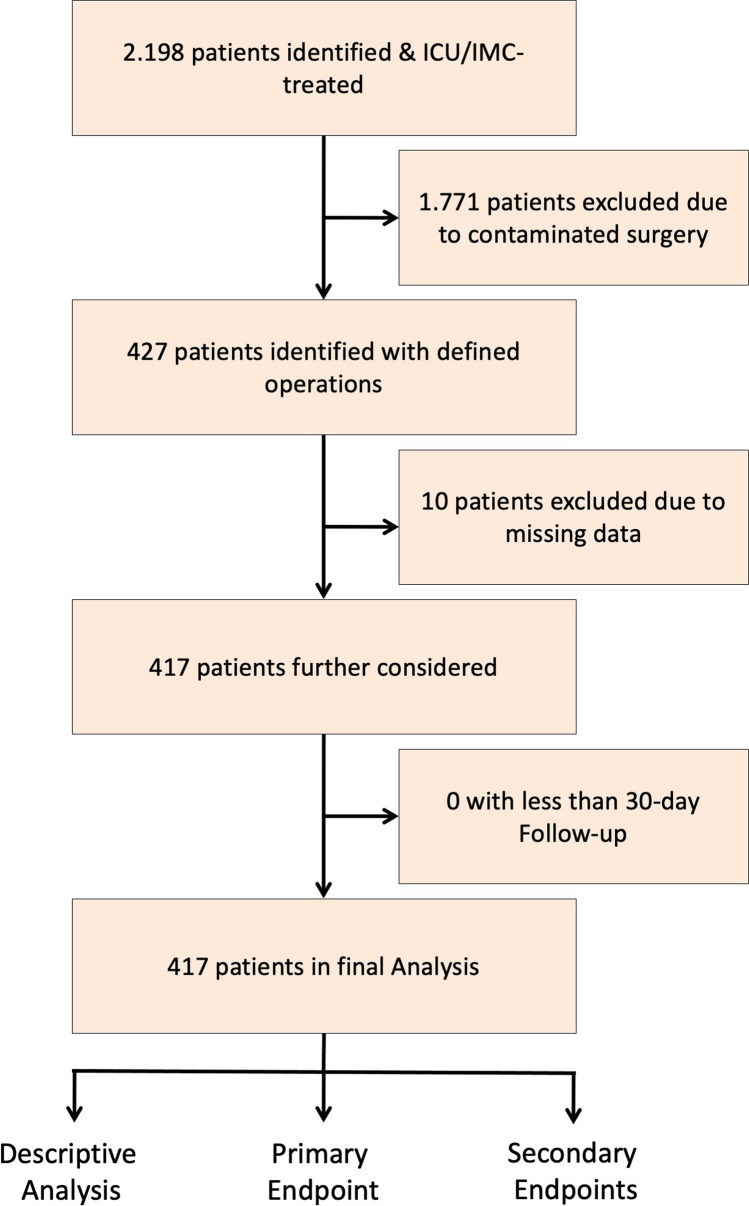
Our retrospective non-interventional study was conducted at the Department of General, Visceral, and Transplant Surgery, University Hospital Heidelberg, Germany. Patients operated on between January 2018 and December 2019 were retrospectively enrolled in the study based on inclusion (minimum age of 18 years, surgery at our Department, intensive care / IMC treatment after major surgery, availability of patient-specific preoperative dental status assessment, documentation of postoperative complications) and exclusion criteria (minor patients or legally incapacitated patients, lack of intensive care or intermediate care (IMC) monitoring, incomplete documentation of preoperative dental status, intestinal surgery with potential intraoperative contamination of the site by intestinal microbes, pre-existing preoperative infection, absence of data regarding the primary endpoints of the study). The primary study endpoint was the incidence of postoperative complications. Secondary study endpoints were: 30-day mortality, length of hospital stay, duration of intensive care stay, Incidence of infectious complications, the microbial spectrum of infectious complication. A bacteriology examination was added whenever possible (if and only if the examination was safe for the patient)for infectious complications.
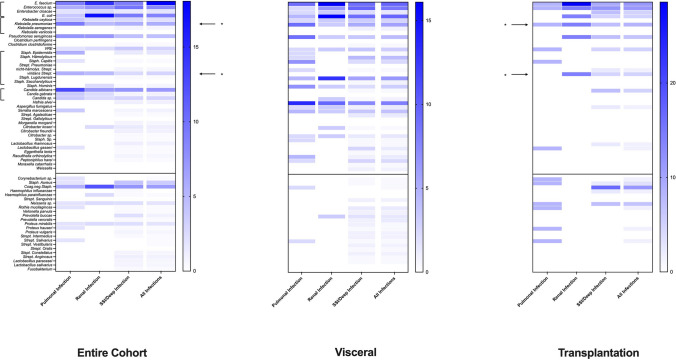
The final patient cohort consisted of 417 patients. While dental status did not show an influence (p = 0.73) on postoperative complications, BMI (p = 0.035), age (p = 0.049) and quick (p = 0.033) were shown to be significant prognostic factors. There was significant association between oral health and the rate of infectious complications for all surgical procedures (p = 0.034), excluding transplant surgery. However, this did not result in increased 30-day mortality rates, prolonged intensive care unit treatment or an increase in the length of hospital stay (LOS) for the cohort as a whole. In contrast there was a significant correlation between the presence of oral pathogens and postoperative complications for a group as a whole (p < 0.001) and the visceral surgery subgroup (p < 0.001). Whilst this was not the case in the cohort who underwent transplant surgery, there was a correlation between oral health and LOS in this subgroup (p = 0.040). Bacterial swabs supports the link between poor oral health and infectious morbidity.
Dental status was a significant predictor of postoperative infectious complications in this visceral surgery cohort. This study highlights the importance preoperative dental assessment and treatment prior to major surgery, particularly in the case of elective surgical procedures. Further research is required to determine the effect of oral health on surgical outcomes in order to inform future practice.
Trial registered under the ethics-number S-082/2022 (Ethic Committee of the University Heidelberg).
牙齿状况和口腔卫生对一系列医疗状况的重要性已得到广泛认可。然而,牙周炎、口腔细菌失调与内脏手术结果之间的相关性尚未得到充分证实。为此,我们研究旨在确定牙齿健康和口腔卫生对德国海德堡大学医院普通、内脏和移植外科手术后并发症发生率的影响,这是一项探索性的、单中心的、回顾性的、非干预性研究。
我们的回顾性非干预性研究在德国海德堡大学医院普通、内脏和移植外科进行。根据纳入标准(年龄至少 18 岁、在我们科室进行手术、主要手术后在重症监护室/IMC 治疗、术前有患者特定的牙齿状况评估、记录术后并发症)和排除标准(未成年患者或法律上无行为能力的患者、缺乏重症监护或中间护理(IMC)监测、术前牙齿状况记录不完整、肠道手术术中肠道微生物潜在污染术区、术前存在感染、缺乏研究主要终点的数据),从 2018 年 1 月至 2019 年 12 月对患者进行回顾性入组。主要研究终点是术后并发症的发生率。次要研究终点为:30 天死亡率、住院时间、重症监护时间、感染并发症发生率、感染并发症的微生物谱。只要有可能(只要检查对患者安全),就会对感染并发症进行细菌学检查。
最终患者队列包括 417 名患者。尽管牙齿状况与术后并发症无显著相关性(p=0.73),但 BMI(p=0.035)、年龄(p=0.049)和快速(p=0.033)被证明是显著的预后因素。口腔健康与所有手术程序(p=0.034),包括移植手术,的感染并发症发生率之间存在显著相关性。然而,这并没有导致整个队列的 30 天死亡率升高、重症监护室治疗时间延长或住院时间(LOS)延长。相反,口腔病原体的存在与整体(p<0.001)和内脏手术亚组(p<0.001)的术后并发症之间存在显著相关性。尽管在接受移植手术的患者中并非如此,但该亚组的口腔健康与 LOS 之间存在相关性(p=0.040)。细菌拭子支持口腔卫生不良与感染发病率之间的联系。
在这个内脏手术队列中,牙齿状况是术后感染性并发症的一个显著预测因素。本研究强调了在主要手术前进行术前牙科评估和治疗的重要性,特别是在择期手术的情况下。需要进一步研究口腔健康对手术结果的影响,以便为未来的实践提供信息。
在海德堡大学伦理委员会的伦理编号 S-082/2022 下进行试验注册。