Department of Medical Oncology, Clinical Oncology School of Fujian Medical University, Fujian Cancer Hospital, Fuzhou, Fujian Province, China.
Fujian Key Laboratory of Translational Cancer Medicine, Fuzhou, Fujian Province, China.
BMC Cancer. 2024 Sep 19;24(1):1166. doi: 10.1186/s12885-024-12950-y.
The prognosis of breast cancer patients with visceral metastasis (VM) is significantly worse than that of patients without VM. We aimed to evaluate EZH2 (enhancer of zeste homolog 2) mutation as a biomarker associated with VM.
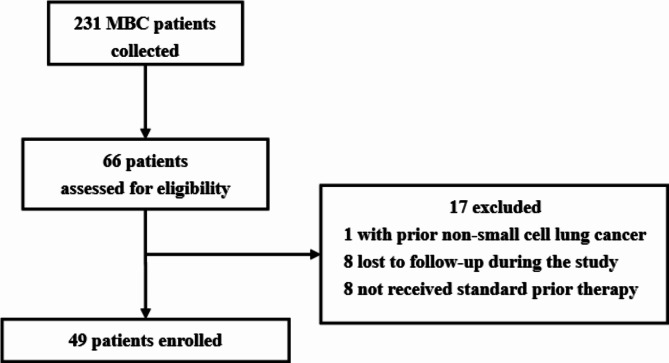
Data from forty-nine patients with metastatic breast cancer (MBC) pathologically confirmed at our hospital between March 2016 and September 2018 were collected. Metastatic tissue samples were obtained via ultrasound-guided needle biopsy, and paired peripheral blood samples were also collected. Tissue and blood samples were subjected to targeted next-generation sequencing via a 247-gene panel. Stably transfected MDA-MB-231 cells expressing wild-type EZH2 (EZH2) or a mutant form of EZH2 (EZH2) were generated. Cell proliferation, colony formation ability, migration and invasion abilities and apoptosis were assessed using CCK-8 assays, plate colony formation assays, Transwell chamber assays and flow cytometry.
The incidence of EZH2 mutations in the VM subgroup was greater than that in the non-VM subgroup in the entire cohort (n = 49, 42.3% vs. 13.0%, p = 0.024) and in the triple-negative breast cancer (TNBC) subgroup (n = 20, 50.0% vs. 10.0%, p = 0.05). Patients carrying EZH2 mutations had a significantly greater risk of developing VM than did those in the non-EZH2 mutation group in the entire cohort (HR 2.9) and in the TNBC subgroup (HR 6.45). Multivariate analysis revealed that EZH2 mutation was an independent prognostic factor for VM (HR 2.99, p = 0.009) in the entire cohort and in the TNBC subgroup (HR 10.1, p = 0.006). Data from cBioPortal also showed that patients with EZH2 mutations had a significantly greater risk of developing VM (HR 3.1), and the time to develop VM was significantly earlier in the EZH2 mutation group (31.5 months vs. 109.7 months, p = 0.008). Multivariate analysis revealed that EZH2 mutation (HR 2.73, p = 0.026) was an independent factor for VM after breast cancer surgery. There was no correlation between EZH2 mutations and BRCA1/2 mutations. Most of the patients (81.8%) in our cohort who developed VM carried the "c.1544A > G (p.K515R)" mutation. Compared with EZH2 MDA-MB-231 cells, EZH2 MDA-MB-231 cells had greater colony formation rates (p < 0.01), greater migration and invasion rates (p < 0.001), and lower apoptosis rates (p < 0.01). The proportion of S + G2/M phase cells in the EZH2 group was significantly greater than that in the EZH2 group.
EZH2 mutation is associated with VM development in breast cancer patients. The EZH2 mutation leads to VM and a poor prognosis by enhancing proliferation and invasion and inhibiting apoptosis in breast cancer cells.
有内脏转移(VM)的乳腺癌患者的预后明显差于无 VM 的患者。我们旨在评估 EZH2(增强子的锌指蛋白 2)突变作为与 VM 相关的生物标志物。
收集了 2016 年 3 月至 2018 年 9 月在我院病理确诊的 49 例转移性乳腺癌(MBC)患者的数据。通过超声引导下的针吸活检获得转移组织样本,并同时采集配对的外周血样本。通过 247 个基因panel 对组织和血液样本进行靶向二代测序。生成表达野生型 EZH2(EZH2)或突变型 EZH2(EZH2)的稳定转染 MDA-MB-231 细胞。使用 CCK-8 测定法、平板集落形成测定法、Transwell 室测定法和流式细胞术评估细胞增殖、集落形成能力、迁移和侵袭能力以及细胞凋亡。
在整个队列(n=49,42.3%比 13.0%,p=0.024)和三阴性乳腺癌(TNBC)亚组(n=20,50.0%比 10.0%,p=0.05)中,VM 亚组的 EZH2 突变发生率大于非 VM 亚组。在整个队列(HR 2.9)和 TNBC 亚组(HR 6.45)中,携带 EZH2 突变的患者发生 VM 的风险明显大于非 EZH2 突变组。多变量分析显示,EZH2 突变是整个队列(HR 2.99,p=0.009)和 TNBC 亚组(HR 10.1,p=0.006)VM 的独立预后因素。cBioPortal 的数据还显示,EZH2 突变患者发生 VM 的风险明显更高(HR 3.1),EZH2 突变组发生 VM 的时间明显更早(31.5 个月比 109.7 个月,p=0.008)。多变量分析显示,EZH2 突变(HR 2.73,p=0.026)是乳腺癌手术后 VM 的独立因素。EZH2 突变与 BRCA1/2 突变之间无相关性。我们队列中发生 VM 的大多数患者(81.8%)携带“c.1544A>G(p.K515R)”突变。与 EZH2 MDA-MB-231 细胞相比,EZH2 MDA-MB-231 细胞的集落形成率更高(p<0.01),迁移和侵袭率更高(p<0.001),凋亡率更低(p<0.01)。EZH2 组 S+G2/M 期细胞的比例明显大于 EZH2 组。
EZH2 突变与乳腺癌患者的 VM 发展有关。EZH2 突变通过增强乳腺癌细胞的增殖和侵袭,抑制细胞凋亡,导致 VM 和不良预后。