Kaye Alan D, Sala Kelly R, Abbott Brennan M, Dicke Alexandra N, Johnson Landyn D, Wilson Parker A, Amarasinghe Sam N, Singh Naina, Ahmadzadeh Shahab, Kaye Adam M, Shekoohi Sahar, Varrassi Giustino
Department of Anesthesiology, Louisiana State University Health Sciences Center, Shreveport, USA.
School of Medicine, Louisiana State University Health New Orleans, New Orleans, USA.
Cureus. 2024 Aug 19;16(8):e67232. doi: 10.7759/cureus.67232. eCollection 2024 Aug.
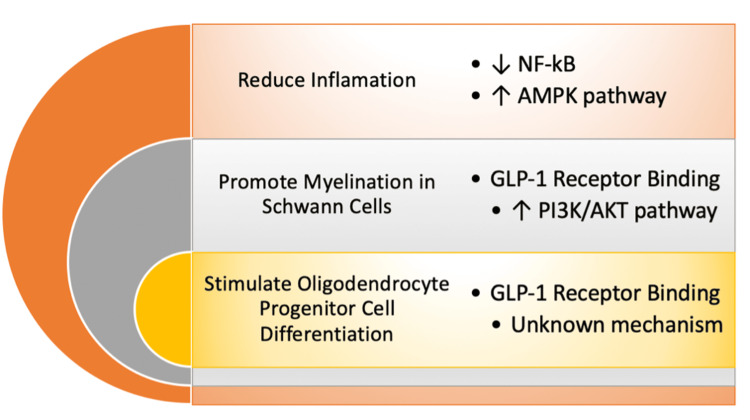
Multiple sclerosis (MS) is a chronic, progressive autoimmune disease modulated by autoantibodies that inflame and destroy the myelin sheath encasing neuronal axons, impairing proper axonal conduction and function. Glucagon-like peptide-1 (GLP-1) receptor agonists have been demonstrated to exert anti-inflammatory and neuroprotective effects, making these drugs particularly exciting prospects in the treatment of MS. While the exact mechanism remains unclear, GLP-1 receptor agonists may modulate inflammatory responses by targeting GLP-1 receptors present on immune cells such as macrophages, monocytes, and lymphocytes. In animal models, GLP-1 agonists have been shown to significantly delay the onset and severity of experimental autoimmune encephalopathy symptoms, as well as to increase nerve myelination and brain weight. In further experiments using animal models of nerve crush injury, specimens given GLP-1 agonists reported a significant increase in the rate and density of nerve regeneration compared to controls. Thus, GLP-1 agonists show promise as both prophylactic and symptomatic treatment for MS and may provide further utility in the treatment of other autoimmune, inflammatory, and neurodegenerative conditions.
多发性硬化症(MS)是一种慢性进行性自身免疫性疾病,由自身抗体调节,这些自身抗体使包裹神经元轴突的髓鞘发炎并破坏,损害轴突的正常传导和功能。胰高血糖素样肽-1(GLP-1)受体激动剂已被证明具有抗炎和神经保护作用,使这些药物在MS治疗中具有特别令人兴奋的前景。虽然确切机制尚不清楚,但GLP-1受体激动剂可能通过靶向免疫细胞(如巨噬细胞、单核细胞和淋巴细胞)上存在的GLP-1受体来调节炎症反应。在动物模型中,GLP-1激动剂已被证明能显著延迟实验性自身免疫性脑病症状的发作和严重程度,并增加神经髓鞘形成和脑重量。在使用神经挤压伤动物模型的进一步实验中,与对照组相比,给予GLP-1激动剂的标本报告神经再生速率和密度显著增加。因此,GLP-1激动剂有望作为MS的预防性和症状性治疗药物,并可能在治疗其他自身免疫性、炎症性和神经退行性疾病方面提供更多用途。