Department of Obstetrics and Gynecology, University Hospital and Medical Faculty of Heinrich Heine University Duesseldorf, Duesseldorf, Germany.
Center for Integrated Oncology (CIO Aachen, Bonn, Cologne, Duesseldorf), Duesseldorf, Germany.
J Transl Med. 2024 Sep 20;22(1):848. doi: 10.1186/s12967-024-05616-7.
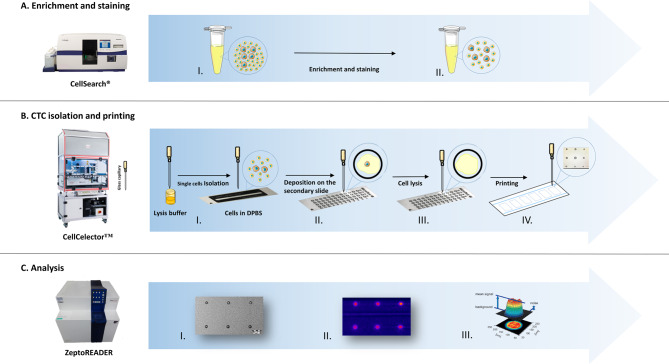
Traditional genomic profiling and mutation analysis of single cells like Circulating Tumor Cells (CTCs) fails to capture post-translational and functional alterations of proteins, often leading to limited treatment efficacy. To overcome this gap, we developed a miniaturized 'protein analysis on the single cell level' workflow-baptized ZeptoCTC. It integrates established technologies for single-cell isolation with sensitive Reverse Phase Protein Array (RPPA) analysis, thus enabling the comprehensive assessment of multiple protein expression and activation in individual CTCs.
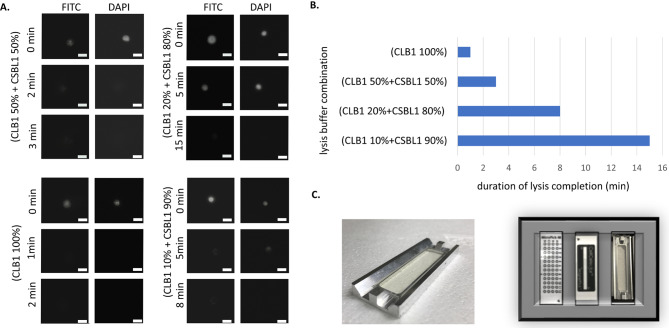
The ZeptoCTC workflow involves several critical steps. Firstly, individual cells are labeled and isolated. This is followed by cell lysis and the printing of true single cell lysate preparations onto a ZeptoChip using a modified micromanipulator, CellCelector™. The printed lysates then undergo fluorescence immunoassay RPPA protein detection using a ZeptoReader. Finally, signal quantification is carried out with Image J software, ensuring precise measurement of multiple protein levels.
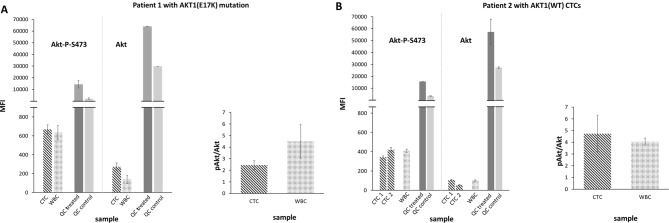
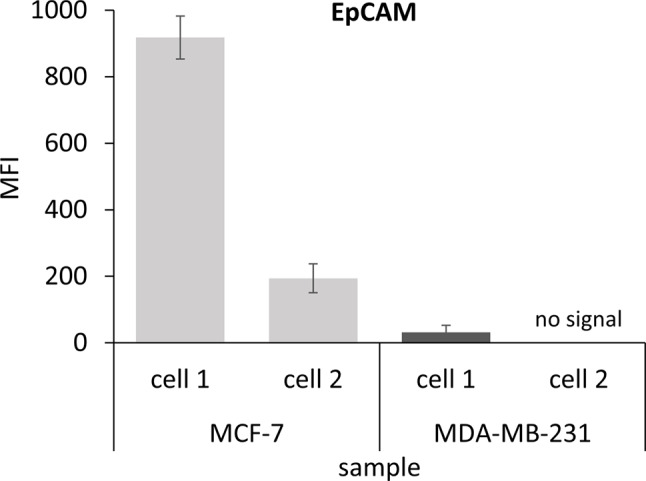
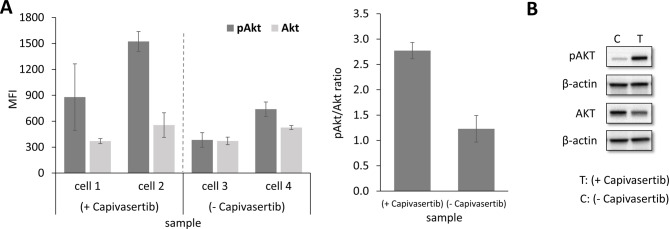
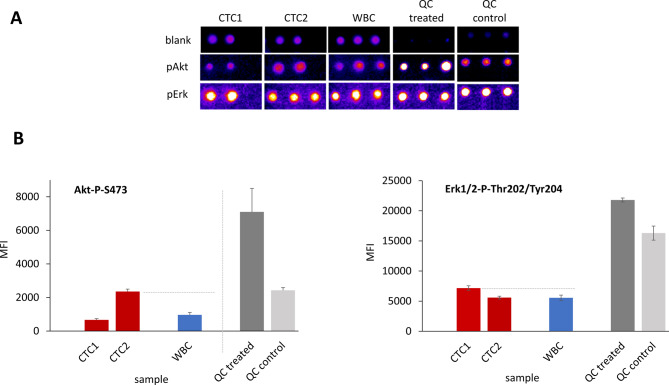
The efficacy of ZeptoCTC was demonstrated through various applications. Initially, it was used for measuring EpCAM protein expression, a standard marker for CTC detection, revealing higher levels in single MCF-7 over MDA-MB-231 tumor cells. Furthermore, in Capivasertib (Akt-inhibitor)-treated MCF-7 single cells, ZeptoCTC detected a 2-fold increase in the pAkt/Akt ratio compared to control cells, and confirmed co-performed bulk-cell western blot analysis results. Notably, when applied to individual CTCs from metastasized breast cancer patients, ZeptoCTC revealed significant differences in protein activation levels, particularly in measured pAkt and pErk levels, compared to patient-matched WBCs. Moreover, it successfully differentiated between CTCs from patients with different Akt1 genotypes, highlighting its potential to determine the activation status of druggable cancer driving proteins for individual and targeted treatment decision making.
The ZeptoCTC workflow represents a valuable tool in single cell cancer research, crucial for personalized medicine. It permits detailed analysis of key proteins and their activation status of targeted, cancer-driven signaling pathways in single cell samples, aiding in understanding tumor response, progression, and treatment efficacy beyond bulk analysis. The method significantly advances clinical investigations in cancer, improving treatment precision and effectiveness. The workflow will be applicable to protein analysis on other types of single cells like relevant in stem cell, neuropathology and hemopoietic cell research.
传统的基因组分析和对循环肿瘤细胞(CTC)等单细胞的突变分析无法捕捉到蛋白质的翻译后和功能改变,这往往导致治疗效果有限。为了克服这一差距,我们开发了一种微型的“单细胞水平上的蛋白质分析”工作流程,称为 ZeptoCTC。它集成了用于单细胞分离的成熟技术和敏感的反向蛋白质阵列(RPPA)分析,从而能够对单个 CTC 中的多种蛋白质表达和激活进行全面评估。
ZeptoCTC 工作流程涉及多个关键步骤。首先,对单个细胞进行标记和分离。接着进行细胞裂解,并使用经过改良的微操作器 CellCelector 将真正的单细胞裂解物制备品打印到 ZeptoChip 上。然后,使用 ZeptoReader 对打印的裂解物进行荧光免疫测定 RPPA 蛋白检测。最后,使用 Image J 软件进行信号定量,确保对多种蛋白质水平进行精确测量。
ZeptoCTC 的功效通过各种应用得到了证明。最初,它用于测量 EpCAM 蛋白表达,这是 CTC 检测的标准标志物,结果表明 MCF-7 肿瘤细胞中单细胞的 EpCAM 蛋白表达水平高于 MDA-MB-231 肿瘤细胞。此外,在 Capivasertib(Akt 抑制剂)处理的 MCF-7 单细胞中,ZeptoCTC 检测到 pAkt/Akt 比值比对照细胞增加了 2 倍,并证实了与批量细胞 Western blot 分析结果一致。值得注意的是,当应用于转移性乳腺癌患者的单个 CTC 时,ZeptoCTC 显示出蛋白质激活水平的显著差异,特别是在测量的 pAkt 和 pErk 水平上,与患者匹配的 WBC 相比。此外,它还成功地区分了不同 Akt1 基因型患者的 CTC,这表明它有潜力确定针对个体和靶向治疗决策的可用药癌症驱动蛋白的激活状态。
ZeptoCTC 工作流程是单细胞癌症研究中的一种有价值的工具,对个性化医学至关重要。它允许对单细胞样本中靶向、癌症驱动的信号通路的关键蛋白及其激活状态进行详细分析,有助于在批量分析之外了解肿瘤反应、进展和治疗效果。该方法显著推进了癌症的临床研究,提高了治疗的精准性和有效性。该工作流程将适用于其他类型的单细胞蛋白质分析,如相关的干细胞、神经病理学和造血细胞研究。