Department of Neurosciences, Rehabilitation, Ophthalmology, Genetics, Maternal and Child Health, University of Genoa, Genoa, Italy.
U.O.C. Genetica Medica, IRCCS Istituto Giannina Gaslini, Genoa, Italy.
Clin Genet. 2025 Jan;107(1):83-90. doi: 10.1111/cge.14621. Epub 2024 Sep 21.
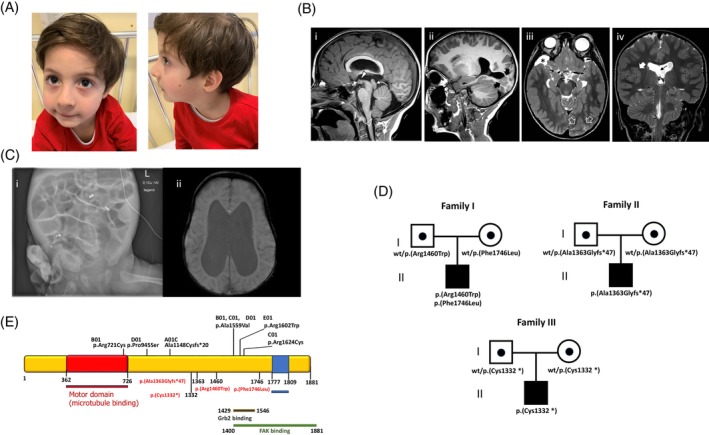
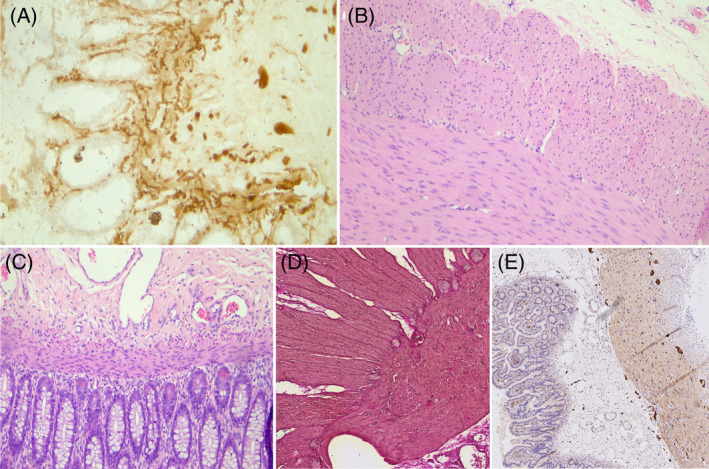
Pediatric intestinal pseudo-obstruction (PIPO) is a rare congenital disorder of the enteric nervous system with distal colon aganglionosis potentially leading to intestinal obstruction. Recently, biallelic variants in KIF26A, encoding a crucial motor protein for the migration and differentiation of enteric neural crest cells, have been associated with a neurodevelopmental condition featuring cortical defects and PIPO-like features, though in absence of aganglionosis. So far, only 10 patients have been reported. In this study, we investigated three subjects with congenital hydrocephalus, neurodevelopmental impairment, and intestinal obstruction megacolon syndrome. Brain MRI revealed malformations within cortical dysplasia spectrum, including polymicrogyria and heterotopia. Pathology study of the intestine revealed aganglionosis and elevated acetylcholinesterase activity in parasympathetic nerve fibers. Through trio-exome sequencing (ES), we detected four novel biallelic KIF26A variants, including two missense changes (#1) and two distinct homozygous truncating variants in (#2 and #3). All variants are rare and predicted to be deleterious according to in silico tools. To characterize the impact of the missense variants, we performed 3D protein modeling using Alphafold3 and YASARA. Mutants exhibited increased energy scores compared to wild-type protein, supporting a significant structural destabilization of the protein. Our study expands the genotype and phenotype spectrum of the emerging KIF26A-related disorder.
小儿肠假性梗阻(PIPO)是一种罕见的先天性肠神经系统疾病,其特征为远端结肠无神经节细胞,可能导致肠梗阻。最近,编码肠神经嵴细胞迁移和分化的关键运动蛋白 KIF26A 的双等位基因突变与一种以皮质缺陷和 PIPO 样特征为特征的神经发育状况相关,尽管没有无神经节细胞症。到目前为止,仅报道了 10 例患者。在这项研究中,我们研究了 3 名患有先天性脑积水、神经发育障碍和巨结肠性肠梗阻综合征的患者。脑 MRI 显示出皮质发育不良谱系内的畸形,包括多微小脑回和异位。肠道病理学研究显示无神经节细胞症和副交感神经纤维乙酰胆碱酯酶活性升高。通过三体外显子组测序(ES),我们检测到 4 种新的 KIF26A 双等位基因突变,包括 2 种错义变化 (#1) 和 2 种不同的纯合截断变异 (#2 和 #3)。所有变异均为罕见,根据计算机预测为有害。为了表征错义变异的影响,我们使用 Alphafold3 和 YASARA 进行了 3D 蛋白建模。与野生型蛋白相比,突变体的能量评分增加,表明蛋白的结构稳定性显著降低。我们的研究扩展了新兴 KIF26A 相关疾病的基因型和表型谱。