Forsyth Anna R, Melkonyan Arsen A, Kerns Kristopher, Flake Natasha M, Greene Rachel M, Roberts Frank A
Department of Pediatric Dentistry, University of Washington, Seattle, Washington, USA.
Private Practice Pediatric Dentistry, Troy, Michigan, USA.
J Dent Educ. 2025 Feb;89(2):177-185. doi: 10.1002/jdd.13713. Epub 2024 Sep 22.
The Regional Initiatives in Dental Education (RIDE) program is an educational track of the University of Washington School of Dentistry that aims to produce leaders who practice in rural areas of the Pacific Northwest. This study assesses outcomes of the first 10 years of the RIDE program. The hypothesis tested is that rural background is the most important predictor of long-term rural dental practice.
This descriptive study assessed existing data including graduates' location of practice, demographics, rurality of origin, parental occupation, and practice type over time. Subjects are all graduates of the RIDE program from 2012 to 2021 (N = 80), and range in age from 25 to 50 years. Statistical analyses were utilized to explore associations.
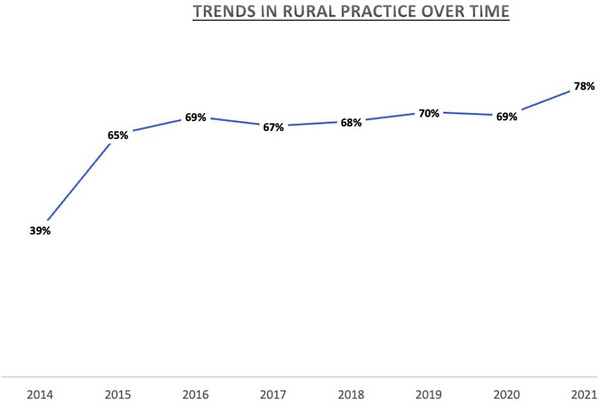
Within the study sample 78% of graduates practiced in a rural and/or underserved area, 32.5% of graduates pursued post-graduate dental training, 40% participated in Medicaid, and 78% practiced in the Pacific Northwest at the time of analysis (March 2023). Statistical analysis demonstrated a strong association and medium to large effect sizes between both rural upbringing and training sites and established dental practice in a rural region.
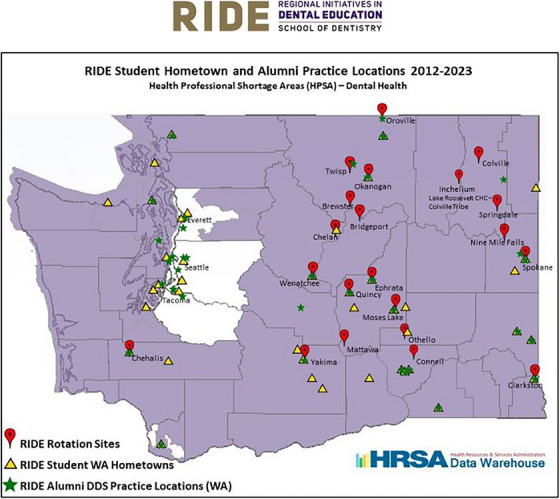
Graduates of the RIDE program practice in rural areas in greater proportion compared to the general population of practicing dentists. RIDE graduates from the study period tended to be male, and white, and practice in a health professional shortage area or rural site. The rurality of origin analysis was confounded by the substantial number of graduates from Spokane, Washington, an urban area surrounded by extensive rural territory.
牙科教育区域倡议(RIDE)项目是华盛顿大学牙科学院的一个教育项目,旨在培养在太平洋西北地区农村地区执业的领导者。本研究评估了RIDE项目头10年的成果。所检验的假设是,农村背景是长期在农村从事牙科执业的最重要预测因素。
这项描述性研究评估了现有数据,包括毕业生的执业地点、人口统计学特征、出身地的农村程度、父母职业以及不同时期的执业类型。研究对象为2012年至2021年RIDE项目的所有毕业生(N = 80),年龄在25岁至50岁之间。采用统计分析来探索关联。
在研究样本中,78%的毕业生在农村和/或服务不足地区执业,32.5%的毕业生接受了牙科研究生培训,40%参与了医疗补助计划,在分析时(2023年3月),78%的毕业生在太平洋西北地区执业。统计分析表明,农村成长经历和培训地点与在农村地区建立牙科执业之间存在很强的关联,效应大小为中等至较大。
与执业牙医的总体人群相比,RIDE项目的毕业生在农村地区执业的比例更高。研究期间的RIDE项目毕业生往往为男性、白人,且在卫生专业人员短缺地区或农村地区执业。出身地的农村程度分析因大量来自华盛顿州斯波坎市(一个被广阔农村地区环绕的城市)的毕业生而受到混淆。