Clinical Pharmacology Asia, Bayer Healthcare Company Ltd, Shanghai, China.
Clinical Pharmacology, Translational Sciences, Research & Development Japan, Bayer Yakuhin, Ltd, Tokyo, Japan.
Pharmacol Res Perspect. 2024 Oct;12(5):e70012. doi: 10.1002/prp2.70012.
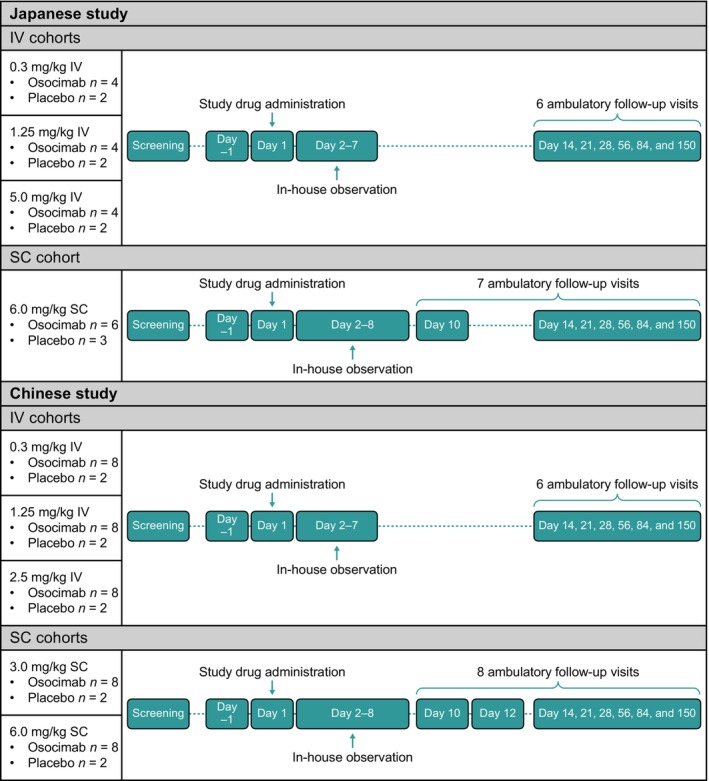
The pharmacokinetics, pharmacodynamics, immunogenicity, and safety of osocimab single doses in healthy Chinese and Japanese volunteers over 149 days were evaluated. Two phase 1 single-blinded, placebo-controlled studies with 27 Japanese and 50 Chinese participants were conducted. Osocimab was investigated with IV doses of 0.3, 1.25, and 2.5 mg/kg (Chinese study) and 0.3, 1.25, and 5.0 mg/kg (Japanese study), as well as SC doses of 3.0 and 6.0 mg/kg (Chinese study) and 6.0 mg/kg (Japanese study). The maximum plasma concentration was reached 1-3 h and 4-6 days after IV and SC administration, respectively. Osocimab exhibited a deviation from dose-proportional pharmacokinetics for AUC but not C; higher doses had higher apparent clearance and disproportionately lower total exposure. A slightly lower exposure was observed in Japanese compared with Chinese volunteers after IV administration; conversely, relatively higher exposure in Japanese volunteers with SC dosing was identified. Osocimab was associated with a dose-dependent increase in activated partial thromboplastin time (aPTT). Maximal aPTT prolongations were observed 1-4 h and 2-6 days after IV and SC administration, respectively. Anti-drug antibodies of low titer were detected in 1/9 (11.1%) Japanese volunteers administered placebo and 26/40 (65.0%) Chinese volunteers administered osocimab. Adverse events were reported in 8/18 (44.4%) Japanese and 28/40 (70.0%) Chinese volunteers who received osocimab, as well as in 1/9 (11.1%) Japanese and 6/10 (60.0%) Chinese volunteers who received placebo. In conclusion, data did not suggest a clear dose-proportionality for osocimab within the investigated dose range. The effect of osocimab on aPTT was expected per its mechanism of action. Osocimab was generally well tolerated.
在 149 天内,评估了单次剂量的 osocimab 在健康的中国和日本志愿者中的药代动力学、药效学、免疫原性和安全性。进行了两项单盲、安慰剂对照的 1 期研究,共纳入 27 名日本志愿者和 50 名中国志愿者。研究中分别给予中国志愿者静脉注射(osocimab)0.3、1.25 和 2.5mg/kg 和皮下注射(osocimab)3.0 和 6.0mg/kg,给予日本志愿者静脉注射(osocimab)0.3、1.25 和 5.0mg/kg 和皮下注射(osocimab)6.0mg/kg。最大血药浓度分别在静脉和皮下给药后 1-3 小时和 4-6 天达到。osocimab 的 AUC 表现出与剂量不成比例的药代动力学,但 C 无此表现;高剂量的药物具有更高的表观清除率和不成比例的更低的总暴露量。与中国志愿者相比,日本志愿者静脉注射后观察到的暴露量略低;相反,皮下注射时日本志愿者的相对暴露量较高。osocimab 与激活部分凝血活酶时间(aPTT)的剂量依赖性增加有关。最大 aPTT 延长分别在静脉和皮下给药后 1-4 小时和 2-6 天观察到。在接受安慰剂的 9 名日本志愿者中的 1 名(11.1%)和接受 osocimab 的 40 名中国志愿者中的 26 名(65.0%)中检测到低滴度的抗药物抗体。接受 osocimab 的 18 名日本志愿者中的 8 名(44.4%)和 40 名中国志愿者中的 28 名(70.0%)以及接受安慰剂的 9 名日本志愿者中的 1 名(11.1%)和 10 名中国志愿者中的 6 名(60.0%)报告了不良事件。总之,数据并未提示在研究剂量范围内 osocimab 具有明确的剂量比例关系。osocimab 对 aPTT 的影响与其作用机制相符。osocimab 总体耐受性良好。