Luo Cheng, He Yijun, Huang Jiongfeng
Department of Osteoarthropathy and Sports Medicine, The Affiliated Panyu Central Hospital of Guangzhou Medical University, Guangzhou, China.
Rehabilitation Medicine Institute of Panyu District, The Affiliated Panyu Central Hospital of Guangzhou Medical University, Guangzhou, China.
Arthrosc Tech. 2024 May 26;13(9):103058. doi: 10.1016/j.eats.2024.103058. eCollection 2024 Sep.
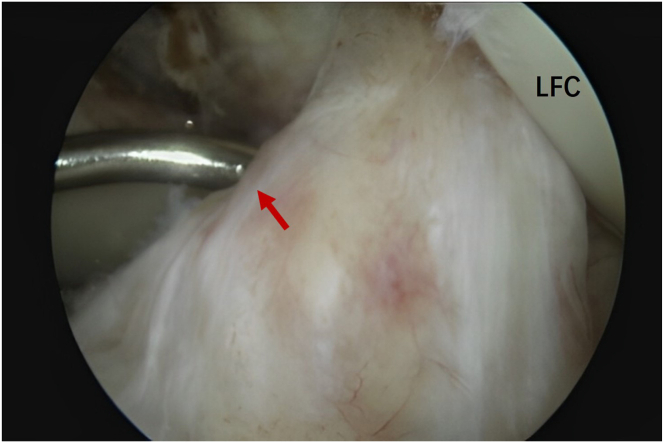
This technical note outlines a minimalist arthroscopic approach to anterior cruciate ligament avulsion fracture fixation using a bioabsorbable knotless suture anchor. This method represents a less invasive alternative to traditional techniques, catering specifically to fractures classified as Meyers and McKeever type II or III. The procedure is performed through standard anterolateral and anteromedial portals without the need for additional incisions or bone tunnel drilling, making it particularly suitable for children and adolescent patients with open physes. The technique involves the use of a suture hook to pass a double-stranded suture through the anterior cruciate ligament, anchored eccentrically to the anterior tibial incline with a knotless suture anchor. This approach allows for anatomic reduction with adjustable tension and without the potential risk of iatrogenic osteochondral injury. Nonetheless, it should be acknowledged that prospective biomechanical studies and larger patient samples are necessary to validate this technique compared with existing fixation methods.
本技术说明概述了一种使用生物可吸收无结缝线锚钉对前交叉韧带撕脱骨折进行固定的微创关节镜手术方法。该方法是传统技术的一种侵入性较小的替代方案,特别适用于Meyers和McKeever II型或III型骨折。该手术通过标准的前外侧和前内侧入路进行,无需额外的切口或骨隧道钻孔,特别适合骨骺未闭合的儿童和青少年患者。该技术包括使用缝线钩将双链缝线穿过前交叉韧带,并用无结缝线锚钉偏心固定在前胫骨斜坡上。这种方法可以实现解剖复位,张力可调,且没有医源性骨软骨损伤的潜在风险。尽管如此,与现有的固定方法相比,仍需要进行前瞻性生物力学研究和更大规模的患者样本研究来验证该技术。