Affiliated Hospital of Guangdong Medical University, Guangdong Provincial Key Laboratory of Autophagy and Major Chronic Non-communicable Diseases, Key Laboratory of Prevention and Management of Chronic Kidney Disease of Zhanjiang City, Institute of Nephrology, Zhanjiang, Guangdong Province, China.
Affiliated Hospital of Guangdong Medical University, Guangdong Provincial Key Laboratory of Autophagy and Major Chronic Non-communicable Diseases, Zhanjiang, Guangdong, China.
PeerJ. 2024 Sep 19;12:e18063. doi: 10.7717/peerj.18063. eCollection 2024.
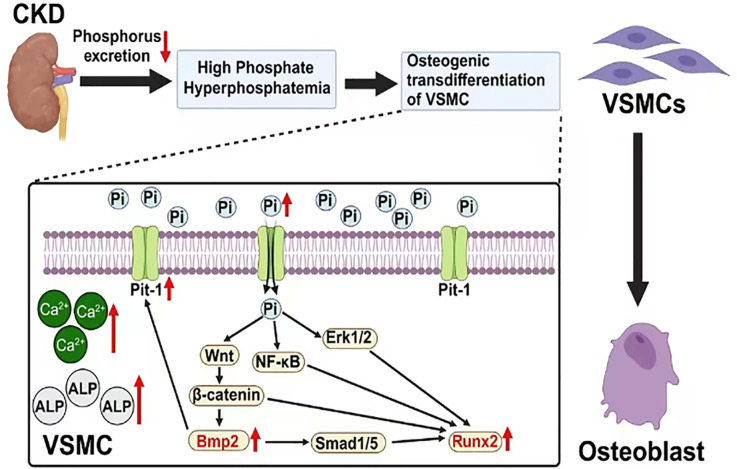
Vascular calcification is quite common in patients with end-stage chronic kidney disease and is a major trigger for cardiovascular complications in these patients. These complications significantly impact the survival rate and long-term prognosis of individuals with chronic kidney disease. Numerous studies have demonstrated that the development of vascular calcification involves various pathophysiological mechanisms, with the osteogenic transdifferentiation of vascular smooth muscle cells (VSMCs) being of utmost importance. High phosphate levels, bone morphogenetic protein 2 (BMP2), and runt-related transcription factor 2 (RUNX2) play crucial roles in the osteogenic transdifferentiation process of VSMCs. This article primarily reviews the molecular mechanisms by which high phosphate, BMP2, and RUNX2 regulate vascular calcification secondary to chronic kidney disease, and discusses the complex interactions among these factors and their impact on the progression of vascular calcification. The insights provided here aim to offer new perspectives for future research on the phenotypic switching and osteogenic transdifferentiation of VSMCs, as well as to aid in optimizing clinical treatment strategies for this condition, bearing significant clinical and scientific implications.
血管钙化在终末期慢性肾脏病患者中较为常见,是这些患者心血管并发症的主要触发因素。这些并发症显著影响慢性肾脏病患者的生存率和长期预后。大量研究表明,血管钙化的发生涉及多种病理生理机制,其中血管平滑肌细胞(VSMCs)的成骨转化最为重要。高磷水平、骨形态发生蛋白 2(BMP2)和 runt 相关转录因子 2(RUNX2)在 VSMCs 的成骨转化过程中发挥关键作用。本文主要综述了高磷、BMP2 和 RUNX2 通过何种分子机制调节慢性肾脏病继发的血管钙化,并讨论了这些因素之间的复杂相互作用及其对血管钙化进展的影响。本文提供的这些见解旨在为未来研究 VSMCs 的表型转换和成骨转化提供新的视角,并有助于优化该疾病的临床治疗策略,具有重要的临床和科学意义。