Kobashi Yurie, Kawamura Takeshi, Shimazu Yuzo, Kaneko Yudai, Nishikawa Yoshitaka, Sugiyama Akira, Tani Yuta, Nakayama Aya, Yoshida Makoto, Zho Tianchen, Yamamoto Chika, Saito Hiroaki, Takita Morihito, Wakui Masatoshi, Kodama Tatsuhiko, Tsubokura Masaharu
Department of Radiation Health Management, Fukushima Medical University School of Medicine, Fukushima City, Fukushima, Japan.
Department of General Internal Medicine, Hirata Central Hospital, Hirata, Ishikawa District, Fukushima, Japan.
Vaccine X. 2024 Sep 12;20:100553. doi: 10.1016/j.jvacx.2024.100553. eCollection 2024 Oct.
Understanding the waning of immunity after booster vaccinations is important to identify which immune-low populations should be prioritized.
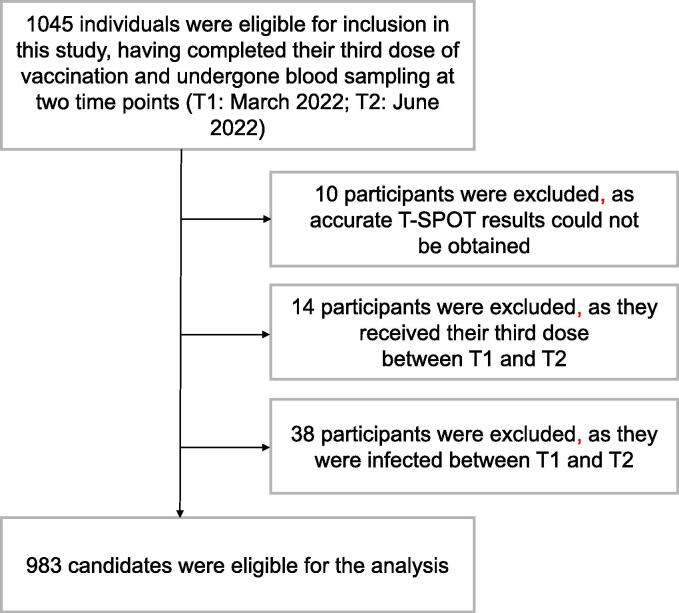
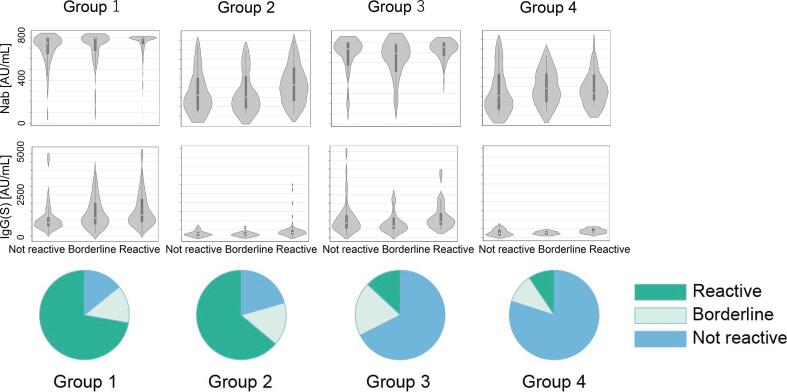
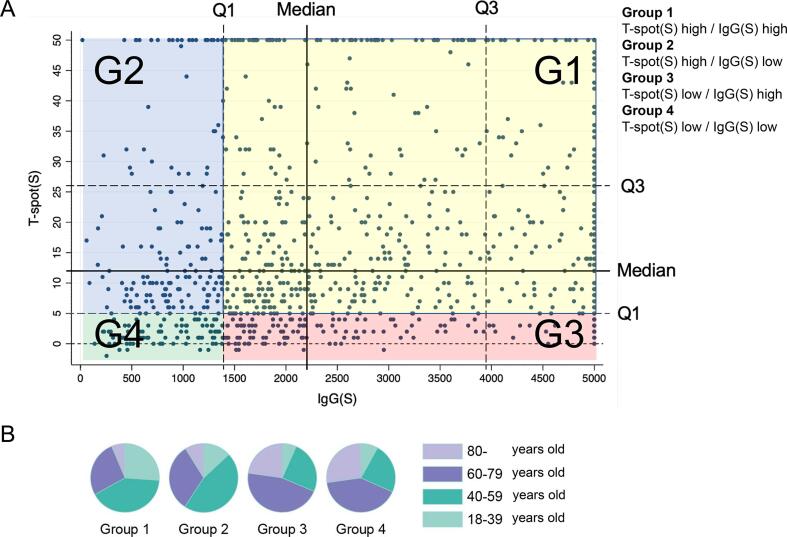
We investigated longitudinal cellular and humoral immunity after the third vaccine dose in both high- and low-cellular and humoral immunity groups at the peak immunity phase after the booster vaccination in a large community-based cohort. Blood samples were collected from 1045 participants at peak (T1: median 54 days post-third dose) and decay (T2: median 145 days post-third dose) phases to assess IgG(S), neutralizing activity, and ELISpot responses. Participants were categorized into high/low ELISpot/IgG(S) groups at T1. Cellular and humoral responses were tracked for approximately five months after the third vaccination.
In total, 983 participants were included in the cohort. IgG(S) geometric mean fold change between timepoints revealed greater waning in the >79 years age group (T2/T1 fold change: 0.27) and higher IgG(S) fold change in the low-ELISpot group at T1 (T2/T1 fold change: 0.32-0.33) than in the other groups, although ELISpot geometric mean remained stable.
Antibody level of those who did not respond well to third dose vaccination waned rapidly than those who responded well. Evidence-based vaccine strategies are essential in preventing potential health issues caused by vaccines, including side-effects.
了解加强疫苗接种后免疫力的减弱情况对于确定哪些免疫低下人群应被优先考虑至关重要。
我们在一个大型社区队列中,对加强疫苗接种后免疫高峰期的高细胞和体液免疫组以及低细胞和体液免疫组,研究了第三次疫苗接种后的纵向细胞和体液免疫情况。在峰值(T1:第三次接种后中位数54天)和衰退期(T2:第三次接种后中位数145天)从1045名参与者采集血样,以评估IgG(S)、中和活性和酶联免疫斑点反应。在T1时将参与者分为高/低酶联免疫斑点/IgG(S)组。在第三次接种后对细胞和体液反应进行了约五个月的跟踪。
该队列共纳入983名参与者。时间点之间的IgG(S)几何平均倍数变化显示,>79岁年龄组的下降幅度更大(T2/T1倍数变化:0.27),且T1时低酶联免疫斑点组的IgG(S)倍数变化更高(T2/T1倍数变化:0.32 - 0.33),高于其他组,尽管酶联免疫斑点几何平均值保持稳定。
对第三次疫苗接种反应不佳者的抗体水平比反应良好者下降得更快。基于证据的疫苗策略对于预防疫苗引起的潜在健康问题(包括副作用)至关重要。