Jourshari Marzieh Shahbandari, Rezasoltani Parvaneh, Nazari Mojgan, Maroufizadeh Saman, Aski Soudabeh Kazemi, Qobadighadikolaei Roja, Yousefbeyk Fatemeh
Department of Midwifery, School of Nursing and Midwifery, Guilan University of Medical Sciences, Rasht, Iran.
Department of Midwifery, Zeyinab (P.B.U.H) School of Nursing and Midwifery, Guilan University of Medical Sciences, Rasht, Iran.
J Educ Health Promot. 2024 Jul 29;13:251. doi: 10.4103/jehp.jehp_389_23. eCollection 2024.
Flatulence is one of the gastrointestinal complaints after a cesarean section (C-section). A host of treatments have been used to reduce this symptom in hospitals, and most of them are based on chemical drugs. It is considered that herbal drugs may have fewer side effects than chemical drugs, and it seems that fennel can reduce flatulence through stimulation of bowel movements. This study compared the efficacy of fennel and dimethicone capsules on the flatulence rate in post-cesarean birth women.
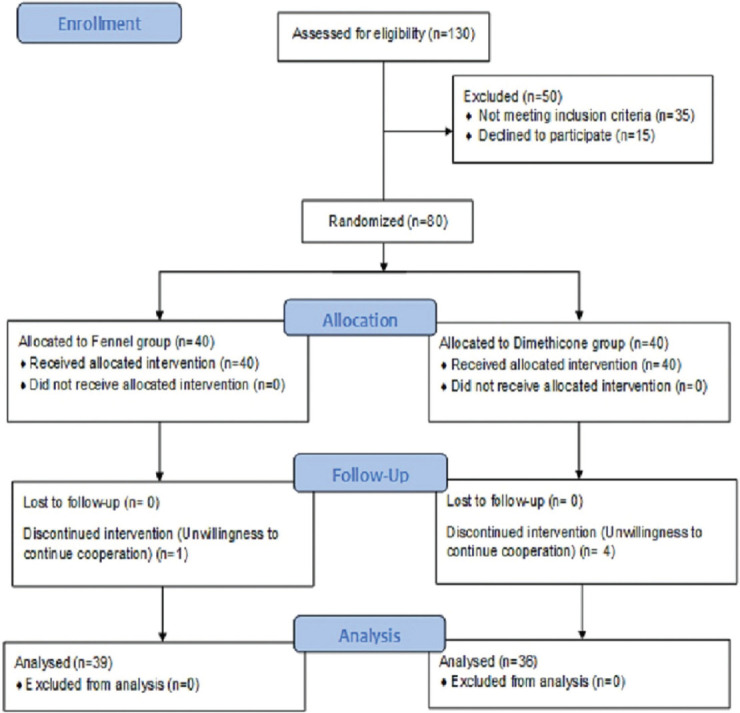
This study was a parallel double-blind randomized controlled trial, conducted in a teaching hospital. Eligible women who underwent a C-section and had the sensation of flatulence were randomly block allocated to the fennel and dimethicone groups (1:1). Each group received drugs every 6 hours for four doses after restarting oral feeding. Flatulence rate was the main variable measured before and one hour after taking each dose by the visual analog scale (VAS). Data were analyzed by statistical tests including repeated-measures analysis of covariance (ANCOVA) based on the intention-to-treat method in Statistical Package for the Social Sciences (SPSS) version 16.0.
The dimethicone group showed a significant reduction in flatulence (F =198.5, < 0.001, η = 0.850). The same trend was also obtained for the fennel group (F =215.0, < 0.001, η = 0.849). However, there was no difference between groups on the flatulence level after adjusting for the baseline level of flatulence (F =0.27, = 0.607, η = 0.004). The same result was also obtained one hour after taking capsule 4 (F =0.63, = 0.430, η = 0.009).
Both fennel and dimethicone capsules can reduce flatulence rate after C-section, although there was no significant difference among them.
肠胃胀气是剖宫产术后的胃肠道不适之一。医院中已采用多种治疗方法来减轻这种症状,且大多数方法基于化学药物。人们认为草药药物的副作用可能比化学药物少,并且茴香似乎可以通过刺激肠道蠕动来减轻肠胃胀气。本研究比较了茴香和西甲硅油胶囊对剖宫产术后妇女肠胃胀气发生率的疗效。
本研究是在一家教学医院进行的平行双盲随机对照试验。符合条件的剖宫产且有肠胃胀气感觉的妇女被随机整群分配到茴香组和西甲硅油组(1:1)。每组在恢复口服喂养后每6小时服用一次药物,共服用四剂。肠胃胀气发生率是通过视觉模拟量表(VAS)在每次服药前和服药后1小时测量的主要变量。数据采用统计检验进行分析,包括基于意向性分析方法,在社会科学统计软件包(SPSS)16.0版中进行重复测量协方差分析(ANCOVA)。
西甲硅油组的肠胃胀气有显著减轻(F = 198.5,P < 0.001,η = 0.850)。茴香组也得到了相同的趋势(F = 215.0,P < 0.001,η = 0.849)。然而,在调整肠胃胀气的基线水平后,两组之间的肠胃胀气水平没有差异(F = 0.27,P = 0.607,η = 0.004)。在服用第4粒胶囊1小时后也得到了相同的结果(F = 0.63,P = 0.430,η = 0.009)。
茴香和西甲硅油胶囊均可降低剖宫产术后的肠胃胀气发生率,尽管它们之间没有显著差异。