Qiu Jingyue, Liu Jiakuo, Cai Kexin, Xu Ting, Liu Wenwen, Lin Fei, Shi Ning
Pharmaceutical Department, PLA Strategic Support Force Medical Center, Beijing, China.
Pharmaceutical Department, PLA Rocket Force Medical Center, Beijing, China.
Front Pharmacol. 2024 Sep 9;15:1420455. doi: 10.3389/fphar.2024.1420455. eCollection 2024.
The study aims to assess the efficacy and safety of the recently approved S1PR modulator etrasimod in adults with ulcerative colitis during the induction phase through meta-analysis.
A systemic search was performed for randomized controlled trials evaluating the efficacy and safety of the S1PR modulator etrasimod using electronic databases PubMed, Embase, the Cochrane Library, Clinical Trials, and the International Clinical Trials Registry Platform. Three studies with 943 patients met the inclusion criteria and were included in this analysis. The study's primary endpoint was the proportion of patients who achieved clinical remission at week 12. Key secondary endpoints included the proportion of patients with clinical response, endoscopic improvement, and histologic remission. The incidence of adverse effects (AEs), serious AEs (SAEs), and AE-related treatment discontinuation were statistically analyzed to determine the safety of etrasimod.
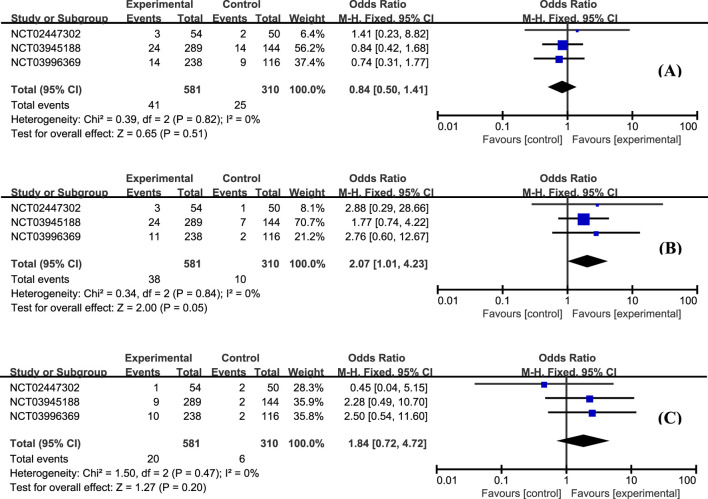
This study revealed that etrasimod is superior to placebo at the primary endpoint clinical remission (OR = 3.09, 95% CI: 2.04-4.69), as well as at the secondary endpoints clinical response (OR = 2.56, 95% CI: 1.91-3.43), endoscopic improvement (OR = 2.15, 95% CI: 1.51-3.05), and histologic remission (OR = 3.39, 95% CI: 2.03-5.68). The proportion of patients with TEAE (OR = 1.34, 95% CI: 1.01-1.78) and SAE (OR = 0.77, 95% CI: 0.41-1.43) was similar between the etrasimod and placebo groups. Patients receiving etrasimod had slightly higher odds of experiencing headache (OR = 2.07, 95% CI: 1.01-4.23), and nausea (OR = 1.84, 95% CI: 0.72-4.72). The incidences of upper respiratory tract infection (OR = 0.79, 95% CI: 0.27-2.32), nasopharyngitis (OR = 0.40, 95% CI: 0.15-1.07), and urinary tract infection (OR = 1.82, 95% CI: 0.59-5.60) were generally lower in the etrasimod groups and no treatment-related serious infections were reported.
This study demonstrates that etrasimod is effective in treating moderately to severely active ulcerative colitis with a favorable benefit-risk profile at week 12. Etrasimod shows promise as a potential first-line oral therapy for individuals suffering from this disease. Additional RCTs with larger sample sizes and longer observation periods are needed to confirm the sustained efficacy of etrasimod beyond the initial phase.
本研究旨在通过荟萃分析评估近期获批的S1PR调节剂etrasimod在诱导期对成人溃疡性结肠炎患者的疗效和安全性。
使用电子数据库PubMed、Embase、Cochrane图书馆、临床试验和国际临床试验注册平台,对评估S1PR调节剂etrasimod疗效和安全性的随机对照试验进行系统检索。三项涉及943例患者的研究符合纳入标准并纳入本分析。该研究的主要终点是在第12周实现临床缓解的患者比例。关键次要终点包括临床反应、内镜改善和组织学缓解的患者比例。对不良反应(AE)、严重不良反应(SAE)和与AE相关的治疗中断发生率进行统计分析,以确定etrasimod的安全性。
本研究表明,在主要终点临床缓解方面(OR = 3.09,95%CI:2.04 - 4.69),以及在次要终点临床反应(OR = 2.56,95%CI:1.91 - 3.43)、内镜改善(OR = 2.15,95%CI:1.51 - 3.05)和组织学缓解(OR = 3.39,95%CI:2.03 - 5.68)方面,etrasimod优于安慰剂。etrasimod组和安慰剂组的治疗中出现的不良事件(TEAE)(OR = 1.34,95%CI:1.01 - 1.78)和严重不良事件(SAE)(OR = 0.77,95%CI:0.41 - 1.43)比例相似。接受etrasimod治疗的患者出现头痛(OR = 2.07,95%CI:1.01 - 4.23)和恶心(OR = 1.84,95%CI:0.72 - 4.72)的几率略高。etrasimod组上呼吸道感染(OR = 0.79,95%CI:0.27 - 2.32)、鼻咽炎(OR = 0.40,95%CI:0.15 - 1.07)和尿路感染(OR = 1.82,95%CI:0.59 - 5.60)的发生率通常较低,且未报告与治疗相关的严重感染。
本研究表明,etrasimod在治疗中度至重度活动性溃疡性结肠炎方面有效,在第12周时具有良好的效益风险比。Etrasimod有望成为患有这种疾病的个体的潜在一线口服疗法。需要更多样本量更大、观察期更长的随机对照试验来确认etrasimod在初始阶段之后的持续疗效。