Xu Hanmeng, Aparicio Camilla, Wats Aanchal, Araujo Barbara L, Pitzer Virginia E, Warren Joshua L, Shapiro Eugene D, Niccolai Linda M, Weinberger Daniel M, Oliveira Carlos R
Department of Epidemiology of Microbial Diseases, Yale School of Public Health, New Haven, CT, USA.
Department of Pediatrics, Section of Infectious Diseases and Global Health, Yale School of Medicine, New Haven, CT, USA.
medRxiv. 2024 Sep 12:2024.09.12.24313545. doi: 10.1101/2024.09.12.24313545.
Nirsevimab, a long-acting monoclonal antibody, has demonstrated efficacy against RSV-related lower respiratory tract infections (LRTIs) in clinical trials. Post-licensure monitoring is essential to confirm these benefits in real-world settings.
To evaluate the real-world effectiveness of nirsevimab against medically attended RSV infections in infants and to assess how effectiveness varies by disease severity, dosage, and time since immunization.
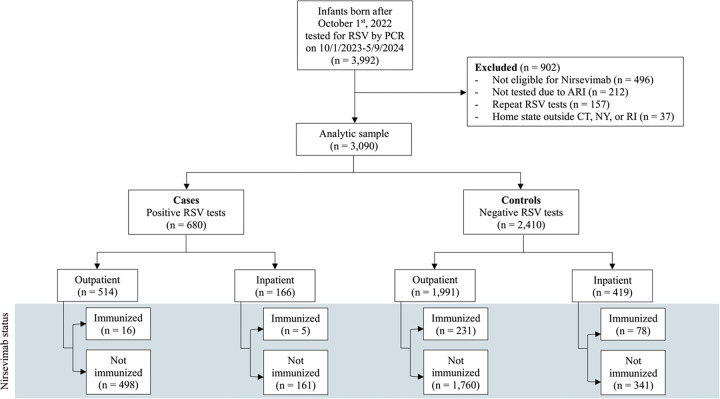
This test-negative case-control study used inpatient, outpatient, and emergency room data from the Yale New Haven Health System. Nirsevimab-eligible infants who were tested for RSV using polymerase chain reaction between October 1, 2023 and May 9, 2024 were included. Cases were infants with confirmed RSV infections; controls were those who tested negative.
Nirsevimab immunization, verified through state immunization registries.
Effectiveness was estimated using multivariable logistic regression, adjusting for age, calendar month, and individual risk factors. Separate models examined effectiveness by clinical setting, disease severity, dose, and time since immunization. Broader outcomes, including all-cause LRTI and LRTI-related hospitalization, were also analyzed, with stratification by early and late respiratory seasons.
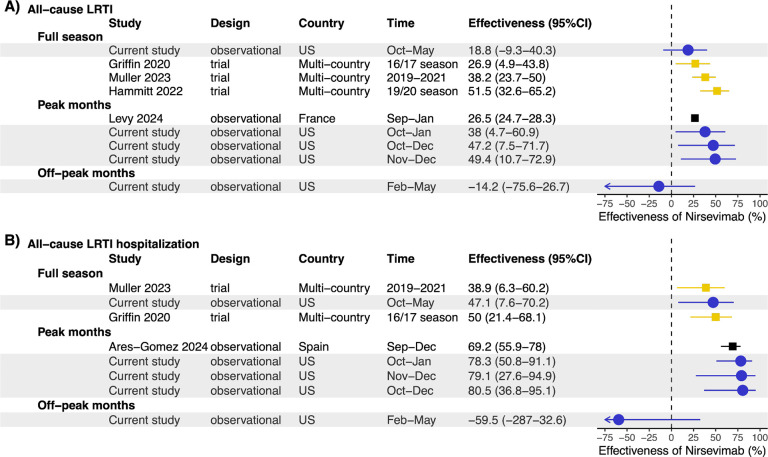
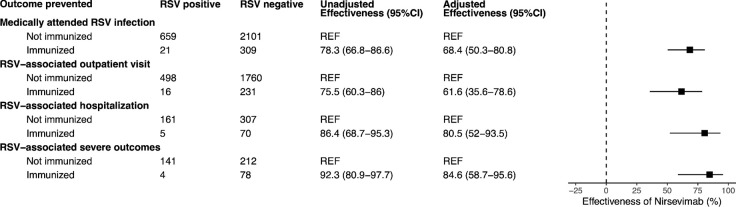
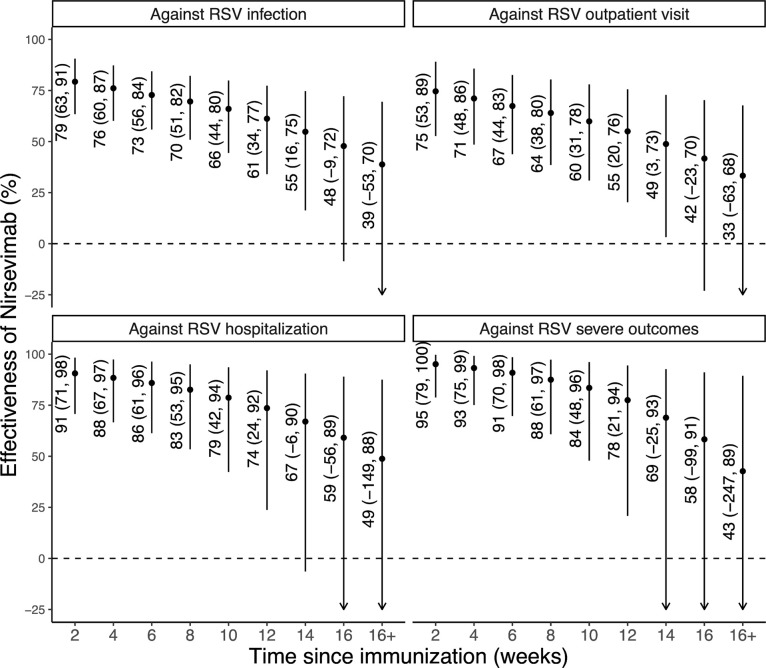
The analytic sample included 3,090 infants (median age 6.7 months, IQR 3.6-9.7), with 680 (22.0%) RSV-positive and 2,410 (78.0%) RSV-negative. 21 (3.1%) RSV-positive and 309 (12.8%) RSV-negative infants received nirsevimab. Effectiveness against RSV infection was 68.4% (95% CI, 50.3%-80.8%). Effectiveness was 61.6% (95% CI, 35.6%-78.6%) for outpatient visits and 80.5% (95% CI, 52.0%-93.5%) for hospitalizations. The highest effectiveness, 84.6% (95% CI, 58.7%-95.6%), was observed against severe RSV outcomes requiring ICU admission or high-flow oxygen. Although effectiveness against RSV infections declined over time, it remained significant at 55% (95% credible interval, 16%-75%) at 14 weeks post-immunization. Protective effectiveness was also observed against all-cause LRTI and LRTI-related hospitalizations during peak RSV season (49.4% [95% CI, 10.7%-72.9%] and 79.1% [95% CI, 27.6%-94.9%], respectively). However, from February to May, when RSV positivity was low, effectiveness against these broader outcomes was negligible.
Nirsevimab provided substantial protection against RSV-related outcomes for at least three months. These findings support the continued use of nirsevimab and provide evidence that may help build public confidence in the immunization program.
长效单克隆抗体尼塞维单抗在临床试验中已证明对呼吸道合胞病毒(RSV)相关的下呼吸道感染(LRTI)有效。上市后监测对于在现实环境中确认这些益处至关重要。
评估尼塞维单抗对婴儿就医的RSV感染的实际效果,并评估效果如何因疾病严重程度、剂量和免疫接种后的时间而有所不同。
设计、设置和参与者:这项检测阴性的病例对照研究使用了耶鲁纽黑文医疗系统的住院、门诊和急诊室数据。纳入了在2023年10月1日至2024年5月9日期间使用聚合酶链反应检测RSV的符合尼塞维单抗使用条件的婴儿。病例为确诊RSV感染的婴儿;对照为检测阴性的婴儿。
通过州免疫登记处核实的尼塞维单抗免疫接种。
使用多变量逻辑回归估计效果,并对年龄、日历月份和个体风险因素进行调整。单独的模型按临床环境、疾病严重程度、剂量和免疫接种后的时间来检验效果。还分析了更广泛 的结局,包括全因LRTI和与LRTI相关的住院情况,并按呼吸道季节的早期和晚期进行分层分析。
分析样本包括3090名婴儿(中位年龄6.7个月,四分位距3.6 - 9.7),其中680名(22.0%)RSV呈阳性,2410名(78.0%)RSV呈阴性。21名(3.1%)RSV呈阳性和309名(12.8%)RSV呈阴性的婴儿接受了尼塞维单抗。对RSV感染的有效率为68.4%(95%置信区间,50.3% - 80.8%)。门诊就诊的有效率为61.6%(95%置信区间,35.6% - 78.6%),住院的有效率为80.5%(95%置信区间,52.0% - 93.5%)。对于需要入住重症监护病房或使用高流量氧气的严重RSV结局,观察到的最高有效率为84.6%(95%置信区间,58.7% - 95.6%)。虽然对RSV感染的有效率随时间下降,但在免疫接种后14周时仍显著,为55%(95%可信区间,16% - 75%)。在RSV高峰季节,对全因LRTI和与LRTI相关的住院也观察到了保护效果(分别为49.4%[95%置信区间,10.7% - 72.9%]和79.1%[95%置信区间,27.6% - 94.9%])。然而,在2月至5月RSV阳性率较低时,对这些更广泛结局的有效率可忽略不计。
尼塞维单抗为RSV相关结局提供了至少三个月的实质性保护。这些发现支持继续使用尼塞维单抗,并提供了可能有助于增强公众对免疫计划信心的证据。