Kamel Serageldin, Humbert-Vidan Laia, Kaffey Zaphanlene, Abusaif Abdulrahman, Fuentes David T A, Wahid Kareem, Dede Cem, Naser Mohamed A, He Renjie, Moawad Ahmed W, Elsayes Khaled M, Chen Melissa M, Otun Adegbenga O, Rigert Jillian, Chambers Mark, Hope Andrew, Watson Erin, Brock Kristy K, Hutcheson Katherine, van Dijk Lisanne, Moreno Amy C, Lai Stephen Y, Fuller Clifton D, Mohamed Abdallah S R
The University of Texas MD Anderson Cancer Center, Division of Radiation Oncology, Houston, USA.
The University of Texas MD Anderson Cancer Center, Department of Imaging Physics, Houston, USA.
medRxiv. 2024 Sep 12:2024.09.11.24313485. doi: 10.1101/2024.09.11.24313485.
This study aims to identify radiomic features extracted from contrast-enhanced CT scans that differentiate osteoradionecrosis (ORN) from normal mandibular bone in patients with head and neck cancer (HNC) treated with radiotherapy (RT).
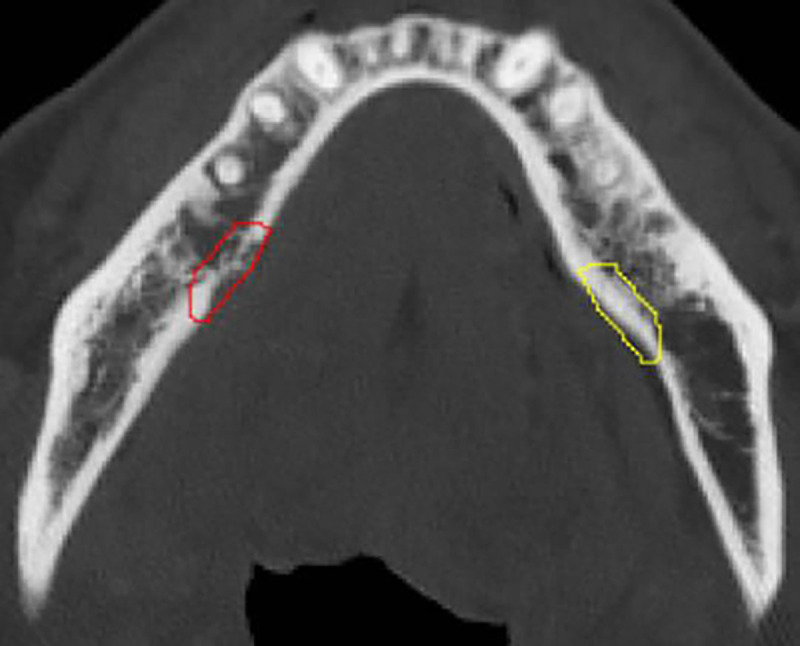
Contrast-enhanced CT (CECT) images were collected for 150 patients (80% train, 20% test) with confirmed ORN diagnosis at The University of Texas MD Anderson Cancer Center between 2008 and 2018. Using PyRadiomics, radiomic features were extracted from manually segmented ORN regions and the corresponding automated control regions, the later defined as the contralateral healthy mandible region. A subset of pre-selected features was obtained based on correlation analysis (r > 0.95) and used to train a Random Forest (RF) classifier with Recursive Feature Elimination. Model explainability SHapley Additive exPlanations (SHAP) analysis was performed on the 20 most important features identified by the trained RF classifier.
From a total of 1316 radiomic features extracted, 810 features were excluded due to high collinearity. From a set of 506 pre-selected radiomic features, the optimal subset resulting on the best discriminative accuracy of the RF classifier consisted of 67 features. The RF classifier was well calibrated (Log Loss 0.296, ECE 0.125) and achieved an accuracy of 88% and a ROC AUC of 0.96. The SHAP analysis revealed that higher values of Wavelet-LLH First-order Mean and Median were associated with ORN of the jaw (ORNJ). Conversely, higher Exponential GLDM Dependence Entropy and lower Square First-order Kurtosis were more characteristic of normal mandibular tissue.
This study successfully developed a CECT-based radiomics model for differentiating ORNJ from healthy mandibular tissue in HNC patients after RT. Future work will focus on the detection of subclinical ORNJ regions to guide earlier interventions.
本研究旨在识别从接受放射治疗(RT)的头颈癌(HNC)患者的对比增强CT扫描中提取的、能区分放射性骨坏死(ORN)与正常下颌骨的放射组学特征。
2008年至2018年期间,在德克萨斯大学MD安德森癌症中心收集了150例确诊为ORN的患者(80%用于训练,20%用于测试)的对比增强CT(CECT)图像。使用PyRadiomics从手动分割的ORN区域和相应的自动对照区域提取放射组学特征,后者定义为对侧健康下颌骨区域。基于相关性分析(r>0.95)获得一组预先选择的特征子集,并用于训练具有递归特征消除的随机森林(RF)分类器。对训练后的RF分类器识别出的20个最重要特征进行模型可解释性SHapley加性解释(SHAP)分析。
在总共提取的1316个放射组学特征中,810个特征因高共线性被排除。从一组506个预先选择的放射组学特征中,使RF分类器具有最佳判别准确性的最优子集由67个特征组成。RF分类器校准良好(对数损失0.296,预期校准误差0.125),准确率达88%,ROC曲线下面积为0.96。SHAP分析表明,小波-LLH一阶均值和中位数的较高值与颌骨放射性骨坏死(ORNJ)相关。相反,指数广义局部二值模式依赖熵较高和平方一阶峰度较低是正常下颌组织更具特征性的表现。
本研究成功开发了一种基于CECT的放射组学模型,用于区分放疗后HNC患者的ORNJ与健康下颌组织。未来的工作将集中在亚临床ORNJ区域的检测上,以指导早期干预。