State Key Laboratory of Biocatalysis and Enzyme Engineering, Hubei Key Laboratory of Industrial Biotechnology, School of Life Sciences, Hubei University, Wuhan, Hubei 430062, China.
State Key Laboratory of Swine and Poultry Breeding Industry, Agro-biological Gene Research Center, Guangdong Academy of Agricultural Sciences, Guangzhou 510640, China.
Nucleic Acids Res. 2024 Oct 28;52(19):11895-11910. doi: 10.1093/nar/gkae820.
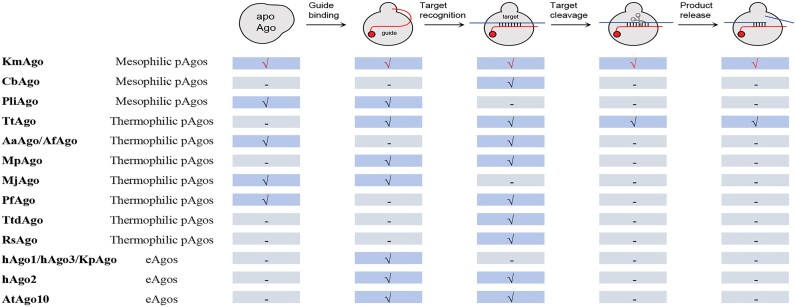
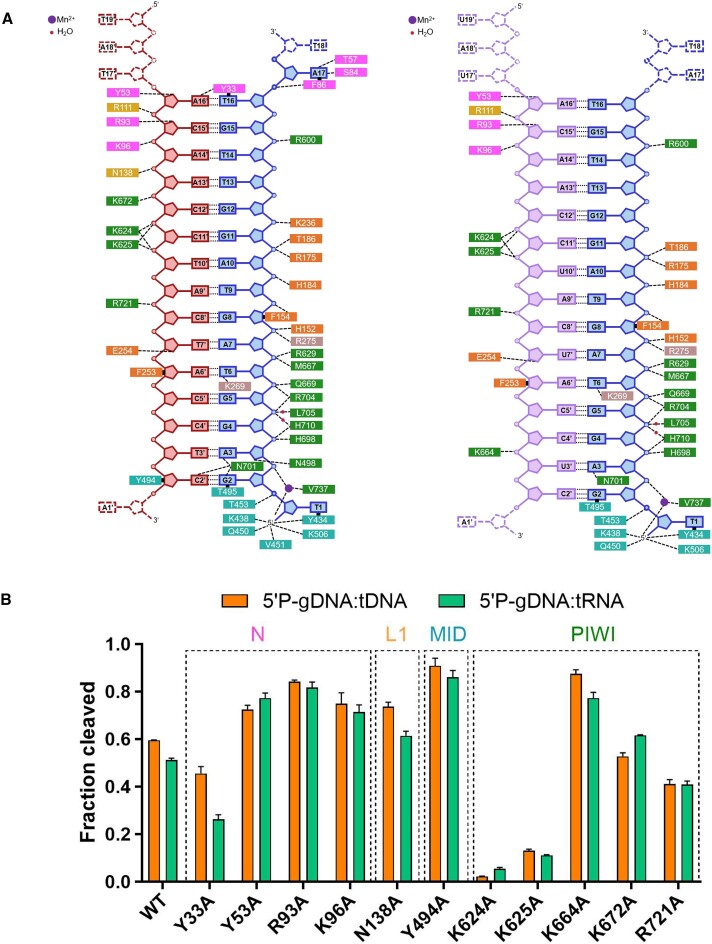
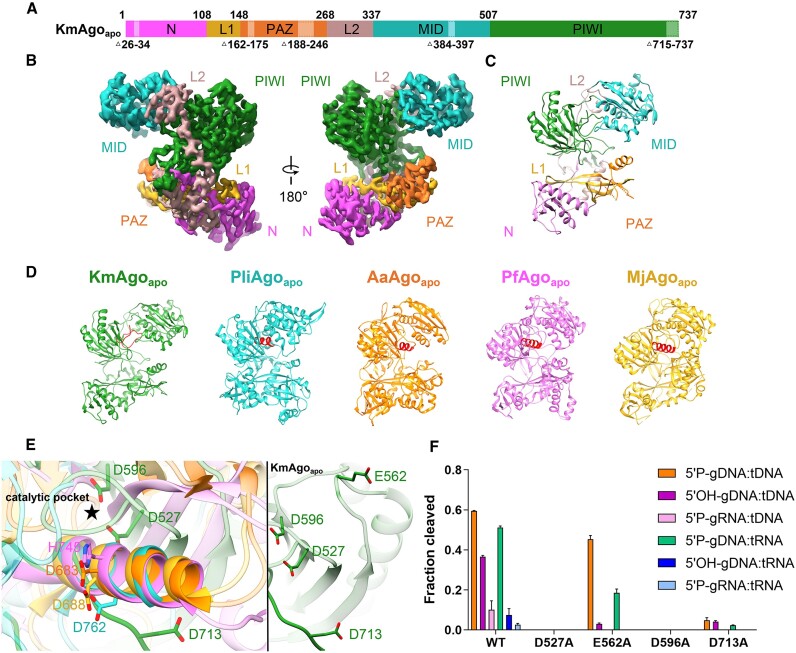
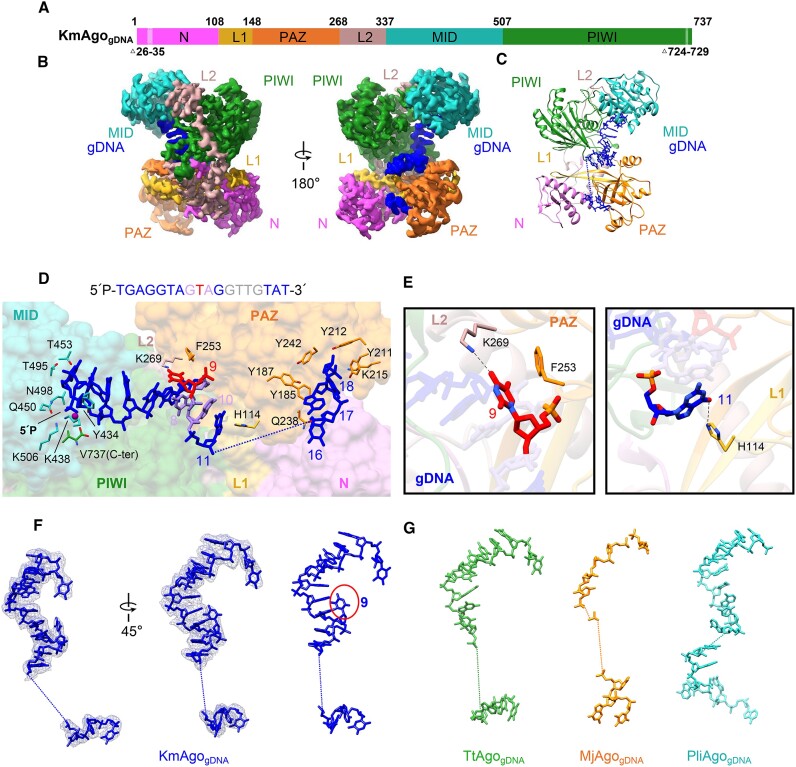
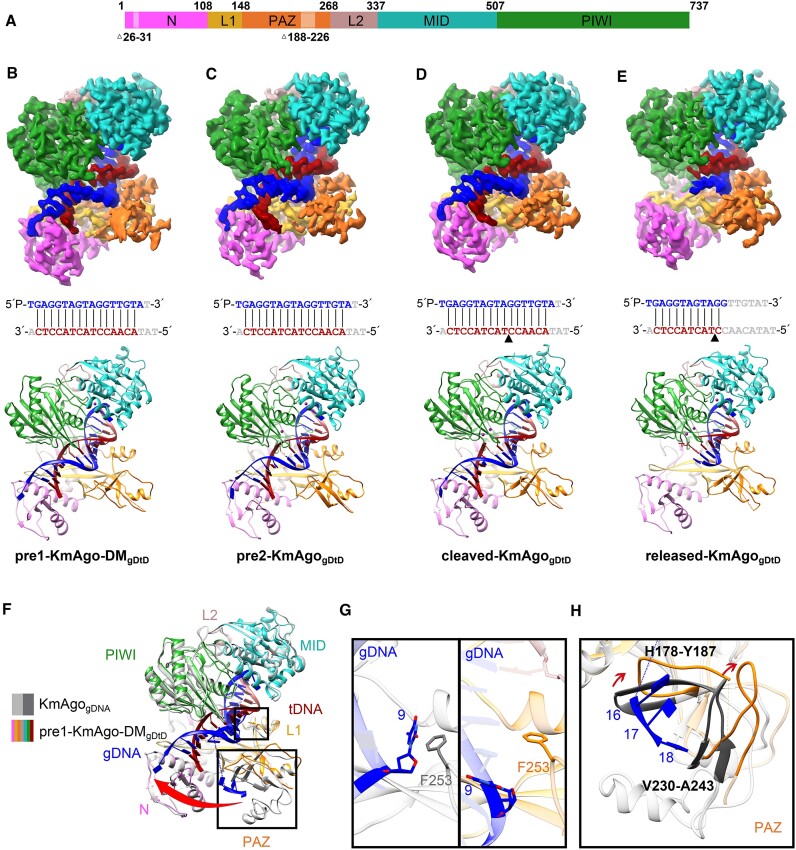
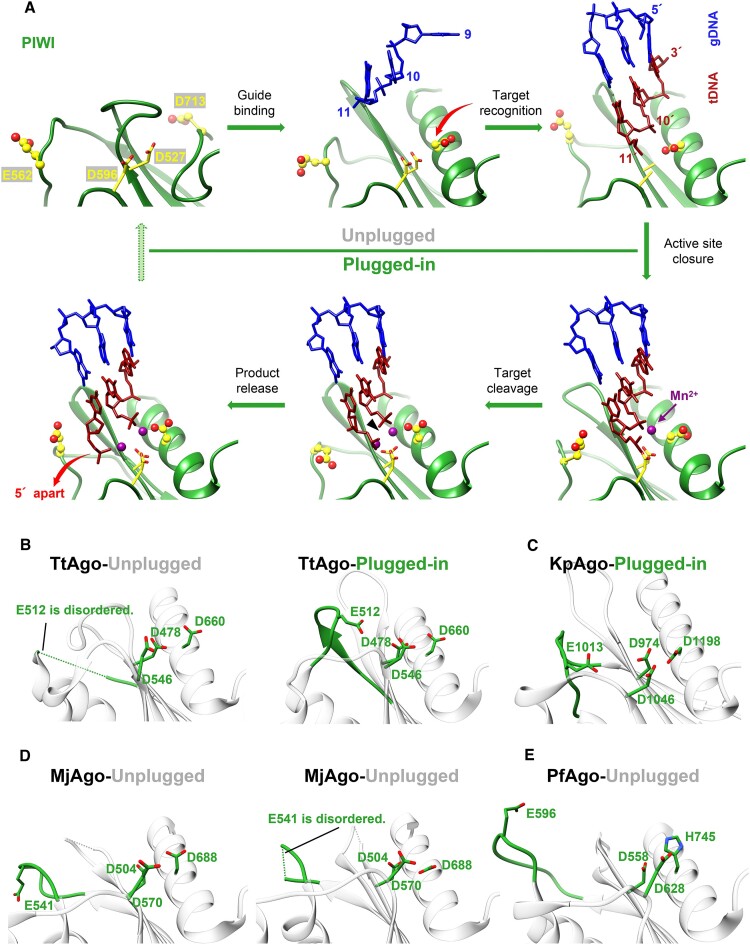
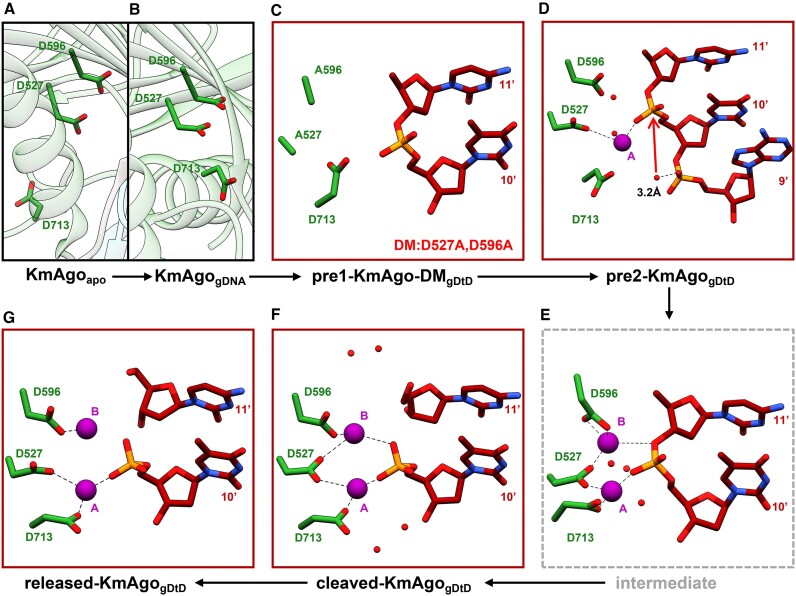
Argonaute (Ago) proteins are programmable nucleases found in all domains of life, playing a crucial role in biological processes like DNA/RNA interference and gene regulation. Mesophilic prokaryotic Agos (pAgos) have gained increasing research interest due to their broad range of potential applications, yet their molecular mechanisms remain poorly understood. Here, we present seven cryo-electron microscopy structures of Kurthia massiliensis Ago (KmAgo) in various states. These structures encompass the steps of apo-form, guide binding, target recognition, cleavage, and release, revealing that KmAgo employs a unique DDD catalytic triad, instead of a DEDD tetrad, for DNA target cleavage under 5'P-DNA guide conditions. Notably, the last catalytic residue, D713, is positioned outside the catalytic pocket in the absence of guide. After guide binding, D713 enters the catalytic pocket. In contrast, the corresponding catalytic residue in other Agos has been consistently located in the catalytic pocket. Moreover, we identified several sites exhibiting enhanced catalytic activity through alanine mutagenesis. These sites have the potential to serve as engineering targets for augmenting the catalytic efficiency of KmAgo. This structural analysis of KmAgo advances the understanding of the diversity of molecular mechanisms by Agos, offering insights for developing and optimizing mesophilic pAgos-based programmable DNA and RNA manipulation tools.
Argonaute (Ago) 蛋白是存在于所有生命领域的可编程核酸酶,在 DNA/RNA 干扰和基因调控等生物学过程中发挥着关键作用。嗜温原核 Ago(pAgo)由于其广泛的潜在应用而引起了越来越多的研究兴趣,但它们的分子机制仍知之甚少。在这里,我们展示了七种不同状态的马塞氏库特氏菌 Ago(KmAgo)的冷冻电子显微镜结构。这些结构涵盖了apo 形式、引导结合、靶标识别、切割和释放的步骤,揭示了 KmAgo 在 5'P-DNA 引导条件下使用独特的 DDD 催化三联体,而不是 DEDD 四联体,用于 DNA 靶标切割。值得注意的是,最后一个催化残基 D713 在没有引导的情况下位于催化口袋之外。在引导结合后,D713 进入催化口袋。相比之下,其他 Ago 中的相应催化残基一直位于催化口袋中。此外,我们通过丙氨酸突变鉴定了几个显示增强催化活性的位点。这些位点有可能成为增强 KmAgo 催化效率的工程目标。这项对 KmAgo 的结构分析推进了对 Ago 分子机制多样性的理解,为开发和优化基于嗜温 pAgo 的可编程 DNA 和 RNA 操作工具提供了思路。