Hsu Ping-Chih, Chang John Wen-Cheng, Chiu Li-Chung, Yang Cheng-Ta, Kuo Scott Chih-Hsi, Fang Yueh-Fu, Wu Chiao-En
Division of Thoracic Oncology, Department of Thoracic Medicine, Chang Gung Memorial Hospital at Linkou, Taoyuan, 33305, Taiwan.
Department of Medicine, College of Medicine, Chang Gung University, Taoyuan, 33302, Taiwan.
Clin Transl Oncol. 2025 May;27(5):1967-1979. doi: 10.1007/s12094-024-03727-7. Epub 2024 Sep 24.
Genomic alterations after resistance to osimertinib therapy in advanced T790M-mutated non-small cell lung cancer (NSCLC) are complex and poorly understood. In this study, we aimed to detect these genomic alternations via comprehensive next-generation sequencing (NGS) of tissue and liquid biopsies.
From September 2020 to June 2021, 31 stage IIIB/IV T790M-mutated NSCLC patients who exhibited progressive disease after osimertinib therapy and provided written informed consent were recruited. Liquid and tissue biopsy samples for NGS testing were collected from 31 and 18 patients, respectively. Eighteen study patients had paired NGS data from tissue and liquid biopsies.
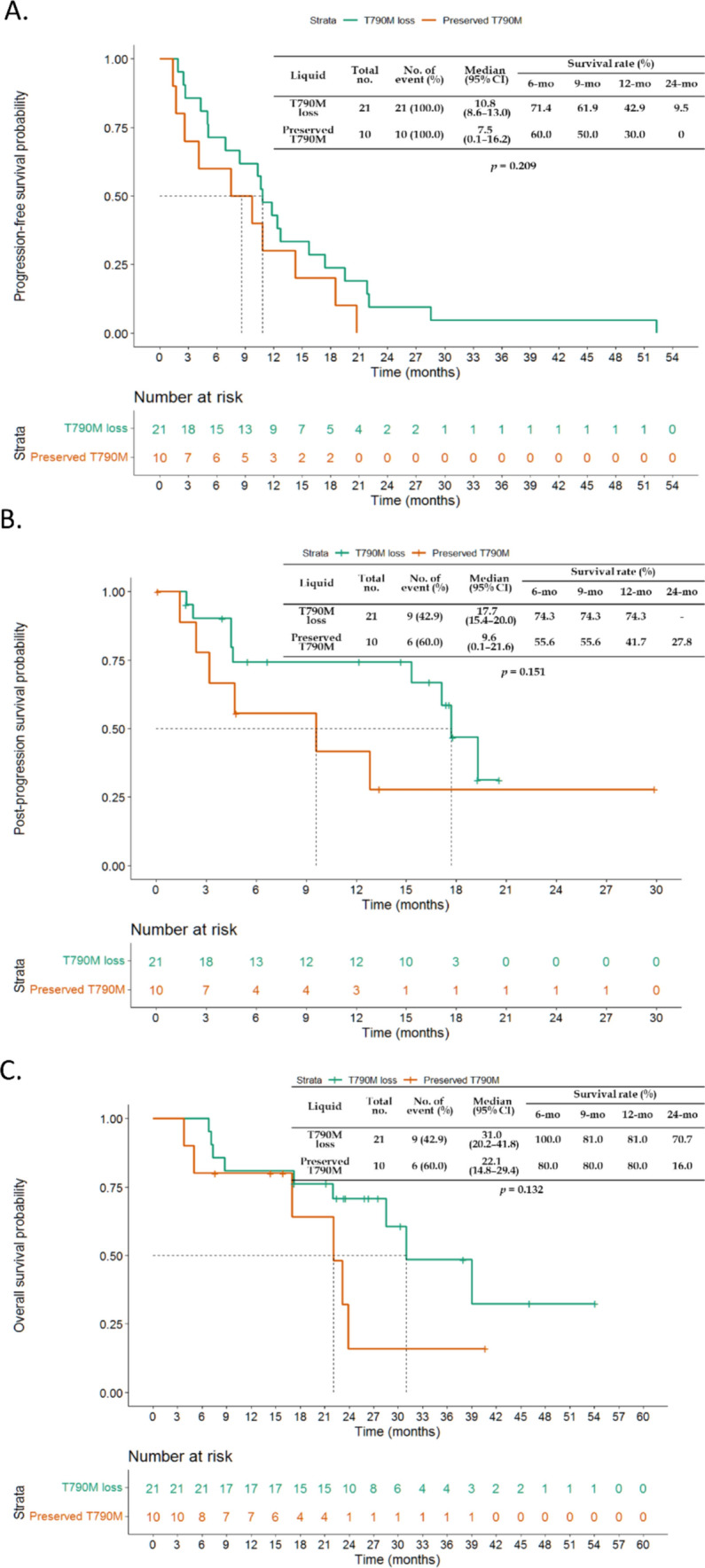
With respect to the T790M mutation status, the preservation and loss rates were 33% and 67%, respectively, in both liquid and tissue biopsy samples. Five patients (16.1%) had the C797S mutation (4 liquid samples and 1 tissue sample). Two (6.5%) had MET mutations, 3 (9.7%) had BRAF-V600E mutations, and 1 (3.2%) had a KRAS-G12C mutation. Among the 18 patients who underwent tissue rebiopsies, those with preserved T790M mutation had significantly longer progression-free survival (PFS) with osimertinib therapy than those with T790M mutation loss (10.8 vs. 5.0 months, P = 0.045). Among all patients, those with T790M mutation loss in liquid biopsy samples had longer PFS after osimertinib therapy (10.8 vs. 7.5 months, P = 0.209) and postprogression survival (17.7 vs. 9.6 months, P = 0.132) than those with preserved T790M mutation based on liquid biopsies.
NGS using either tissue or liquid biopsy samples from advanced T790M-mutated NSCLC patients with acquired resistance to osimertinib therapy can detect various genomic alternations. Future studies focusing on subsequent tailored therapies on the basis of NGS results are warranted.
晚期T790M突变型非小细胞肺癌(NSCLC)患者对奥希替尼治疗产生耐药后的基因组改变复杂,目前了解较少。在本研究中,我们旨在通过对组织和液体活检样本进行全面的二代测序(NGS)来检测这些基因组改变。
2020年9月至2021年6月,招募了31例IIIB/IV期T790M突变型NSCLC患者,这些患者在接受奥希替尼治疗后出现疾病进展,并提供了书面知情同意书。分别从31例和18例患者中收集用于NGS检测的液体和组织活检样本。18例研究患者有组织和液体活检的配对NGS数据。
就T790M突变状态而言,液体和组织活检样本中的保留率和丢失率分别为33%和67%。5例患者(16.1%)发生C797S突变(4例液体样本和1例组织样本)。2例(6.5%)发生MET突变,3例(9.7%)发生BRAF-V600E突变,1例(3.2%)发生KRAS-G12C突变。在18例接受组织再次活检的患者中,T790M突变保留的患者接受奥希替尼治疗的无进展生存期(PFS)显著长于T790M突变丢失的患者(10.8个月对5.0个月,P = 0.045)。在所有患者中,基于液体活检,液体活检样本中T790M突变丢失的患者在接受奥希替尼治疗后的PFS(10.8个月对7.5个月,P = 0.209)和疾病进展后生存期(17.7个月对9.6个月,P = 0.132)长于T790M突变保留的患者。
对奥希替尼治疗获得性耐药的晚期T790M突变型NSCLC患者,使用组织或液体活检样本进行NGS检测可发现各种基因组改变。有必要开展未来研究,基于NGS结果进行后续的精准治疗。