Epidemiology of Infectious Diseases, Sciensano, Brussels, Belgium.
I-BioStat, Data Science Institute, Hasselt University, Hasselt, Belgium.
Front Public Health. 2024 Sep 10;12:1429021. doi: 10.3389/fpubh.2024.1429021. eCollection 2024.
Following harmonization efforts by the Belgian National Reference Center for SARS-CoV-2, semi-quantitative PCR test (SQ-PCR) results, used as a proxy for viral load, were routinely collected after performing RT-qPCR tests.
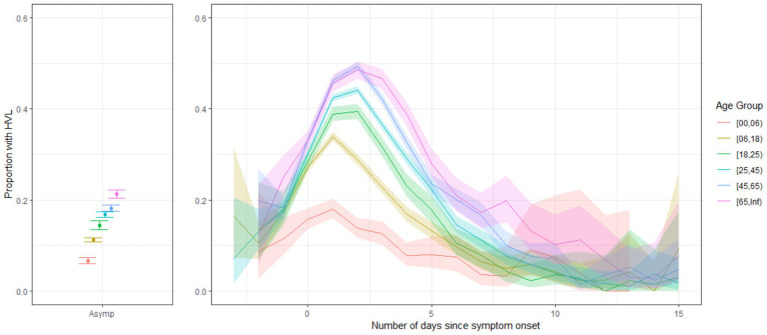
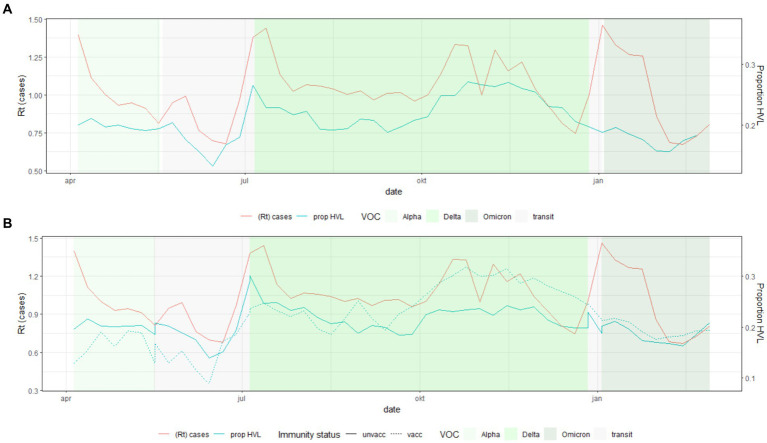
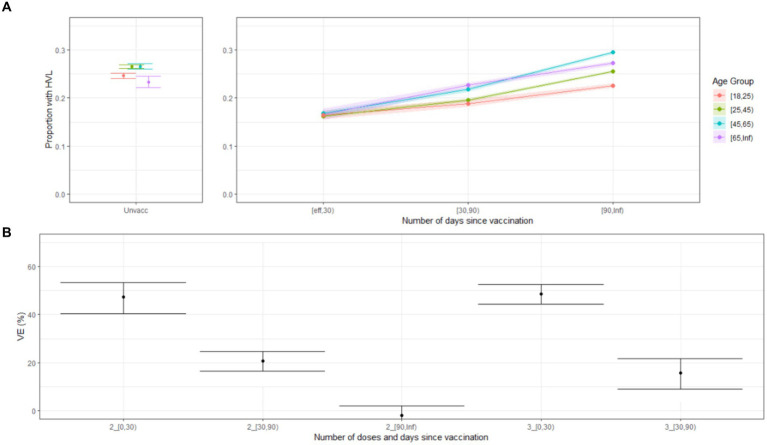
We investigated both the personal characteristics associated with SQ-PCR results and the transmission dynamics involving these results. We used person-level laboratory test data and contact tracing data collected in Belgium from March 2021 to February 2022. Personal characteristics (age, sex, vaccination, and laboratory-confirmed prior infection) and disease stage by date of symptom onset were analyzed in relation to SQ-PCR results using logistic regression. Vaccine effectiveness (VE) against a high viral load (≥10 copies/mL) was estimated from the adjusted probabilities. Contact tracing involves the mandatory testing of high-risk exposure contacts (HREC) after contact with an index case. Odds ratios for test positivity and high viral load in HREC were calculated based on the SQ-PCR result of the index case using logistic regression models adjusted for age, sex, immunity status (vaccination, laboratory-confirmed prior infection), variant (Alpha, Delta, Omicron), calendar time, and contact tracing covariates.
We included 909,157 SQ-PCR results of COVID-19 cases, 379,640 PCR results from index cases, and 72,052 SQ-PCR results of HREC. High viral load was observed more frequently among recent cases, symptomatic cases, cases over 25 years of age, and those not recently vaccinated (>90 days). The vaccine effectiveness (VE) of the primary schedule in the first 30 days after vaccination was estimated at 47.3% (95%CI 40.8-53.2) during the Delta variant period. A high viral load in index cases was associated with an increased test positivity in HREC (OR 2.7, 95%CI 2.62-2.79) and, among those testing positive, an increased likelihood of a high viral load (OR 2.84, 95%CI 2.53-3.19).
在比利时国家 SARS-CoV-2 参考中心进行协调努力之后,半定量 PCR 检测(SQ-PCR)结果作为病毒载量的替代指标,在进行 RT-qPCR 检测后被常规收集。
我们调查了与 SQ-PCR 结果相关的个人特征以及涉及这些结果的传播动态。我们使用了 2021 年 3 月至 2022 年 2 月期间在比利时收集的个人层面的实验室检测数据和接触者追踪数据。使用逻辑回归分析了与 SQ-PCR 结果相关的个人特征(年龄、性别、疫苗接种和实验室确认的既往感染)和按发病日期划分的疾病阶段。使用调整后的概率估计了针对高病毒载量(≥10 拷贝/mL)的疫苗有效性(VE)。接触者追踪涉及对与病例接触后的高风险暴露接触者(HREC)进行强制性检测。根据病例的 SQ-PCR 结果,使用逻辑回归模型计算了 HREC 检测阳性和高病毒载量的比值比,并根据年龄、性别、免疫状态(疫苗接种、实验室确认的既往感染)、变异(Alpha、Delta、Omicron)、日历时间和接触者追踪协变量进行了调整。
我们纳入了 909157 例 COVID-19 病例的 SQ-PCR 结果、379640 例病例的 PCR 结果和 72052 例 HREC 的 SQ-PCR 结果。近期病例、有症状病例、25 岁以上病例和最近未接种疫苗(>90 天)的病例中更常观察到高病毒载量。在 Delta 变异期,接种疫苗后 30 天内的初级方案疫苗有效性估计为 47.3%(95%CI 40.8-53.2)。病例的高病毒载量与 HREC 检测阳性率增加相关(比值比 2.7,95%CI 2.62-2.79),在检测阳性的病例中,高病毒载量的可能性增加(比值比 2.84,95%CI 2.53-3.19)。