Stetzel Leah, Foucher Florence, Jang Seung Jin, Wu Tai-Hsien, Fields Henry, Schumacher Fernanda, Richmond Stephen, Ko Ching-Chang
Division of Orthodontics, The Ohio State University, 305 W. 12th Avenue, Columbus, OH 43210, USA.
Division of Biostatistics, The Ohio State University, 1841 Neil Avenue, Columbus, OH 43210, USA.
Bioengineering (Basel). 2024 Aug 23;11(9):861. doi: 10.3390/bioengineering11090861.
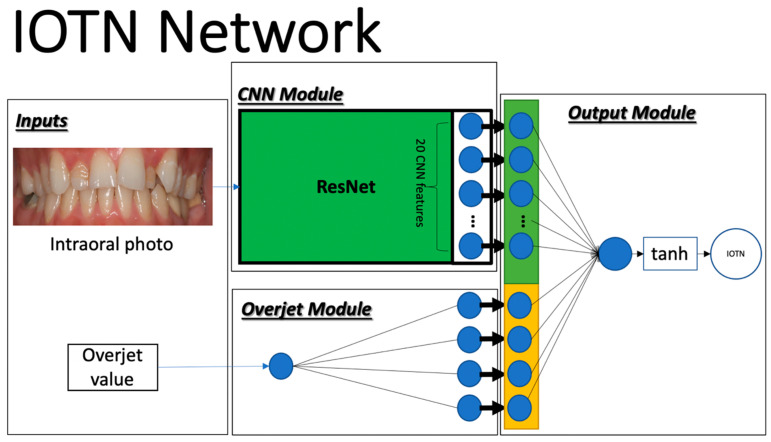
The aesthetic component (AC) of the Index of Orthodontic Treatment Need (IOTN) is internationally recognized as a reliable and valid method for assessing aesthetic treatment need. The objective of this study is to use artificial intelligence (AI) to automate the AC assessment. A total of 1009 pre-treatment frontal intraoral photos with overjet values were collected. Each photo was graded by an experienced calibration clinician. The AI was trained using the intraoral images, overjet, and two other approaches. For Scheme 1, the training data were AC 1-10. For Scheme 2, the training data were either the two groups AC 1-5 and AC 6-10 or the three groups AC 1-4, AC 5-7, and AC 8-10. Sensitivity, specificity, positive predictive value, negative predictive value, and accuracy were measured for all approaches. The performance was tested without overjet values as input. The intra-rater reliability for the grader, using kappa, was 0.84 (95% CI 0.76-0.93). Scheme 1 had 77% sensitivity, 88% specificity, 82% accuracy, 89% PPV, and 75% NPV in predicting the binary groups. All other schemes offered poor tradeoffs. Findings after omitting overjet and dataset supplementation results were mixed, depending upon perspective. We have developed deep learning-based algorithms that can predict treatment need based on IOTN-AC reference standards; this provides an adjunct to clinical assessment of dental aesthetics.
正畸治疗需求指数(IOTN)的美学组成部分(AC)在国际上被公认为是一种评估美学治疗需求的可靠且有效的方法。本研究的目的是使用人工智能(AI)实现AC评估的自动化。总共收集了1009张带有覆盖值的治疗前口腔正面照片。每张照片由一位经验丰富的校准临床医生进行评分。使用口腔内图像、覆盖值和其他两种方法对AI进行训练。对于方案1,训练数据为AC 1 - 10。对于方案2,训练数据要么是AC 1 - 5和AC 6 - 10两组,要么是AC 1 - 4、AC 5 - 7和AC 8 - 10三组。对所有方法测量了敏感性、特异性、阳性预测值、阴性预测值和准确性。在不将覆盖值作为输入的情况下测试性能。使用kappa计算,评分者的组内信度为0.84(95%CI 0.76 - 0.93)。在预测二元组时,方案1的敏感性为77%,特异性为88%,准确性为82%,阳性预测值为89%,阴性预测值为75%。所有其他方案的权衡效果都较差。省略覆盖值和数据集补充后的结果好坏参半,取决于不同的视角。我们开发了基于深度学习的算法,该算法可以根据IOTN - AC参考标准预测治疗需求;这为牙科美学的临床评估提供了辅助手段。