Clinical Immunology Service, School of Infection, Inflammation and Immunology, University of Birmingham, Birmingham, UK.
Department of Immunology, Royal Free London NHS Foundation Trust, London, UK.
J Clin Immunol. 2024 Sep 27;45(1):18. doi: 10.1007/s10875-024-01809-3.
This study investigates the frequency of hospital attendances, emergency care attendances and geographical influences on service interaction in cohorts of patients with primary and secondary antibody deficiency, to inform future service planning and delivery.
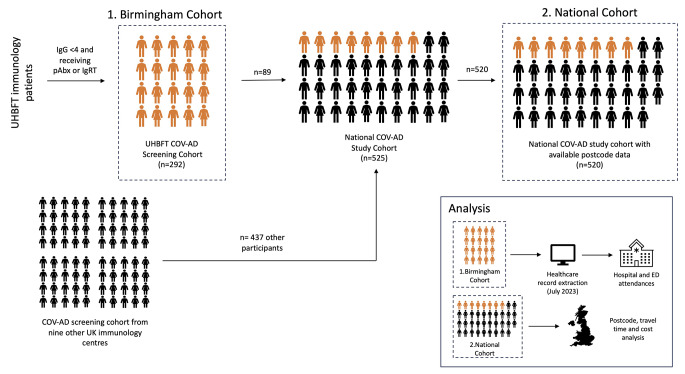
The COVID-19 in Antibody Deficiency (COV-AD) study was a United Kingdom study that enrolled 525 participants between April 2021 and September 2022. Data on health care utilisation was extracted from a screening cohort of participants at one participating site (Birmingham, UK). Hospital attendance (i.e. all outpatient and inpatient care episodes, including hospital-based IVIG treatment) and emergency care attendance patterns were analysed. Geographical differences in travel times to hospitals and associated costs were considered for all participants at all recruiting sites.
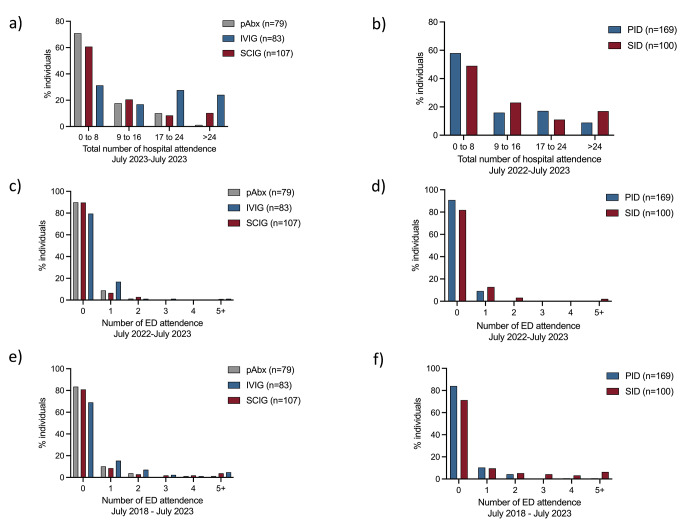
Individuals with antibody deficiency had a median of 7 hospital attendances per year. A diagnosis of secondary antibody deficiency, and antibody deficiency severe enough to require treatment with immunoglobulin replacement were associated with an increased frequency of hospital attendance. 12.7% of the cohort attended the Emergency Department at least once in the preceding twelve months. Individuals with secondary antibody deficiency were at greater risk of requiring emergency care over the preceding one-year and five-year periods. Individuals receiving subcutaneous immunoglobulin lived further from their local immunology centre and were more likely to engage with the COV-AD research study remotely, via dried blood spots sampling.
This study highlights the utilisation of emergency and secondary care usage amongst patient with immunodeficiency and may inform service adaptation and development to better accommodate patient needs and circumstances.
本研究调查了原发性和继发性抗体缺陷患者队列中因就诊频率、急诊就诊和地理因素对服务交互的影响,以为未来的服务规划和提供提供信息。
COVID-19 与抗体缺陷(COV-AD)研究是一项英国研究,于 2021 年 4 月至 2022 年 9 月期间招募了 525 名参与者。在参与研究的一个地点(英国伯明翰)的参与者筛查队列中提取了关于医疗保健利用的数据。分析了医院就诊(即所有门诊和住院治疗,包括基于医院的 IVIG 治疗)和急诊就诊模式。考虑了所有参与者在所有招募地点到医院的旅行时间和相关费用的地理差异。
抗体缺陷个体的年平均就诊次数中位数为 7 次。继发性抗体缺陷诊断和严重到需要免疫球蛋白替代治疗的抗体缺陷与就诊频率增加有关。队列中有 12.7%的人在过去 12 个月中至少有一次去急诊就诊。过去一年和五年期间,继发性抗体缺陷患者更有可能需要急诊治疗。接受皮下免疫球蛋白治疗的个体距离当地免疫学中心更远,更有可能通过干血斑采样远程参与 COV-AD 研究。
本研究强调了免疫缺陷患者对急诊和二级护理的利用,可能为服务调整和发展提供信息,以更好地满足患者的需求和情况。