Landry Mathieu, da Silva Castanheira Jason, Rousseaux Floriane, Rainville Pierre, Ogez David, Jerbi Karim
Département de Psychologie, Université du Québec à Trois-Rivières, Trois-Rivières, QC G9A 5H7, Canada.
Department of Experimental Psychology, University College London, London WC1E 6BT, UK.
Brain Sci. 2024 Aug 30;14(9):883. doi: 10.3390/brainsci14090883.
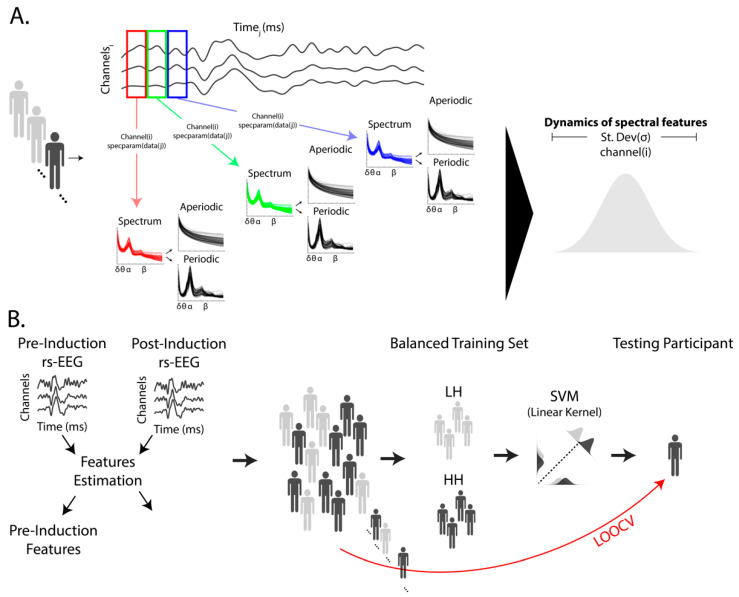
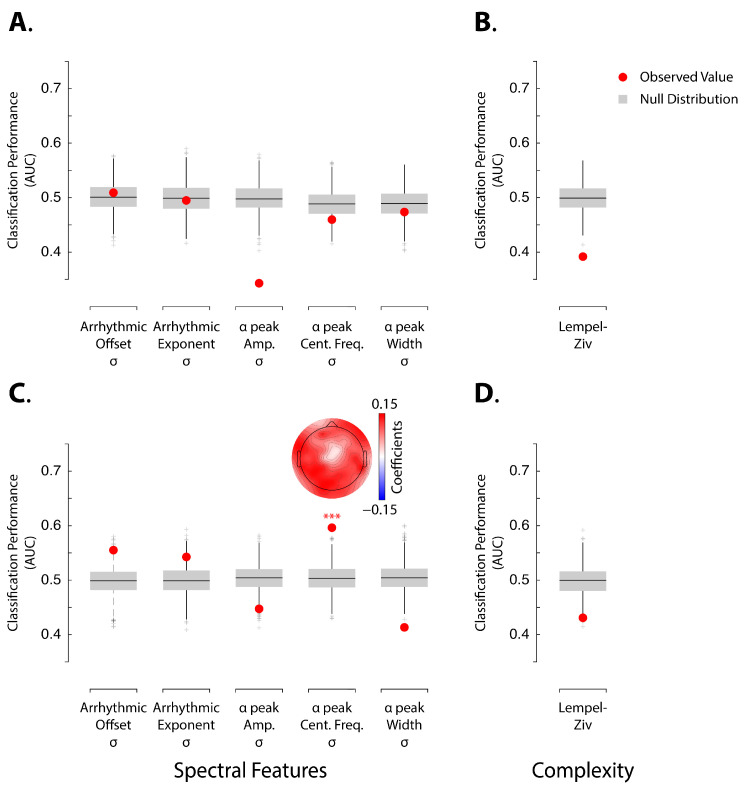
Hypnotic phenomena exhibit significant inter-individual variability, with some individuals consistently demonstrating efficient responses to hypnotic suggestions, while others show limited susceptibility. Recent neurophysiological studies have added to a growing body of research that shows variability in hypnotic susceptibility is linked to distinct neural characteristics. Building on this foundation, our previous work identified that individuals with high and low hypnotic susceptibility can be differentiated based on the arrhythmic activity observed in resting-state electrophysiology (rs-EEG) outside of hypnosis. However, because previous work has largely focused on mean spectral characteristics, our understanding of the variability over time of these features, and how they relate to hypnotic susceptibility, is still limited. Here we address this gap using a time-resolved assessment of rhythmic alpha peaks and arrhythmic components of the EEG spectrum both prior to and following hypnotic induction. Using multivariate pattern classification, we investigated whether these neural features differ between individuals with high and low susceptibility to hypnosis. Specifically, we used multivariate pattern classification to investigate whether these non-stationary neural features could distinguish between individuals with high and low susceptibility to hypnosis before and after a hypnotic induction. Our analytical approach focused on time-resolved spectral decomposition to capture the intricate dynamics of neural oscillations and their non-oscillatory counterpart, as well as Lempel-Ziv complexity. Our results show that variations in the alpha center frequency are indicative of hypnotic susceptibility, but this discrimination is only evident during hypnosis. Highly hypnotic-susceptible individuals exhibit higher variability in alpha peak center frequency. These findings underscore how dynamic changes in neural states related to alpha peak frequency represent a central neurophysiological feature of hypnosis and hypnotic susceptibility.
催眠现象表现出显著的个体间差异,一些个体始终对催眠暗示表现出有效的反应,而另一些个体的易受催眠性则有限。最近的神经生理学研究进一步丰富了越来越多的研究成果,这些研究表明催眠易感性的差异与不同的神经特征有关。在此基础上,我们之前的研究发现,高催眠易感性和低催眠易感性的个体可以根据催眠之外的静息态电生理学(rs-EEG)中观察到的无节律活动来区分。然而,由于之前的研究主要集中在平均频谱特征上,我们对这些特征随时间的变化以及它们与催眠易感性的关系的理解仍然有限。在这里,我们通过对催眠诱导前后脑电图频谱的节律性阿尔法峰值和无节律成分进行时间分辨评估来填补这一空白。使用多变量模式分类,我们研究了这些神经特征在高催眠易感性和低催眠易感性个体之间是否存在差异。具体来说,我们使用多变量模式分类来研究这些非平稳神经特征在催眠诱导前后是否能够区分高催眠易感性和低催眠易感性的个体。我们的分析方法侧重于时间分辨频谱分解,以捕捉神经振荡及其非振荡对应物的复杂动态,以及莱姆普尔-齐夫复杂度。我们的结果表明,阿尔法中心频率的变化表明了催眠易感性,但这种区分仅在催眠期间明显。高催眠易感性个体在阿尔法峰值中心频率上表现出更高的变异性。这些发现强调了与阿尔法峰值频率相关的神经状态的动态变化如何代表催眠和催眠易感性的核心神经生理特征。