Basso Valentina, Döbrössy Máté D, Thompson Lachlan H, Kirik Deniz, Fuller Heidi R, Gates Monte A
School of Medicine, Keele University, Staffordshire ST5 5BG, UK.
Laboratory of Stereotaxy and Interventional Neurosciences, Department of Stereotactic and Functional, Neurosurgery, Medical Center, University of Freiburg, 79106 Freiburg im Breisgau, Germany.
Biology (Basel). 2024 Sep 3;13(9):690. doi: 10.3390/biology13090690.
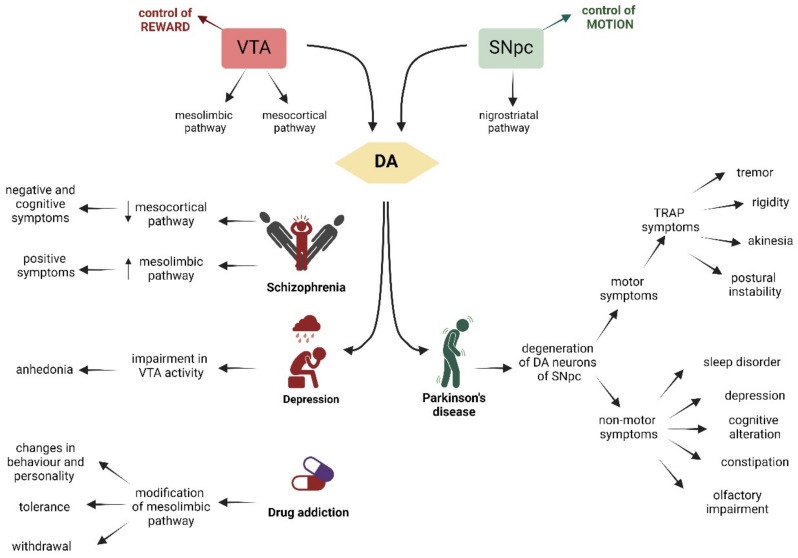
Dopaminergic neurons in the ventral tegmental area (VTA) and the substantia nigra pars compacta (SNpc) comprise around 75% of all dopaminergic neurons in the human brain. While both groups of dopaminergic neurons are in close proximity in the midbrain and partially overlap, development, function, and impairments in these two classes of neurons are highly diverse. The molecular and cellular mechanisms underlying these differences are not yet fully understood, but research over the past decade has highlighted the need to differentiate between these two classes of dopaminergic neurons during their development and in the mature brain. This differentiation is crucial not only for understanding fundamental circuitry formation in the brain but also for developing therapies targeted to specific dopaminergic neuron classes without affecting others. In this review, we summarize the state of the art in our understanding of the differences between the dopaminergic neurons of the VTA and the SNpc, such as anatomy, structure, morphology, output and input, electrophysiology, development, and disorders, and discuss the current technologies and methods available for studying these two classes of dopaminergic neurons, highlighting their advantages, limitations, and the necessary improvements required to achieve more-precise therapeutic interventions.
腹侧被盖区(VTA)和黑质致密部(SNpc)中的多巴胺能神经元约占人类大脑中所有多巴胺能神经元的75%。虽然这两组多巴胺能神经元在中脑位置相邻且部分重叠,但这两类神经元的发育、功能及损伤情况却大不相同。造成这些差异的分子和细胞机制尚未完全明确,但过去十年的研究凸显了在这两类多巴胺能神经元的发育过程及成熟大脑中区分它们的必要性。这种区分不仅对于理解大脑基本神经回路的形成至关重要,而且对于开发针对特定多巴胺能神经元类别且不影响其他神经元的治疗方法也至关重要。在这篇综述中,我们总结了目前对VTA和SNpc多巴胺能神经元之间差异的理解现状,如解剖结构、形态、输出与输入、电生理学、发育及疾病等方面,并讨论了目前可用于研究这两类多巴胺能神经元的技术和方法,强调了它们的优势、局限性以及为实现更精确的治疗干预所需的必要改进。