
肠道上皮芳香烃受体表达和 3,3'-二吲哚甲烷在结肠三级淋巴组织形成中的作用。
Involvement of Intestinal Epithelium Aryl Hydrocarbon Receptor Expression and 3, 3'-Diindolylmethane in Colonic Tertiary Lymphoid Tissue Formation.
机构信息
Department of Nutrition, Texas A&M University, College Station, TX 77843, USA.
Department of Nutrition, University of North Carolina Greensboro, Greensboro, NC 27412, USA.
出版信息
Int J Mol Sci. 2024 Sep 21;25(18):10153. doi: 10.3390/ijms251810153.
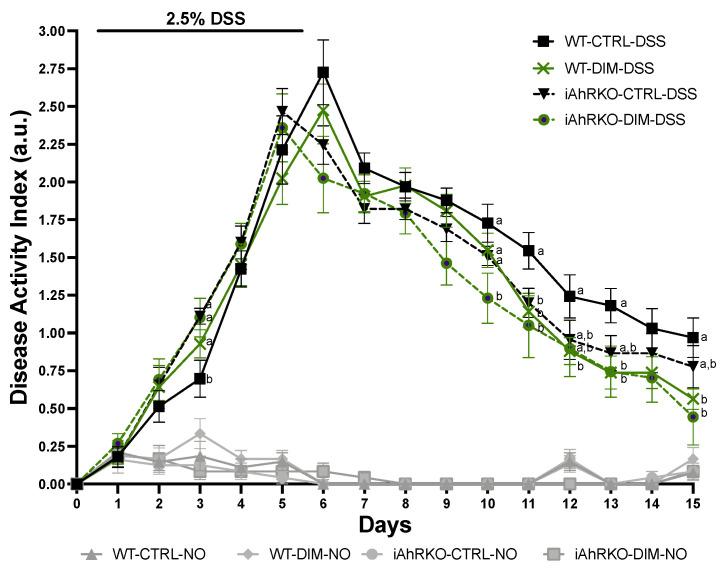
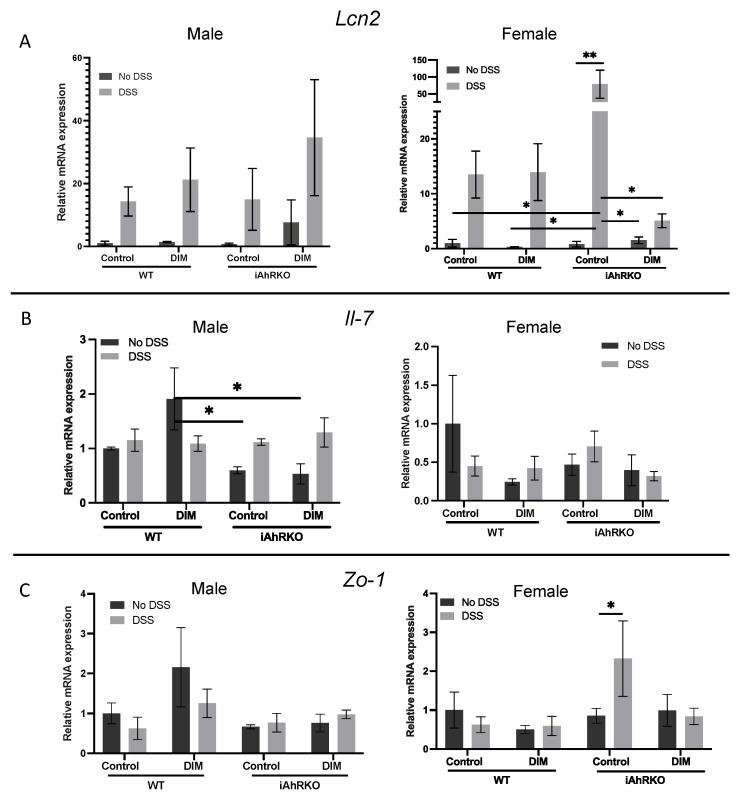
Tertiary lymphoid tissues (TLTs) are adaptive immune structures that develop during chronic inflammation and may worsen or lessen disease outcomes in a context-specific manner. Immune cell activity governing TLT formation in the intestines is dependent on immune cell aryl hydrocarbon receptor (AhR) activation. Homeostatic immune cell activity in the intestines is further dependent on ligand activation of AhR in intestinal epithelial cells (IECs), yet whether AhR activation and signaling in IECs influences the formation of TLTs in the presence of dietary AhR ligands is not known. To this end, we used IEC-specific AhR deletion coupled with a mouse model of dextran sodium sulfate (DSS)-induced colitis to understand how dietary AhR ligand 3, 3'-diindolylmethane (DIM) influenced TLT formation. DIM consumption increased the size of TLTs and decreased T-cell aggregation to TLT sites in an IEC-specific manner. In DSS-exposed female mice, DIM consumption increased the expression of genes implicated in TLT formation (Interleukin-22, ; CXC motif chemokine ligand 13, ) in an IEC AhR-specific manner. Conversely, in female mice without DSS exposure, DIM significantly reduced the expression of or in iAhRKO mice, but this effect was not observed in WT animals. Our findings suggest that DIM affects the immunological landscape of TLT formation during DSS-induced colitis in a manner contingent on AhR expression in IECs and biological sex. Further investigations into specific immune cell activity, IEC-specific AhR signaling pathways, and dietary AhR ligand-mediated effects on TLT formation are warranted.
三级淋巴组织 (TLTs) 是在慢性炎症过程中形成的适应性免疫结构,可能以特定于上下文的方式加重或减轻疾病结局。肠道中调节 TLT 形成的免疫细胞活性依赖于免疫细胞芳香烃受体 (AhR) 的激活。肠道中稳态免疫细胞活性进一步依赖于肠道上皮细胞 (IECs) 中 AhR 的配体激活,然而,IEC 中 AhR 的激活和信号转导是否影响膳食 AhR 配体存在下 TLT 的形成尚不清楚。为此,我们使用 IEC 特异性 AhR 缺失与葡聚糖硫酸钠 (DSS) 诱导的结肠炎小鼠模型相结合,以了解膳食 AhR 配体 3,3'-二吲哚甲烷 (DIM) 如何影响 TLT 的形成。DIM 的消耗以 IEC 特异性的方式增加了 TLT 的大小并减少了 T 细胞在 TLT 部位的聚集。在 DSS 暴露的雌性小鼠中,DIM 的消耗以 IEC AhR 特异性的方式增加了与 TLT 形成相关的基因(白细胞介素-22 , ; CXC 基序趋化因子配体 13 , )的表达。相反,在未暴露于 DSS 的雌性小鼠中,DIM 显著降低了 iAhRKO 小鼠中 或 的表达,但在 WT 动物中未观察到这种效应。我们的研究结果表明,DIM 以依赖于 IEC 中 AhR 表达和生物性别方式影响 DSS 诱导的结肠炎中 TLT 形成的免疫景观。需要进一步研究特定的免疫细胞活性、IEC 特异性 AhR 信号通路以及膳食 AhR 配体对 TLT 形成的影响。





 Zotero 插件