De Corso Eugenio, Mele Dario Antonio, Rizzi Angela, Spanu Camilla, Corbò Marco, Pisciottano Serena, Mastrapasqua Rodolfo Francesco, Baroni Silvia, Porru Davide Paolo, De Maio Gabriele, Rizzuti Alberta, Di Bella Giuseppe Alberto, Ortolan Augusta, Bonini Matteo, Cefaloni Francesca, Boccabella Cristina, Lombardi Francesco, Chini Raffaella, Caruso Cristiano, Panfili Marco, Galli Jacopo
UOC Otorinolaringoiatria, Fondazione Policlinico Universitario Agostino Gemelli-IRCCS, 00168 Roma, Italy.
Department of Head-Neck and Sensory Organs, Università Cattolica del Sacro Cuore, 00168 Rome, Italy.
J Pers Med. 2024 Sep 23;14(9):1014. doi: 10.3390/jpm14091014.
BACKGROUND/OBJECTIVES: Benralizumab is a monoclonal antibody that targets the interleukin-5 receptor (IL-5Rα), leading to the rapid depletion of blood eosinophils. RCTs have demonstrated efficacy in patients with severe eosinophilic asthma (SEA). The aim of this study was to assess the efficacy of benralizumab on sinonasal outcomes in a real-life setting in patients with SEA and concomitant chronic rhinosinusitis with nasal polyps (CRSwNP).
We included 25 patients (mean age: 57.47 years, range: 35-77, F/M = 12:13) who were prescribed 30 mg benralizumab every month for the first three administrations and then every 2 months. The primary endpoint was to evaluate changes in the SinoNasal Outcome Test-22 (SNOT-22) and nasal polyp score (NPS) over a 24-month treatment period. Secondary endpoints included measuring the effects on nasal obstruction and impaired sense of smell.
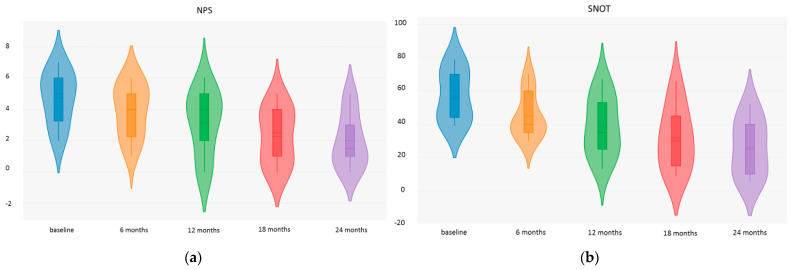
The mean NPS score decreased significantly from 5.11 ± 1.84 at baseline to 2.37 ± 1.96 at 24 months. The mean SNOT-22 decreased from 57 ± 15.30 at baseline to 26 ± 16.73 at 24 months. The SSIT-16 mean score improved with an increase in olfactory performance from 5.23 ± 2.58 at baseline to 7 ± 3.65 at 24 months. Moreover, 8/25 patients (32%) required rescue treatment with systemic steroids and 2 patients required endoscopic sinus surgery.
While the improvement may not seem optimal at 12 months, a progressive enhancement was noted during the second year of treatment. Despite our data showing an improvement in quality of life and a reduction in the size of nasal polyps, no significant improvement in olfactory sensitivity was observed. In addition, in several patients, rescue treatments were required to maintain control of nasal and sinus symptoms. A careful risk-benefit assessment is therefore needed when deciding to continue treatment, weighing the potential for further improvement against the risks of complications. Such decisions should always be made in the context of a multidisciplinary team.
背景/目的:贝那利珠单抗是一种靶向白细胞介素-5受体(IL-5Rα)的单克隆抗体,可导致血液嗜酸性粒细胞迅速减少。随机对照试验已证明其对重度嗜酸性粒细胞性哮喘(SEA)患者有效。本研究的目的是评估在现实生活中,贝那利珠单抗对SEA合并慢性鼻-鼻窦炎伴鼻息肉(CRSwNP)患者鼻窦结局的疗效。
我们纳入了25例患者(平均年龄:57.47岁,范围:35 - 77岁,女性/男性 = 12:13),前三次给药时每月给予30 mg贝那利珠单抗,之后每2个月给药一次。主要终点是评估在24个月的治疗期内,鼻窦结局测试-22(SNOT-22)和鼻息肉评分(NPS)的变化。次要终点包括测量对鼻塞和嗅觉障碍的影响。
平均NPS评分从基线时的5.11±1.84显著降至24个月时的2.37±1.96。平均SNOT-22从基线时的57±15.30降至24个月时的26±16.73。嗅觉功能改善,嗅觉识别测试-16(SSIT-16)平均评分从基线时的5.23±2.58提高到24个月时的7±3.65。此外,25例患者中有8例(32%)需要全身用类固醇进行急救治疗,2例患者需要接受鼻内镜鼻窦手术。
虽然在12个月时改善效果可能不明显,但在治疗的第二年观察到有逐步改善。尽管我们的数据显示生活质量有所改善,鼻息肉大小有所减小,但未观察到嗅觉敏感性有显著改善。此外,在一些患者中,需要进行急救治疗以维持对鼻和鼻窦症状的控制。因此,在决定是否继续治疗时,需要仔细进行风险效益评估,权衡进一步改善的可能性与并发症风险。此类决策应始终在多学科团队的背景下做出。