Zhang Hui, Song Yu, Hu Jingfang, Li Yansheng, Li Yang, Gao Guowei
Beijing Key Laboratory of Sensor, Beijing Information Science & Technology University, Beijing 100101, China.
Key Laboratory of Modern Measurement and Control Technology, Ministry of Education, Beijing Information Science and Technology University, Beijing 100192, China.
Sensors (Basel). 2024 Sep 13;24(18):5959. doi: 10.3390/s24185959.
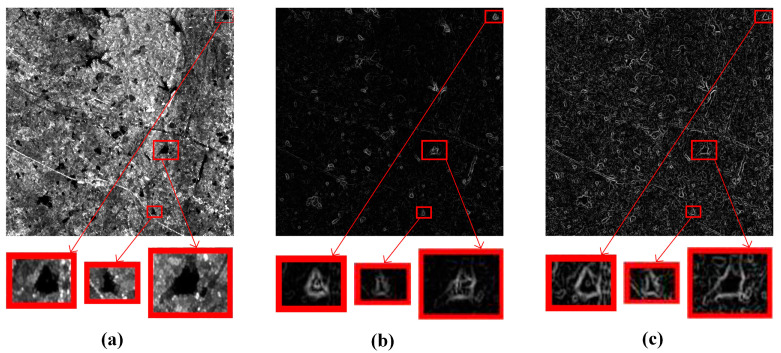
Optical and synthetic aperture radar (SAR) images exhibit non-negligible intensity differences due to their unique imaging mechanisms, which makes it difficult for classical SIFT-based algorithms to obtain sufficiently correct correspondences when processing the registration of these two types of images. To tackle this problem, an accurate optical and SAR image registration algorithm based on the SIFT algorithm (OS-PSO) is proposed. First, a modified ratio of exponentially weighted averages (MROEWA) operator is introduced to resolve the sudden dark patches in SAR images, thus generating more consistent gradients between optical and SAR images. Next, we innovatively construct the Harris scale space to replace the traditional difference in the Gaussian (DoG) scale space, identify repeatable key-points by searching for local maxima, and perform localization refinement on the identified key-points to improve their accuracy. Immediately after that, the gradient location orientation histogram (GLOH) method is adopted to construct the feature descriptors. Finally, we propose an enhanced matching method. The transformed relation is obtained in the initial matching stage using the nearest neighbor distance ratio (NNDR) and fast sample consensus (FSC) methods. And the re-matching takes into account the location, scale, and main direction of key-points to increase the number of correctly corresponding points. The proposed OS-PSO algorithm has been implemented on the Gaofen and Sentinel series with excellent results. The superior performance of the designed registration system can also be applied in complex scenarios, including urban, suburban, river, farmland, and lake areas, with more efficiency and accuracy than the state-of-the-art methods based on the WHU-OPT-SAR dataset and the BISTU-OPT-SAR dataset.
光学图像和合成孔径雷达(SAR)图像由于其独特的成像机制而呈现出不可忽略的强度差异,这使得经典的基于尺度不变特征变换(SIFT)的算法在处理这两类图像的配准时难以获得足够正确的对应关系。为了解决这个问题,提出了一种基于SIFT算法的精确光学与SAR图像配准算法(OS-PSO)。首先,引入改进的指数加权平均比(MROEWA)算子来解决SAR图像中的突然暗斑问题,从而在光学图像和SAR图像之间生成更一致的梯度。接下来,我们创新性地构建哈里斯尺度空间来取代传统的高斯差分(DoG)尺度空间,通过搜索局部最大值来识别可重复的关键点,并对识别出的关键点进行定位细化以提高其准确性。紧接着,采用梯度位置方向直方图(GLOH)方法构建特征描述符。最后,我们提出一种增强匹配方法。在初始匹配阶段使用最近邻距离比(NNDR)和快速样本一致性(FSC)方法获得变换关系。并且重新匹配考虑了关键点的位置、尺度和主方向,以增加正确对应点的数量。所提出的OS-PSO算法已在高分系列和哨兵系列上实现,取得了优异的结果。所设计的配准系统的卓越性能也可应用于复杂场景,包括城市、郊区、河流、农田和湖泊区域,比基于WHU-OPT-SAR数据集和BISTU-OPT-SAR数据集的现有方法更高效、准确。