Barth Maximilian, Werner Magdalena, Otto Pascal, Richwien Benjamin, Bahramsari Samira, Krause Maximilian, Schwan Benjamin, Abendroth Christian
Institute for Waste Management and Circular Economy, TUD Dresden University of Technology, Pirna, Germany.
Robert Boyle Institute e.V, Jena, Germany.
Biotechnol Biofuels Bioprod. 2024 Sep 28;17(1):123. doi: 10.1186/s13068-024-02573-7.
The integration of anaerobic digestion into bio-based industries can create synergies that help render anaerobic digestion self-sustaining. Two-stage digesters with separate acidification stages allow for the production of green hydrogen and short-chain fatty acids, which are promising industrial products. Heat shocks can be used to foster the production of these products, the practical applicability of this treatment is often not addressed sufficiently, and the presented work therefore aims to close this gap.
Batch experiments were conducted in 5 L double-walled tank reactors incubated at 37 °C. Short microwave heat shocks of 25 min duration and exposure times of 5-10 min at 80 °C were performed and compared to oven heat shocks. Pairwise experimental group differences for gas production and chemical parameters were determined using ANOVA and post-hoc tests. High-throughput 16S rRNA gene amplicon sequencing was performed to analyse taxonomic profiles.
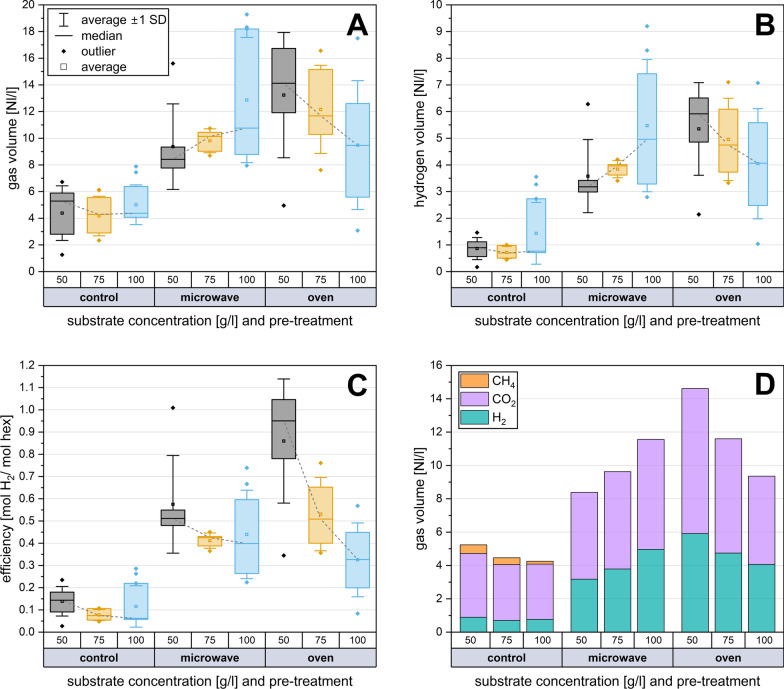
After heat-shocking the entire seed sludge, the highest hydrogen productivity was observed at a substrate load of 50 g/l with 1.09 mol H/mol hexose. With 1.01 mol H/mol hexose, microwave-assisted treatment was not significantly different from oven-based treatments. This study emphasised the better repeatability of heat shocks with microwave-assisted experiments, revealing low variation coefficients averaging 29%. The pre-treatment with microwaves results in a high predictability and a stronger microbial community shift to Clostridia compared to the treatment with the oven. The pre-treatment of heat shocks supported the formation of butyric acid up to 10.8 g/l on average, with a peak of 24.01 g/l at a butyric/acetic acid ratio of 2.0.
The results support the suitability of using heat shock for the entire seed sludge rather than just a small inoculum, making the process more relevant for industrial applications. The performed microwave-based treatment has proven to be a promising alternative to oven-based treatments, which ultimately may facilitate their implementation into industrial systems. This approach becomes economically sustainable with high-temperature heat pumps with a coefficient of performance (COP) of 4.3.
将厌氧消化整合到生物基产业中可产生协同效应,有助于使厌氧消化实现自我维持。具有独立酸化阶段的两级消化器能够生产绿色氢气和短链脂肪酸,这些都是很有前景的工业产品。热休克可用于促进这些产品的生产,但这种处理方法的实际适用性往往未得到充分探讨,因此本研究旨在填补这一空白。
在5升双层罐式反应器中进行批次实验,反应器在37℃下培养。进行了持续25分钟的短微波热休克处理,并在80℃下暴露5 - 10分钟,同时与烘箱热休克处理进行比较。使用方差分析和事后检验确定产气和化学参数的成对实验组差异。进行高通量16S rRNA基因扩增子测序以分析分类学概况。
对整个种子污泥进行热休克处理后,在底物负荷为50 g/l时观察到最高氢气产率,为1.09 mol H/mol己糖。微波辅助处理的氢气产率为1.01 mol H/mol己糖,与烘箱处理无显著差异。本研究强调了微波辅助实验热休克处理具有更好的可重复性,变异系数平均较低,为29%。与烘箱处理相比,微波预处理具有更高的可预测性,并且微生物群落向梭菌属的转移更强。热休克预处理平均支持丁酸形成量高达10.8 g/l,在丁酸/乙酸比为2.0时峰值为24.01 g/l。
结果支持对整个种子污泥而非仅对少量接种物使用热休克处理,这使得该过程在工业应用中更具相关性。所进行的微波处理已被证明是烘箱处理的一种有前景的替代方法,最终可能有助于将其应用于工业系统。采用性能系数(COP)为4.3的高温热泵,这种方法在经济上具有可持续性。