Department of Neurology, Dongguk University Ilsan Hospital, 52-6 Dongguk-Ro, Ilsandong-Gu, Goyang-si, Gyeonggi-do, 10326, Republic of Korea.
National Priority Research Center for Stroke, Goyang, Republic of Korea.
Sci Rep. 2024 Sep 29;14(1):22567. doi: 10.1038/s41598-024-71936-9.
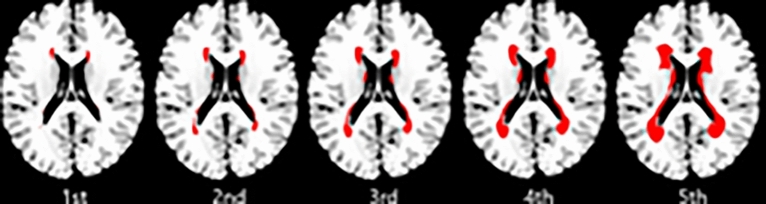
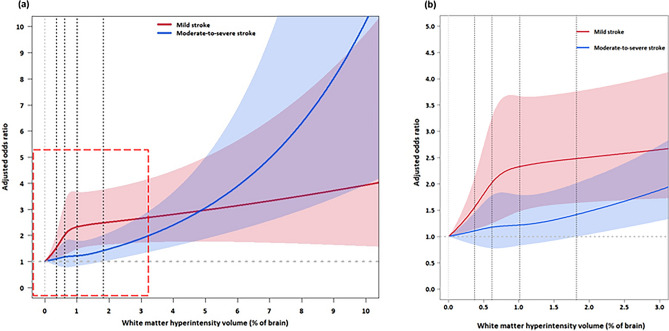
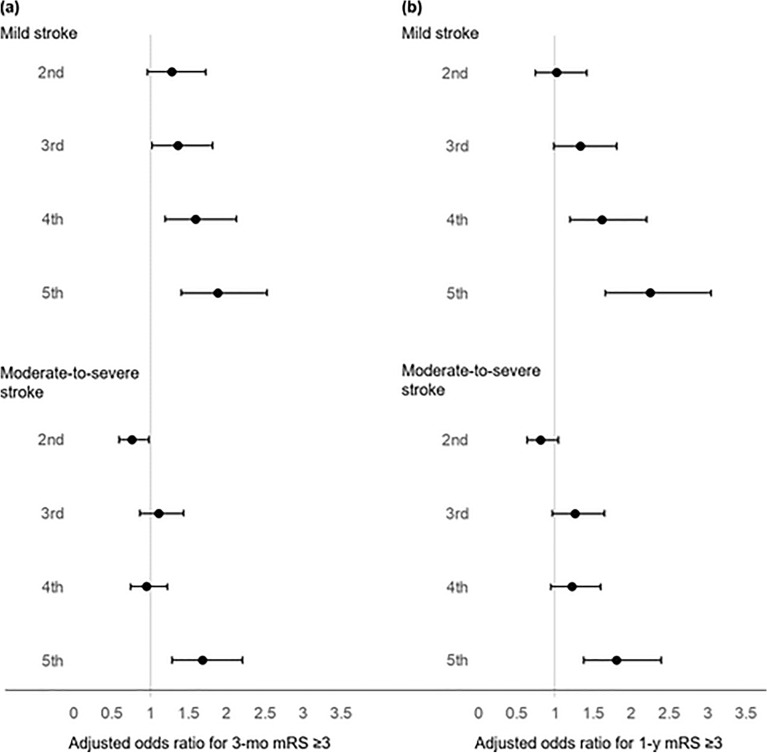
It is uncertain whether the prognostic power of white matter hyperintensity (WMH) on post-stroke outcomes is modulated as a function of initial neurological severity, a critical determinant of outcome after stroke. This multi-center MRI study tested if higher WMH quintiles were associated with 3-month poor functional outcome (modified Rankin Scale ≥ 3) for mild versus moderate-to-severe ischemic stroke. Mild and moderate-to-severe stroke were defined as admission National Institute of Health Stroke Scale scores of 1-4 and ≥ 5, respectively. Mean age of the enrolled patients (n = 8918) was 67.2 ± 12.6 years and 60.1% male. The association between WMH quintiles and poor functional outcome was modified by stroke severity (p-for-interaction = 0.008). In mild stroke (n = 4994), WMH quintiles associated with the 3-month outcome in a dose-dependent manner for the 2nd to 5th quintile versus the 1st quintile, with adjusted-odds-ratios (aOR [95% confidence interval]) being 1.29 [0.96-1.73], 1.37 [1.02-1.82], 1.60 [1.19-2.13], and 1.89 [1.41-2.53], respectively. In moderate-to-severe stroke (n = 3924), however, there seemed to be a threshold effect: only the highest versus the lowest WMH quintile was significantly associated with poor functional outcome (aOR 1.69 [1.29-2.21]). WMH burden aggravates 3-month functional outcome after mild stroke, but has a lesser modulatory effect for moderate-to-severe stroke, likely due to saturation effects.
目前尚不清楚脑白质高信号(WMH)对卒中后结局的预后价值是否会随着初始神经严重程度的变化而改变,而初始神经严重程度是卒中后结局的关键决定因素。本多中心 MRI 研究旨在探讨较高的 WMH 五分位数是否与轻度和中度至重度缺血性卒中患者 3 个月时的不良功能结局(改良 Rankin 量表评分≥3)相关。轻度和中度至重度卒中的定义分别为入院国立卫生研究院卒中量表评分为 1-4 分和≥5 分。纳入患者的平均年龄(n=8918)为 67.2±12.6 岁,60.1%为男性。WMH 五分位数与不良功能结局之间的关联受到卒中严重程度的调节(交互作用检验 P=0.008)。在轻度卒中(n=4994)中,WMH 五分位数与 3 个月结局呈剂量依赖性相关,第 2 至 5 五分位数与第 1 五分位数相比,调整后的优势比(95%置信区间)分别为 1.29(0.96-1.73)、1.37(1.02-1.82)、1.60(1.19-2.13)和 1.89(1.41-2.53)。然而,在中度至重度卒中(n=3924)中,似乎存在一个阈值效应:只有最高五分位数与最低五分位数相比,才与不良功能结局显著相关(优势比 1.69 [1.29-2.21])。WMH 负担加重了轻度卒中后 3 个月的功能结局,但对中度至重度卒中的调节作用较小,这可能是由于饱和效应所致。