Wade-Vallance Adam K, Yang Zhiyong, Libang Jeremy B, Krishnapura Ananya R, Jung James B, Matcham Emily W, Robinson Marcus J, Allen Christopher D C
Biomedical Sciences Graduate Program, University of California, San Francisco, CA 94143, USA.
Cardiovascular Research Institute, University of California, San Francisco, CA 94143, USA.
bioRxiv. 2024 Sep 23:2024.09.18.613749. doi: 10.1101/2024.09.18.613749.
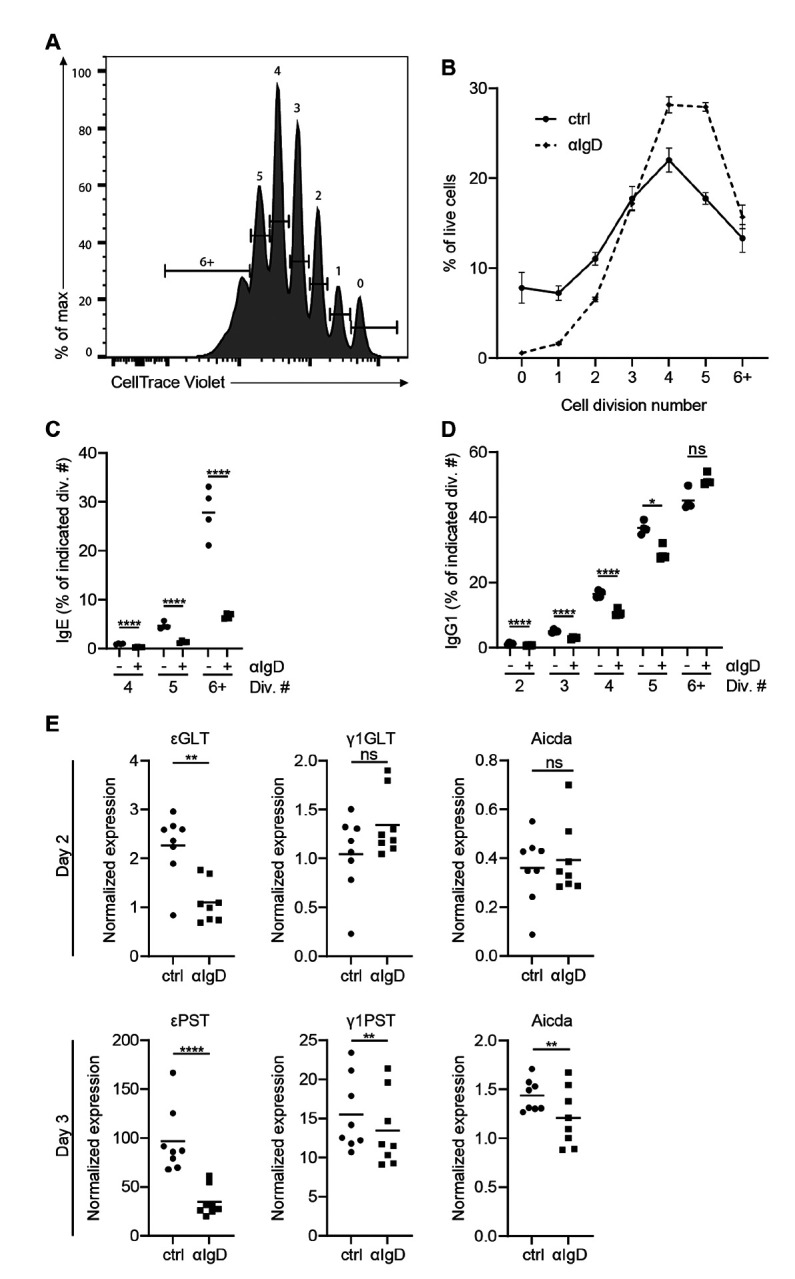
Mechanisms that restrict class switch recombination (CSR) to IgE limit the subsequent production of IgE antibodies and therefore the development of allergic disease. Mice with impaired B cell receptor (BCR) signaling have significantly increased IgE responses, consistent with a role for BCR signaling in IgE regulation. While prior work focused on BCR signaling in IgE-expressing cells to explain these findings, it has been reported that BCR signaling can reduce CSR. Therefore, we investigated the possibility that IgE CSR might be particularly sensitive to inhibition by BCR signaling in unswitched B cells. We found that immunization of mice with high-affinity antigen resulted in reduced representation of IgE-expressing cells among germinal center B cells and plasma cells relative to a low-affinity antigen. Mechanistic experiments with cultured mouse B cells demonstrated that BCR ligands selectively inhibited IgE CSR in a dose-, affinity-, and avidity-dependent manner. Signaling via Syk was required for the inhibition of IgE CSR following BCR stimulation, whereas inhibition of the PI3K subunit p110δ increased IgE CSR independently of BCR ligation. The inhibition of IgE CSR by BCR ligands synergized with IL-21 or TGFβ1. BCR ligation also inhibited CSR to IgE in human tonsillar B cells, and this inhibition was also synergistic with IL-21. These findings establish that IgE CSR is uniquely susceptible to inhibition by BCR signaling in mouse and human B cells, with important implications for the regulation and pathogenesis of allergic disease.
将类别转换重组(CSR)限制在IgE的机制会限制随后IgE抗体的产生,从而限制过敏性疾病的发展。B细胞受体(BCR)信号传导受损的小鼠IgE反应显著增加,这与BCR信号传导在IgE调节中的作用一致。虽然先前的研究集中在表达IgE的细胞中的BCR信号传导来解释这些发现,但据报道BCR信号传导可以减少CSR。因此,我们研究了在未转换的B细胞中IgE CSR可能对BCR信号传导的抑制特别敏感的可能性。我们发现,用高亲和力抗原免疫小鼠会导致生发中心B细胞和浆细胞中表达IgE的细胞相对于低亲和力抗原的比例降低。对培养的小鼠B细胞进行的机制实验表明,BCR配体以剂量、亲和力和avidity依赖性方式选择性抑制IgE CSR。BCR刺激后抑制IgE CSR需要通过Syk进行信号传导,而抑制PI3K亚基p110δ则独立于BCR连接增加IgE CSR。BCR配体对IgE CSR的抑制与IL-21或TGFβ1协同作用。BCR连接也抑制人扁桃体B细胞向IgE的CSR,并且这种抑制也与IL-21协同作用。这些发现表明,在小鼠和人类B细胞中,IgE CSR对BCR信号传导的抑制具有独特的敏感性,这对过敏性疾病的调节和发病机制具有重要意义。