Department of Endocrinology, Dongfang Hospital, Beijing University of Chinese Medicine, Beijing, China.
Graduate School, Beijing University of Chinese Medicine, Beijing, China.
Front Endocrinol (Lausanne). 2024 Sep 13;15:1364375. doi: 10.3389/fendo.2024.1364375. eCollection 2024.
According to reports, iron status has been associated with the risk of bone and joint-related diseases. However, the exact role of iron status in the development of these conditions remains uncertain.
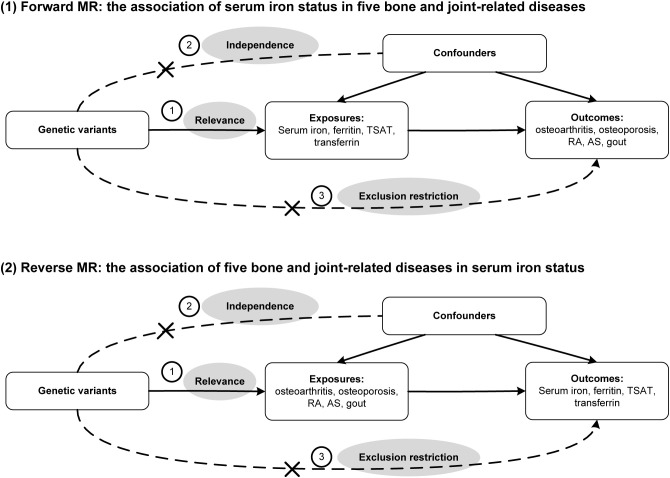
We obtained genetic data on iron status, specifically serum iron, ferritin, transferrin saturation (TSAT), and transferrin, as well as data on five common bone and joint-related diseases (osteoarthritis, osteoporosis, rheumatoid arthritis [RA], ankylosing spondylitis [AS], and gout) from independent genome-wide association studies involving individuals of European ancestry. Our primary approach for causal estimation utilized the inverse variance weighted (IVW) method. To ensure the reliability of our findings, we applied complementary sensitivity analysis and conducted reverse causal analysis.
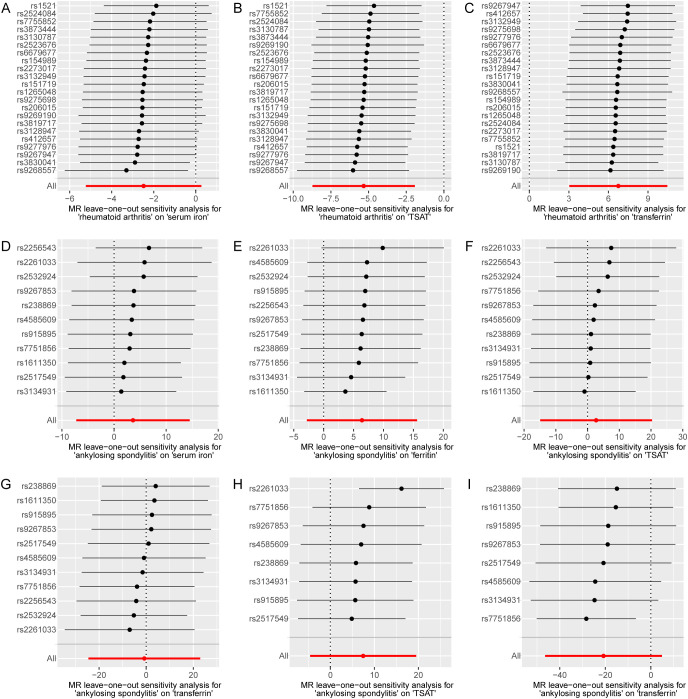
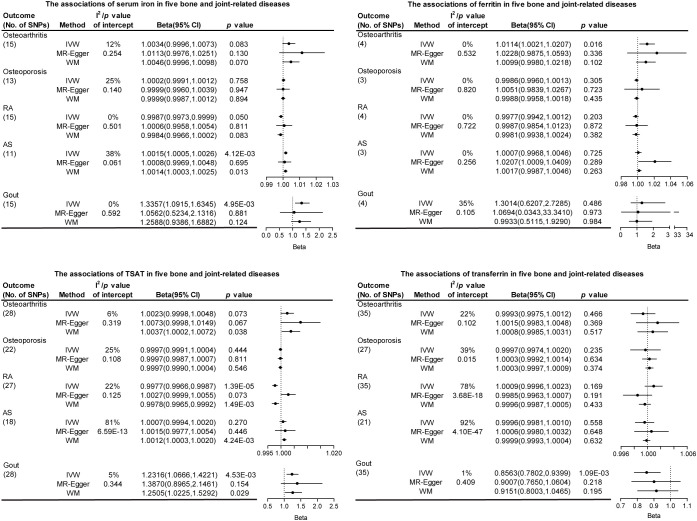
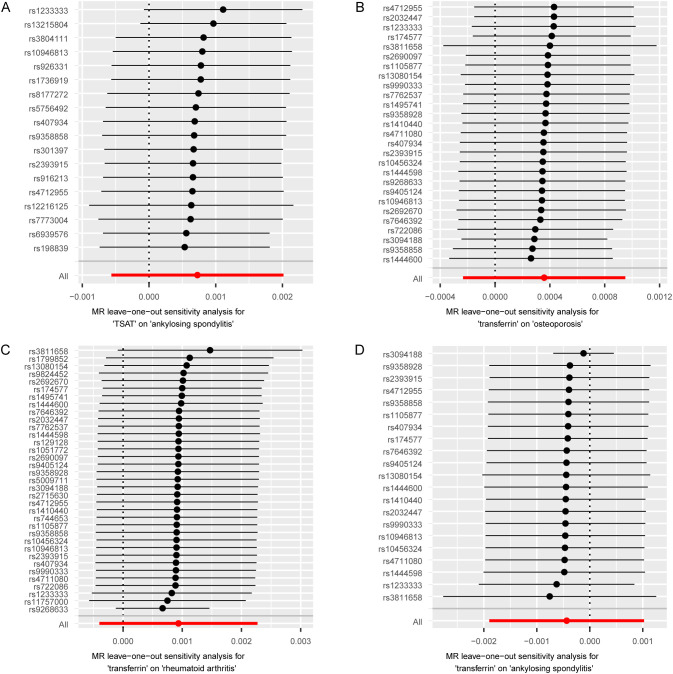
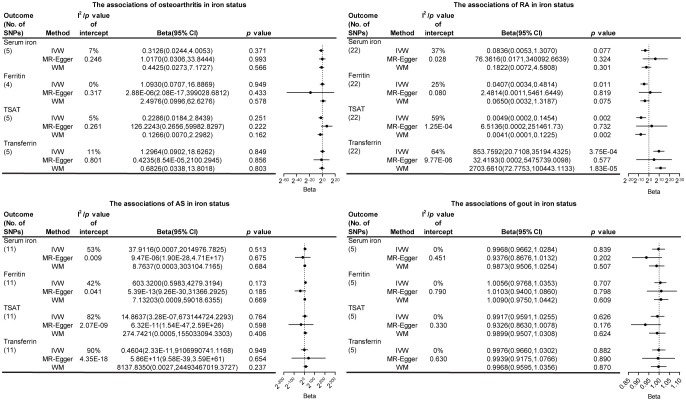
Using the IVW method, we revealed a positive causal relationship between ferritin levels and the risk of osteoarthritis (OR [95% CI], 1.0114 [1.0021-1.0207]). Besides, we identified a protective causal relationship between serum iron levels and TSAT levels in the risk of RA (OR [95% CI] values of serum iron and TSAT were 0.9987 [0.9973-0.9999] and 0.9977 [0.9966-0.9987], respectively). Furthermore, we found a positive causal relationship between serum iron levels and the risk of AS (OR [95% CI], 1.0015 [1.0005-1.0026]). Regarding gout, both serum iron and TSAT showed a positive causal relationship (OR [95% CI] values of 1.3357 [1.0915-1.6345] and 1.2316 [1.0666-1.4221] for serum iron and TSAT, respectively), while transferrin exhibited a protective causal relationship (OR [95% CI], 0.8563 [0.7802-0.9399]). Additionally, our reverse causal analysis revealed a negative correlation between RA and ferritin and TSAT levels (OR [95% CI] values of serum iron and TSAT were 0.0407 [0.0034-0.4814] and 0.0049 [0.0002-0.1454], respectively), along with a positive correlation with transferrin (OR [95% CI], 853.7592 [20.7108-35194.4325]). To ensure the validity of our findings, we replicated the results through sensitivity analysis during the validation process.
Our study demonstrated a significant correlation between iron status and bone and joint-related diseases.
据报道,铁状态与骨骼和关节相关疾病的风险有关。然而,铁状态在这些疾病发展中的确切作用仍不确定。
我们从涉及欧洲血统个体的独立全基因组关联研究中获得了铁状态的遗传数据,具体包括血清铁、铁蛋白、转铁蛋白饱和度(TSAT)和转铁蛋白,以及五种常见的骨骼和关节相关疾病(骨关节炎、骨质疏松症、类风湿关节炎[RA]、强直性脊柱炎[AS]和痛风)的数据。我们用于因果估计的主要方法是使用逆方差加权(IVW)方法。为了确保研究结果的可靠性,我们应用了补充敏感性分析和反向因果分析。
使用 IVW 方法,我们发现铁蛋白水平与骨关节炎风险之间存在正相关关系(OR [95%CI],1.0114 [1.0021-1.0207])。此外,我们发现血清铁水平与 RA 风险中 TSAT 水平之间存在保护性关系(血清铁和 TSAT 的 OR [95%CI] 值分别为 0.9987 [0.9973-0.9999]和 0.9977 [0.9966-0.9987])。此外,我们发现血清铁水平与 AS 风险之间存在正相关关系(OR [95%CI],1.0015 [1.0005-1.0026])。至于痛风,血清铁和 TSAT 均显示出正相关关系(血清铁和 TSAT 的 OR [95%CI] 值分别为 1.3357 [1.0915-1.6345]和 1.2316 [1.0666-1.4221]),而转铁蛋白则表现出保护性关系(OR [95%CI],0.8563 [0.7802-0.9399])。此外,我们的反向因果分析显示 RA 与铁蛋白和 TSAT 水平之间呈负相关(血清铁和 TSAT 的 OR [95%CI] 值分别为 0.0407 [0.0034-0.4814]和 0.0049 [0.0002-0.1454]),而与转铁蛋白呈正相关(OR [95%CI],853.7592 [20.7108-35194.4325])。为了确保研究结果的有效性,我们在验证过程中通过敏感性分析对结果进行了复制。
我们的研究表明铁状态与骨骼和关节相关疾病之间存在显著相关性。