Dias Marcelo, Dörr Felix, Garthof Susett, Schäfer Simona, Elmers Julia, Schwed Louisa, Linz Nicklas, Overell James, Hayward-Koennecke Helen, Tröger Johannes, König Alexandra, Dillenseger Anja, Tackenberg Björn, Ziemssen Tjalf
ki:elements GmbH, Saarbrücken, Germany.
Center of Clinical Neuroscience, Department of Neurology, University Clinic Carl Gustav Carus Dresden, TU Dresden, Dresden, Germany.
Front Hum Neurosci. 2024 Sep 13;18:1449388. doi: 10.3389/fnhum.2024.1449388. eCollection 2024.
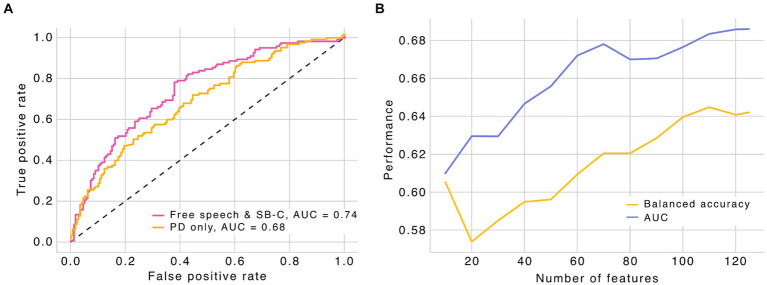
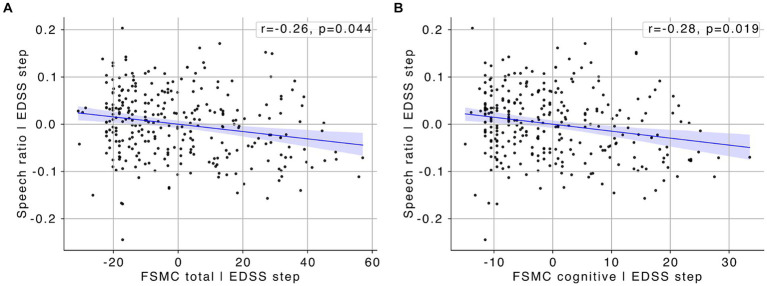
Multiple sclerosis (MS) is a chronic neuroinflammatory disease characterized by central nervous system demyelination and axonal degeneration. Fatigue affects a major portion of MS patients, significantly impairing their daily activities and quality of life. Despite its prevalence, the mechanisms underlying fatigue in MS are poorly understood, and measuring fatigue remains a challenging task. This study evaluates the efficacy of automated speech analysis in detecting fatigue in MS patients. MS patients underwent a detailed clinical assessment and performed a comprehensive speech protocol. Using features from three different free speech tasks and a proprietary cognition score, our support vector machine model achieved an AUC on the ROC of 0.74 in detecting fatigue. Using only free speech features evoked from a picture description task we obtained an AUC of 0.68. This indicates that specific free speech patterns can be useful in detecting fatigue. Moreover, cognitive fatigue was significantly associated with lower speech ratio in free speech ( = -0.283, = 0.001), suggesting that it may represent a specific marker of fatigue in MS patients. Together, our results show that automated speech analysis, of a single narrative free speech task, offers an objective, ecologically valid and low-burden method for fatigue assessment. Speech analysis tools offer promising potential applications in clinical practice for improving disease monitoring and management.
多发性硬化症(MS)是一种慢性神经炎症性疾病,其特征为中枢神经系统脱髓鞘和轴突变性。疲劳影响着大部分MS患者,严重损害他们的日常活动和生活质量。尽管疲劳很常见,但MS患者疲劳的潜在机制仍知之甚少,且测量疲劳仍然是一项具有挑战性的任务。本研究评估了自动语音分析在检测MS患者疲劳方面的有效性。MS患者接受了详细的临床评估并执行了全面的语音方案。利用来自三种不同自由语音任务的特征和一个专有的认知分数,我们的支持向量机模型在检测疲劳时ROC曲线下面积(AUC)达到了0.74。仅使用图片描述任务引发的自由语音特征,我们获得的AUC为0.68。这表明特定的自由语音模式在检测疲劳方面可能有用。此外,认知疲劳与自由语音中较低的言语比率显著相关(r = -0.283,p = 0.001),这表明它可能代表MS患者疲劳的一个特定标志物。总之,我们的结果表明,对单个叙述性自由语音任务进行自动语音分析,为疲劳评估提供了一种客观、生态有效且负担较小的方法。语音分析工具在临床实践中具有改善疾病监测和管理的潜在应用前景。