Gui Qian, Meng Jingcai, Shen Mingqiang, Feng Hongxuan, Dong Xiaofeng, Xu Daqiang, Zhu Wenxin, Cheng Qingzhang, Wang Linhui, Wu Guanhui, Lu Yanli
Department of Neurology, The Affiliated Suzhou Hospital of Nanjing Medical University (Suzhou Municipal Hospital), Suzhou, Jiangsu, 215002, People's Republic of China.
Department of Physiology and Neurobiology, Suzhou Medical College of Soochow University, Suzhou, Jiangsu, 215123, People's Republic of China.
Neuropsychiatr Dis Treat. 2024 Sep 25;20:1809-1821. doi: 10.2147/NDT.S480183. eCollection 2024.
Previous studies have predominantly explored the relationship of the glymphatic system with motor symptoms in Parkinson's disease (PD); however, research on non-motor symptoms remains limited. Therefore, this study investigated the association between glymphatic function and non-motor symptoms, including cognitive impairment and sleep disorders, in PD patients.
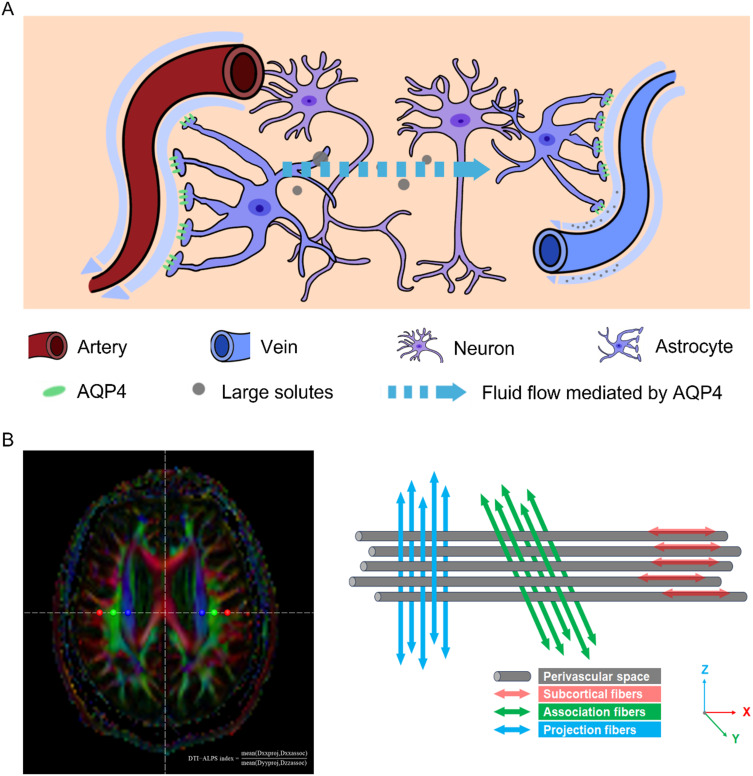
This study recruited 49 PD patients and 38 healthy controls (HC). Glymphatic function was evaluated using enlarged perivascular spaces (EPVS) in the basal ganglia (BG) region and diffusion tensor image analysis along the perivascular space (DTI-ALPS) index. Cognition, sleep, anxiety, and depression scales were assessed in all participants. According to the scale scores, PD patients were further divided into several groups to identify the presence of non-motor symptoms. Differences in EPVS numbers and ALPS index between PD subgroups and HC group were compared. Spearman correlation analysis was performed to investigate the association between the PD non-motor symptoms and ALPS index. Additionally, receiver operating characteristic (ROC) curves analysis was conducted for ALPS index to predict cognitive impairment and insomnia in PD patients.
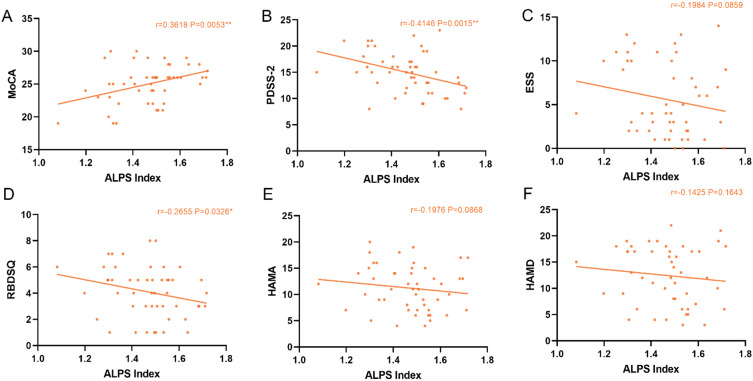
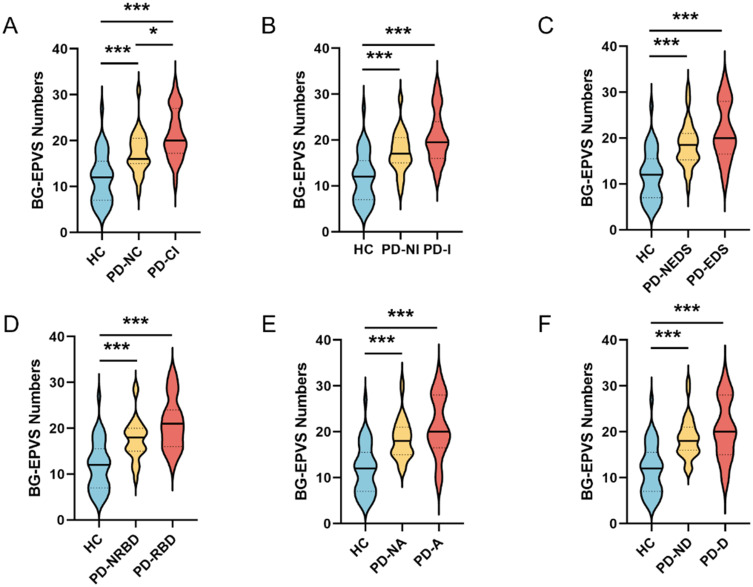
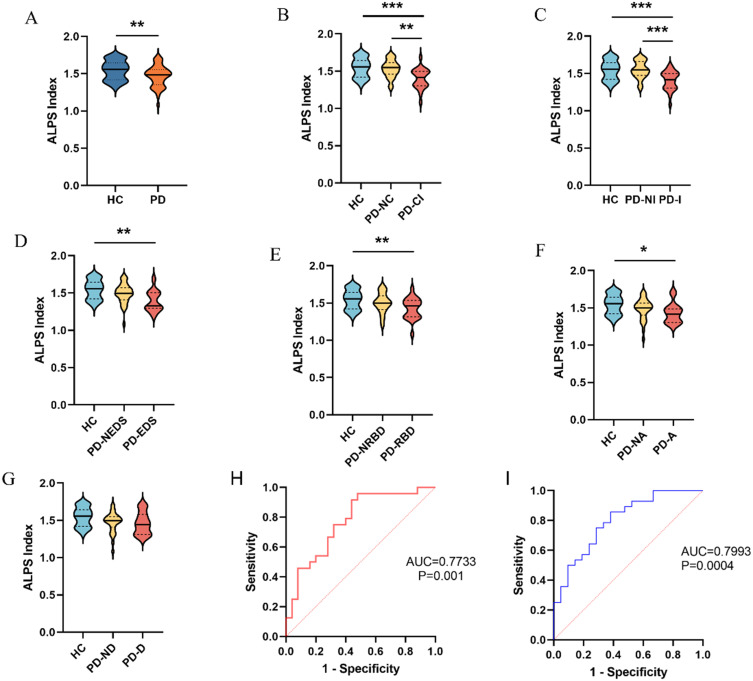
PD patients with and without non-motor symptoms all showed more EPVS numbers than the controls, and the EPVS numbers in PD patients with cognitive impairment were also greater than those without. Notably, except for the depression subgroup, PD patients with non-motor symptoms showed significantly lower ALPS index than the controls. The Montreal Cognitive Assessment (MoCA) scores were positively correlated, whereas the Parkinson's Disease Sleep Scale (PDSS)-2 and REM Sleep Behavior Disorder Screening Questionnaire (RBDSQ) scores were negatively correlated with the ALPS index in PD patients (r=0.3618, P=0.0053; r=-0.4146, P=0.0015; r=-0.2655, P=0.0326, respectively). The ALPS index proved to be predictive of cognitive impairment and insomnia in PD patients (AUC=0.7733, P=0.001; AUC=0.7993, P=0.0004, respectively).
Glymphatic function is closely associated with cognition and sleep of PD patients.
既往研究主要探讨了类淋巴系统与帕金森病(PD)运动症状之间的关系;然而,关于非运动症状的研究仍然有限。因此,本研究调查了PD患者类淋巴功能与非运动症状(包括认知障碍和睡眠障碍)之间的关联。
本研究招募了49例PD患者和38例健康对照(HC)。使用基底节(BG)区域的扩大血管周围间隙(EPVS)和沿血管周围间隙的扩散张量图像分析(DTI-ALPS)指数评估类淋巴功能。对所有参与者进行认知、睡眠、焦虑和抑郁量表评估。根据量表评分,将PD患者进一步分为几个组以确定非运动症状的存在。比较PD亚组与HC组之间EPVS数量和ALPS指数的差异。进行Spearman相关性分析以研究PD非运动症状与ALPS指数之间的关联。此外,对ALPS指数进行受试者工作特征(ROC)曲线分析,以预测PD患者的认知障碍和失眠。
有和无非运动症状的PD患者的EPVS数量均多于对照组,有认知障碍的PD患者的EPVS数量也多于无认知障碍者。值得注意的是,除抑郁亚组外,有非运动症状的PD患者的ALPS指数显著低于对照组。在PD患者中,蒙特利尔认知评估(MoCA)评分与ALPS指数呈正相关,而帕金森病睡眠量表(PDSS)-2和快速眼动睡眠行为障碍筛查问卷(RBDSQ)评分与ALPS指数呈负相关(r分别为0.3618,P = 0.0053;r = -0.4146,P = 0.0015;r = -0.2655,P = 0.0326)。ALPS指数被证明可预测PD患者的认知障碍和失眠(AUC分别为0.7733,P = 0.001;AUC为0.7993,P = 0.0004)。
类淋巴功能与PD患者的认知和睡眠密切相关。