Rocca Bianca, Bigagli Elisabetta, Cerbai Elisabetta
Department of Safety and Bioethics, Catholic University, Largo F. Vito 1, Rome, Italy.
Department of Medicine and Surgery, LUM University, SS 100, km 18, Casamassima, Bari, Italy.
Cardiovasc Drugs Ther. 2024 Dec;38(6):1103-1109. doi: 10.1007/s10557-024-07624-7. Epub 2024 Sep 30.
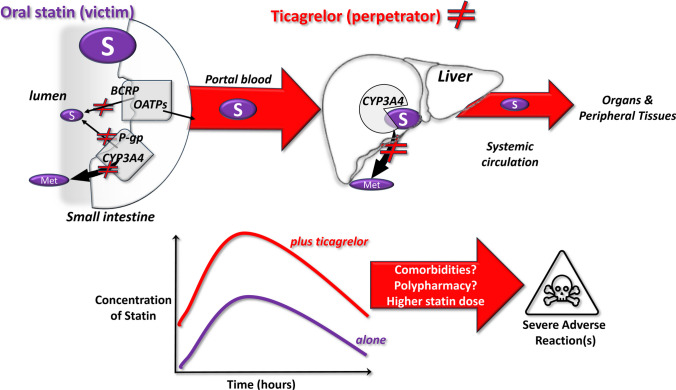
Polypharmacy is often necessary in complex, chronic, comorbid and cardiovascular patients and is a known risk factor for potential drug-drug interaction (DDI) that can cause adverse reactions (toxicity or therapeutic failure). Anti-thrombotic drugs (largely low-dose aspirin and a platelet P2Y12 receptor inhibitor) and statins are among the most co-administered drugs in cardiovascular patients. Ticagrelor is a selective antagonist of the platelet P2Y12-receptor, highly effective in inhibiting platelet aggregation and bio-transformed by the CYP3A4 and substrate of transporters, such as the breast cancer resistance protein (BCRP). Statins have different pharmacokinetic profiles; some undergo CYP3A4-mediated metabolism; rosuvastatin is primarily metabolized by the CYP2C9; and they have different affinities for drug transporters. Rhabdomyolysis is a very rare but severe adverse event, which is specific for statins which can be triggered by DDIs that increase statin's concentrations through blockade of their biotransformation and/or elimination. Large pharmacovigilance and small observational studies reported increased rhabdomyolysis in patients treated with some statins and ticagrelor but not aspirin, clopidogrel or prasugrel. Recent studies in vitro, pharmacokinetic trials and in silico drug modelling identified and validated the BCRP inhibition by ticagrelor, as a mechanism contributing to the DDI with statins, as 'victim' drugs, leading to increased rhabdomyolysis. While the clinical impact of this DDI deserves further investigation, a careful evaluation should be advised when ticagrelor is co-prescribed with some statins.
在患有复杂、慢性、共病和心血管疾病的患者中,联合用药往往是必要的,而且已知这是潜在药物相互作用(DDI)的一个风险因素,可能会导致不良反应(毒性或治疗失败)。抗血栓药物(主要是小剂量阿司匹林和血小板P2Y12受体抑制剂)和他汀类药物是心血管疾病患者中联合使用最多的药物。替格瑞洛是血小板P2Y12受体的选择性拮抗剂,在抑制血小板聚集方面非常有效,并且由CYP3A4进行生物转化,是转运蛋白的底物,如乳腺癌耐药蛋白(BCRP)。他汀类药物具有不同的药代动力学特征;一些药物通过CYP3A4介导代谢;瑞舒伐他汀主要由CYP2C9代谢;它们对药物转运蛋白的亲和力也不同。横纹肌溶解是一种非常罕见但严重的不良事件,是他汀类药物特有的,可能由药物相互作用引发,通过阻断他汀类药物的生物转化和/或消除来增加其浓度。大型药物警戒和小型观察性研究报告称,使用某些他汀类药物和替格瑞洛治疗的患者横纹肌溶解增加,但使用阿司匹林、氯吡格雷或普拉格雷的患者未出现这种情况。最近的体外研究、药代动力学试验和计算机药物建模确定并验证了替格瑞洛对BCRP的抑制作用,这是导致与他汀类药物发生药物相互作用的一种机制,他汀类药物作为“受害者”药物,会导致横纹肌溶解增加。虽然这种药物相互作用的临床影响值得进一步研究,但当替格瑞洛与某些他汀类药物联合处方时,建议进行仔细评估。