Community Oral Health, Tehran University of Medical Sciences, Tehran, Iran (the Islamic Republic of).
Restorative Dentistry, Qom University of Medical Sciences, Qom, Iran (the Islamic Republic of)
BMJ Open. 2024 Sep 30;14(9):e086041. doi: 10.1136/bmjopen-2024-086041.
Senior dental students are more aware of the harmful effects of cariogenic snacks and are expected to better watch their diet compared with freshmen dental students. This study aimed to compare the frequency of consumption of cariogenic snacks by senior and freshmen dental students of Tehran city and the related factors.
This cross-sectional study evaluated the senior and freshmen dental students attending dental schools in Tehran in 2018, who were selected by census sampling. A cariogenic snack record form was used to collect information regarding the frequency of consumption of cariogenic snacks both prospectively (within the upcoming week) and retrospectively (previous 24 hours). We also collected information on the demographic characteristics of the participants. The plaque-producing and decay-producing potential of the diet (PAP) index was calculated for each dental student. Data were analysed by the backward regression model using SPSS.
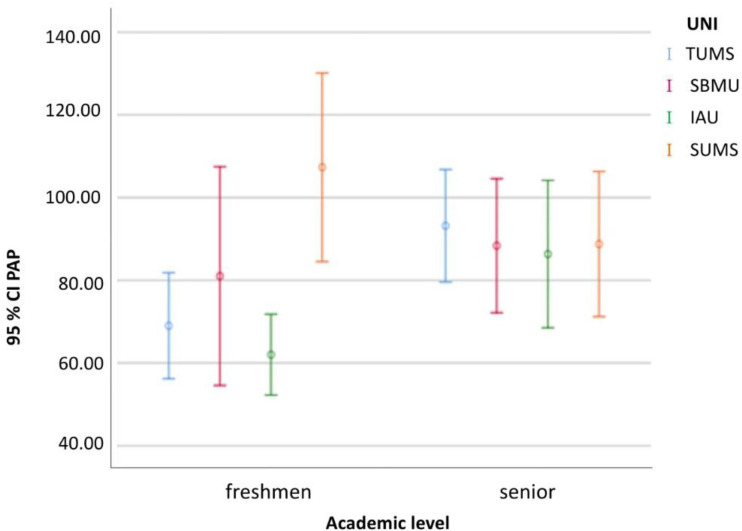
A total of 294 dental students with a mean age of 22±2.85 years participated in this study. The mean PAP score was 76.48±49.91 for the freshmen and 89.87±49.41 for the senior dental students with a significant difference between them (p=0.023). Older dental students (p=0.008) and those not living with their parents (p=0.001) acquired a higher PAP score.
The mean PAP score of freshmen and senior dental students in Tehran was slightly higher than the optimal level. So the instructional techniques of dental curricula are better to be revised to improve the performance of dental students to cut down the consumption of cariogenic snacks.
与新生牙科学生相比,高年级牙科学生更了解致龋零食的有害影响,预计他们会更好地控制自己的饮食。本研究旨在比较德黑兰市高年级和新生牙科学生食用致龋零食的频率以及相关因素。
这是一项横断面研究,评估了 2018 年在德黑兰牙科学校就读的高年级和新生牙科学生,他们是通过整群抽样选择的。使用致龋零食记录表前瞻性(在即将到来的一周内)和回顾性(前 24 小时)收集关于致龋零食消费频率的信息。我们还收集了参与者的人口统计学特征信息。为每位牙科学生计算了产菌斑和致龋潜能(PAP)指数。使用 SPSS 通过向后回归模型对数据进行分析。
共有 294 名平均年龄为 22±2.85 岁的牙科学生参加了这项研究。新生的平均 PAP 得分为 76.48±49.91,高年级的为 89.87±49.41,两者之间存在显著差异(p=0.023)。年长的牙科学生(p=0.008)和不与父母同住的学生(p=0.001)获得了更高的 PAP 得分。
德黑兰新生和高年级牙科学生的平均 PAP 得分略高于最佳水平。因此,牙科课程的教学技术更好地进行修订,以提高牙科学生的表现,减少致龋零食的消费。