Department of Epidemiology and Biostatistics, School of Public Health, Peking University, Beijing, 100191, China.
Peking University Center for Public Health and Epidemic Preparedness & Response, Beijing, 100191, China.
Cell Death Dis. 2024 Sep 30;15(9):706. doi: 10.1038/s41419-024-07087-6.
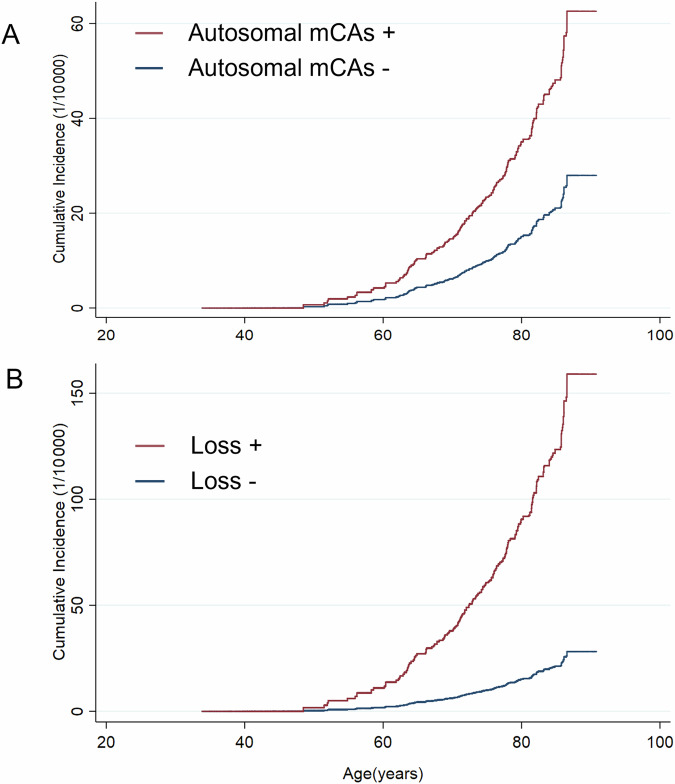
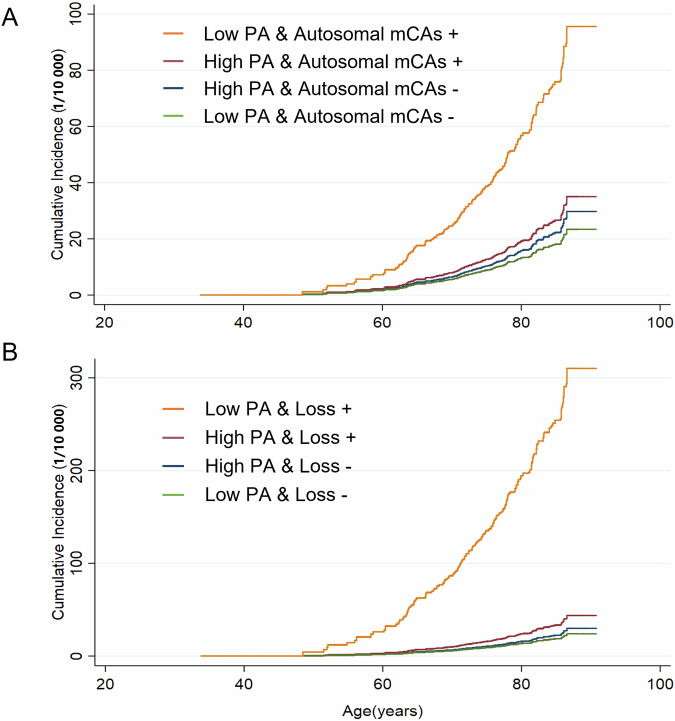
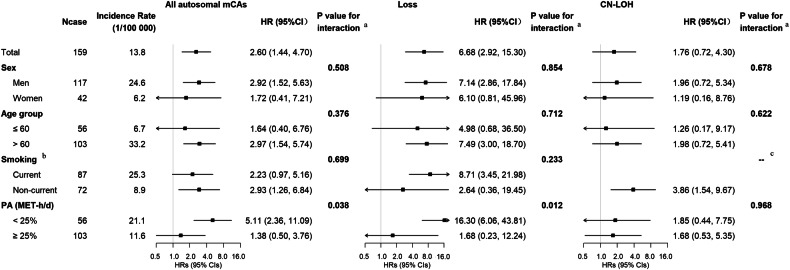
Little is known about the prospective association between autosomal mosaic chromosomal alterations (mCAs), a group of large-scale somatic mutations on autosomes, and bladder cancer. Here we utilized data from 99,877 participants who were free of physician-diagnosed cancer at baseline (2004-2008) of the China Kadoorie Biobank to estimate the associations between autosomal mCAs and bladder cancer (ICD-10: C67). A total of 2874 autosomal mCAs events among 2612 carriers (2.6%) were detected. After a median follow-up of 12.4 years, we discovered that participants with all autosomal mCAs exhibited higher risks of bladder cancer, with a multivariable-adjusted hazard ratio (HR) (95% confidence interval [CI]) of 2.60 (1.44, 4.70). The estimate of such association was even stronger for mosaic loss events (HR [95% CI]: 6.68 [2.92, 15.30]), while it was not significant for CN-LOH events. Both expanded (cell fraction ≥10%) and non-expanded autosomal mCAs, as well as mosaic loss, were associated with increased risks of bladder cancer. Of interest, physical activity (PA) significantly modified the associations of autosomal mCAs and mosaic loss (P = 0.038 and 0.012, respectively) with bladder cancer. The increased risks of bladder cancer were only observed with mCAs and mosaic loss among participants with a lower level of PA (HR [95% CI]: 5.11 [2.36, 11.09] and 16.30 [6.06, 43.81]), but not among participants with a higher level of PA. Our findings suggest that peripheral leukocyte autosomal mCAs may represent a novel risk factor for bladder cancer, and PA may serve as a potential intervention target for mCAs carriers.
关于常染色体镶嵌性染色体改变(mCAs)——一组常染色体上的大规模体细胞突变,与膀胱癌之间的前瞻性关联,目前知之甚少。在这里,我们利用了 99877 名参与者的数据,这些参与者在基线(2004-2008 年)时没有被医生诊断出患有癌症,他们来自中国慢性病前瞻性研究(CKB),旨在估计常染色体 mCAs 与膀胱癌(ICD-10:C67)之间的关联。在 2612 名携带者中检测到了 2874 个常染色体 mCAs 事件(2.6%)。在中位随访 12.4 年后,我们发现所有常染色体 mCAs 的参与者患膀胱癌的风险更高,多变量调整后的风险比(HR)(95%置信区间[CI])为 2.60(1.44,4.70)。对于镶嵌性缺失事件(HR [95%CI]:6.68 [2.92, 15.30]),这种关联的估计值甚至更强,而对于 CN-LOH 事件则不显著。扩展(细胞分数≥10%)和非扩展的常染色体 mCAs 以及镶嵌性缺失都与膀胱癌风险的增加相关。有趣的是,体力活动(PA)显著改变了常染色体 mCAs 和镶嵌性缺失与膀胱癌的关联(分别为 P=0.038 和 0.012)。仅在体力活动水平较低的参与者中,mCAs 和镶嵌性缺失才会增加膀胱癌的风险(HR [95%CI]:5.11 [2.36, 11.09] 和 16.30 [6.06, 43.81]),而在体力活动水平较高的参与者中则没有观察到这种情况。我们的研究结果表明,外周白细胞常染色体 mCAs 可能是膀胱癌的一个新的危险因素,而体力活动可能是 mCAs 携带者的一个潜在干预靶点。