Infurna Maria Rita, Fazio Leonardo, Bevacqua Eleonora, Costanzo Giulia, Falgares Giorgio, Maiorana Antonio, Giannone Francesca, Antonucci Linda Antonella
Department of Psychology, Educational Science and Human Movement, University of Palermo, Palermo, Italy.
Department of Medicine and Surgery, LUM University 'Giuseppe Degennaro', Casamassima, Bari, Italy.
BMC Psychol. 2024 Oct 1;12(1):520. doi: 10.1186/s40359-024-02024-w.
Childhood abuse and neglect pose important risk factors for the development of psychopathology during pregnancy. However, only a few studies have assessed the effects of a specific type of abuse during the perinatal period, namely, psychological maltreatment, which includes emotional abuse and neglect. These studies have found that women who have experienced psychological maltreatment exhibit higher levels of antenatal depressive symptoms and greater difficulties forming attachment with their babies than women who have not experienced this kind of adversity. The aim of this study was to examine how emotional abuse and neglect experiences may favor the occurrence of psychological distress in pregnant women, and whether prenatal attachment might explain this association.
Participants comprised 128 Italian pregnant women ranging in age from 21 to 46 years (M = 33.4; SD = 6.10). Women responded to the following self-report instruments: CECA.Q and CTQ-SF, for the assessment of psychological maltreatment experiences; MAAS, for the evaluation of prenatal attachment; and PAMA, for the assessment of perinatal psychological distress.
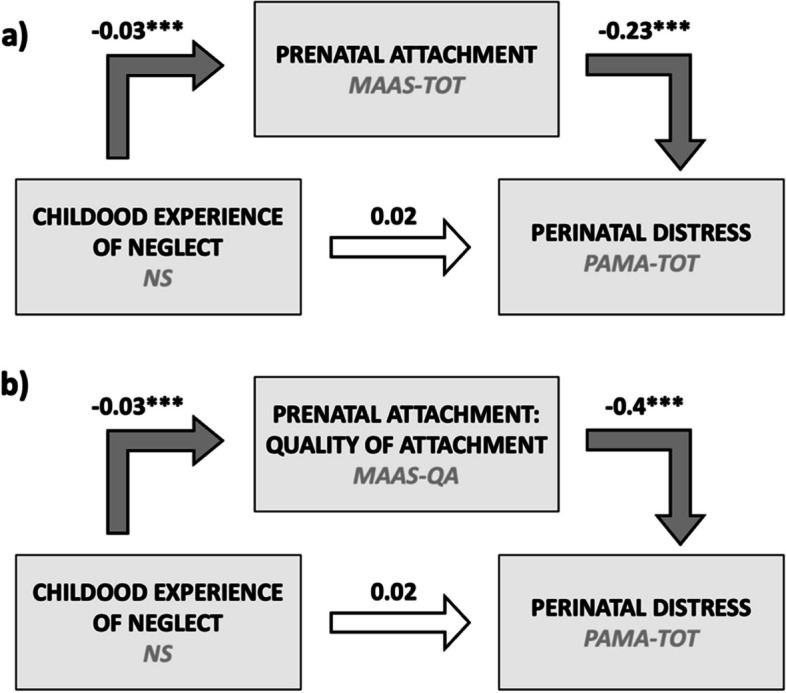
Pearson correlations revealed a positive association between childhood neglect and perinatal psychological distress and a negative association between childhood neglect and prenatal attachment scores. No significant correlations were found for emotional abuse. Perinatal psychological distress was negatively associated with prenatal attachment. Mediation analyses showed significant associations between childhood neglect and the dimensions of perinatal affectivity and prenatal maternal attachment. Prenatal maternal attachment mediated the relationship between neglect and perinatal psychological distress.
The transition to motherhood is a sensitive period, particularly for women who have experienced abuse and neglect during childhood. These experiences may negatively impact a woman's disposition to emotionally and behaviorally engage in the formation of a bond with their unborn baby. These results may have important prevention and clinical implications and thus warrant further exploration.
童年期遭受虐待和忽视是孕期精神病理学发展的重要风险因素。然而,仅有少数研究评估了围产期一种特定类型的虐待,即心理虐待(包括情感虐待和忽视)的影响。这些研究发现,经历过心理虐待的女性比未经历此类逆境的女性表现出更高水平的产前抑郁症状,并且在与婴儿建立依恋关系方面存在更大困难。本研究的目的是探讨情感虐待和忽视经历如何促使孕妇出现心理困扰,以及产前依恋是否可以解释这种关联。
研究对象包括128名年龄在21至46岁之间的意大利孕妇(M = 33.4;SD = 6.10)。女性们对以下自我报告工具做出了回应:用于评估心理虐待经历的CECA.Q和CTQ-SF;用于评估产前依恋的MAAS;以及用于评估围产期心理困扰的PAMA。
皮尔逊相关性分析显示,童年期忽视与围产期心理困扰呈正相关,童年期忽视与产前依恋得分呈负相关。情感虐待未发现显著相关性。围产期心理困扰与产前依恋呈负相关。中介分析表明,童年期忽视与围产期情感维度和产前母亲依恋之间存在显著关联。产前母亲依恋介导了忽视与围产期心理困扰之间的关系。
向母亲角色的转变是一个敏感期,特别是对于童年期经历过虐待和忽视的女性。这些经历可能会对女性在情感和行为上与未出生婴儿建立联系的倾向产生负面影响。这些结果可能具有重要的预防和临床意义,因此值得进一步探索。