Mullin Nathaniel K, Bohrer Laura R, Anfinson Kristin R, Andorf Jeaneen L, Mullins Robert F, Tucker Budd A, Stone Edwin M
Institute for Vision Research, Carver College of Medicine, University of Iowa, Iowa City, IA, USA; Department of Ophthalmology and Visual Sciences, Carver College of Medicine University of Iowa, Iowa City, IA, USA.
Institute for Vision Research, Carver College of Medicine, University of Iowa, Iowa City, IA, USA; Department of Ophthalmology and Visual Sciences, Carver College of Medicine University of Iowa, Iowa City, IA, USA; Department of Neuroscience and Pharmacology, Carver College of Medicine University of Iowa, Iowa City, IA, USA.
HGG Adv. 2025 Jan 9;6(1):100357. doi: 10.1016/j.xhgg.2024.100357. Epub 2024 Sep 30.
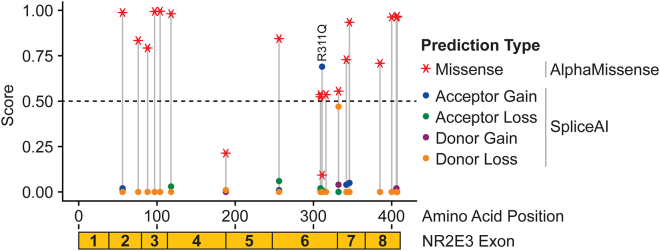
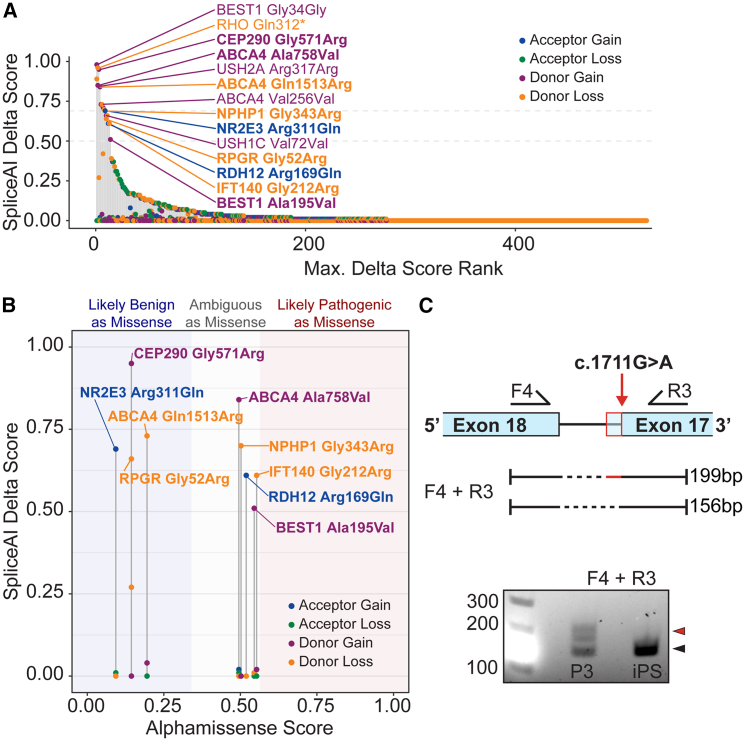
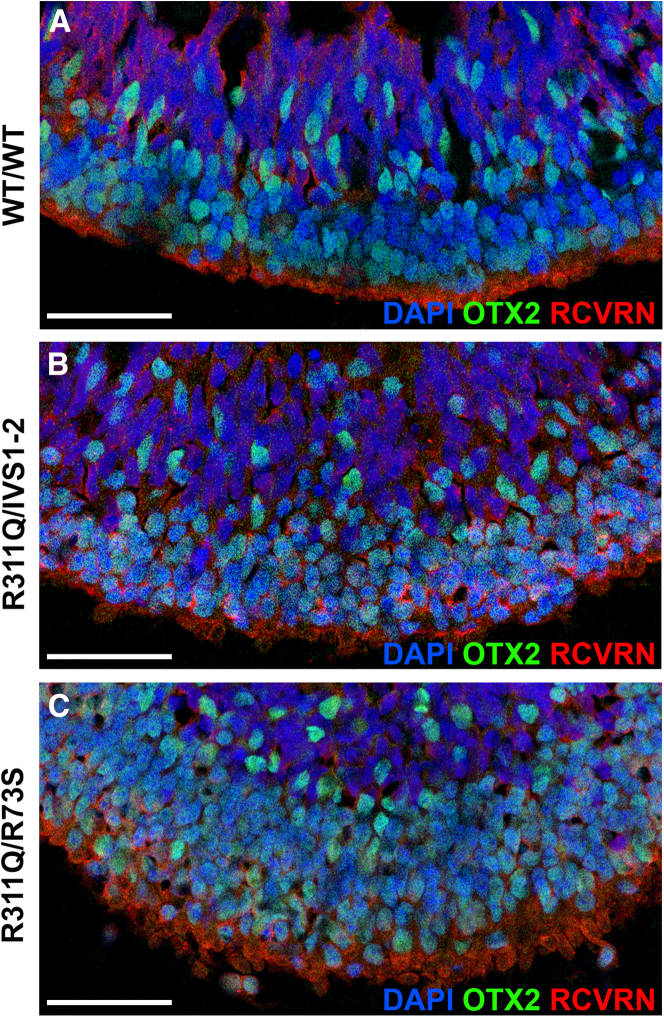
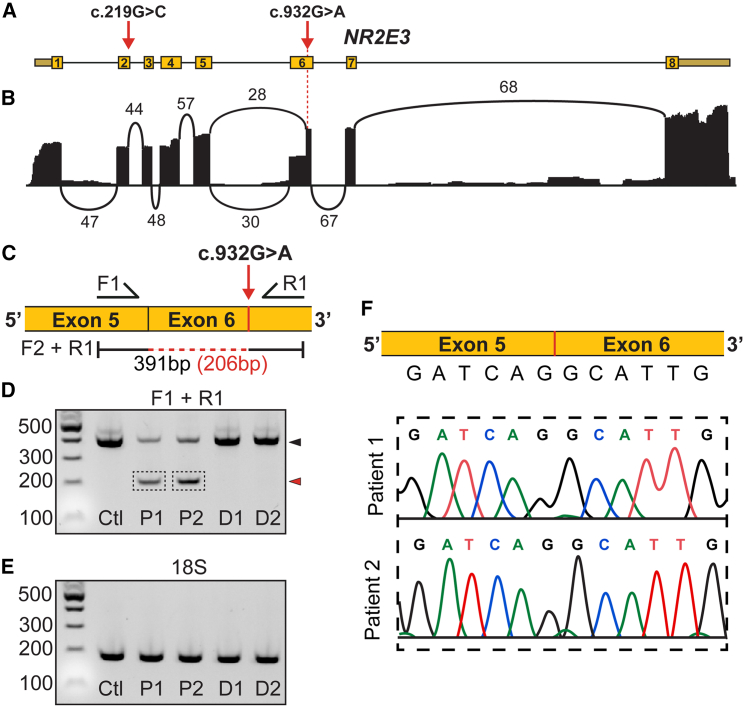
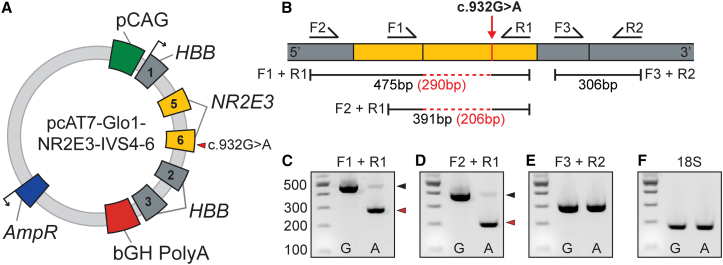
Correct identification of the molecular consequences of pathogenic genetic variants is essential to the development of allele-specific therapies. However, such molecular effects may remain ambiguous following genetic sequence analysis alone. Here, we identify exonic codon-altering variants that are also predicted to disrupt normal RNA splicing in the context of inherited retinal disease. NR2E3 c.932G>A (p.Arg311Gln) is a variant commonly associated with enhanced S cone syndrome. Previous studies using mutagenized cDNA constructs have shown that the arginine to glutamine substitution at position 311 of NR2E3 does not meaningfully diminish function of the rod-specific transcription factor. Using retinal organoids, we explored the molecular consequences of NR2E3 c.932G>A when expressed endogenously during human rod photoreceptor cell development. Retinal organoids carrying the NR2E3 c.932G>A allele expressed a transcript containing a 186-nucleotide deletion of exon 6 within the ligand binding domain. This short transcript was not detected in control organoids or control human donor retina samples. A minigene containing exons 5 and 6 of NR2E3 showed sufficiency of the c.932G>A variant to cause the observed splicing defect. These results support the hypothesis that the pathogenic NR2E3 c.932G>A variant leads to photoreceptor disease by causing a splice defect and not through an amino acid substitution as previously supposed. They also explain the relatively mild effect of Arg311Gln on NR2E3 function in vitro. We also used in silico prediction tools to show that similar changes are likely to affect other inherited retinal disease variants in genes such as CEP290, ABCA4, and BEST1.
正确识别致病基因变异的分子后果对于开发等位基因特异性疗法至关重要。然而,仅通过基因序列分析,这种分子效应可能仍不明确。在这里,我们在遗传性视网膜疾病的背景下,鉴定出也被预测会破坏正常RNA剪接的外显子密码子改变变异。NR2E3 c.932G>A(p.Arg311Gln)是一种通常与增强型S锥体综合征相关的变异。先前使用诱变cDNA构建体的研究表明,NR2E3第311位的精氨酸到谷氨酰胺的取代并没有显著降低视杆特异性转录因子的功能。利用视网膜类器官,我们探索了NR2E3 c.932G>A在人类视杆光感受器细胞发育过程中内源性表达时的分子后果。携带NR2E3 c.932G>A等位基因的视网膜类器官表达了一种转录本,该转录本在配体结合域内缺失了外显子6的186个核苷酸。在对照类器官或对照人类供体视网膜样本中未检测到这种短转录本。一个包含NR2E3外显子5和6的小基因表明,c.932G>A变异足以导致观察到的剪接缺陷。这些结果支持了这样一种假设,即致病性NR2E3 c.932G>A变异通过导致剪接缺陷而非如先前推测的通过氨基酸取代导致光感受器疾病。它们还解释了Arg311Gln在体外对NR2E3功能的相对温和影响。我们还使用了计算机预测工具来表明,类似的变化可能会影响其他遗传性视网膜疾病基因(如CEP290、ABCA4和BEST1)中的变异。