Nemes Attila, Kormányos Árpád, Olajos Dorottya Lilla, Achim Alexandru, Ruzsa Zoltán, Ambrus Nóra, Lengyel Csaba
Department of Medicine, Albert Szent-Györgyi Medical School, University of Szeged, H-6725 Szeged, Hungary.
Rev Cardiovasc Med. 2024 Sep 10;25(9):324. doi: 10.31083/j.rcm2509324. eCollection 2024 Sep.
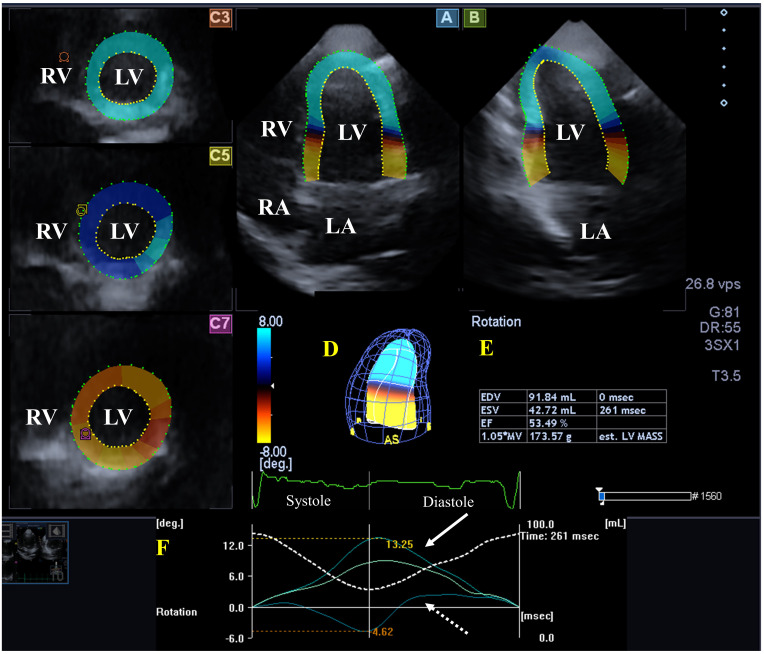
The left ventricular (LV) rotational mechanics are of particular importance in the function of the LV. The rotational movement is the consequence of the arrangement of the subepicardial and subendocardial muscle fibers. These muscle fibers are perpendicular to each other, their contraction creates a characteristic motion. The aim of the present study was to examine the prognostic impact of LV twist assessed by three-dimensional speckle-tracking echocardiography (3D-STE) in healthy circumstances.
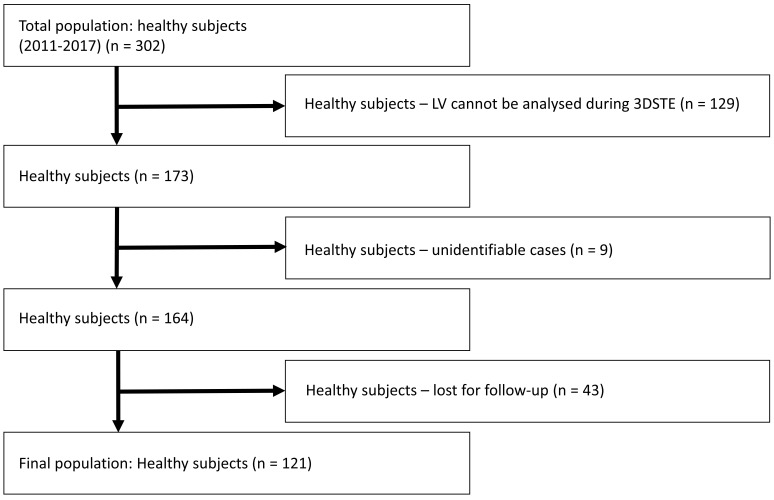
302 healthy adults participated in the study, 181 subjects were excluded due to certain reasons (LV could not be analysed during 3D-STE, subjects were unidentifiable, or lost to follow-up). 121 subjects were involved in the final analysis (mean age of 33.1 ± 12.3 years, 75 males), who were willing to be examined on a voluntary basis.
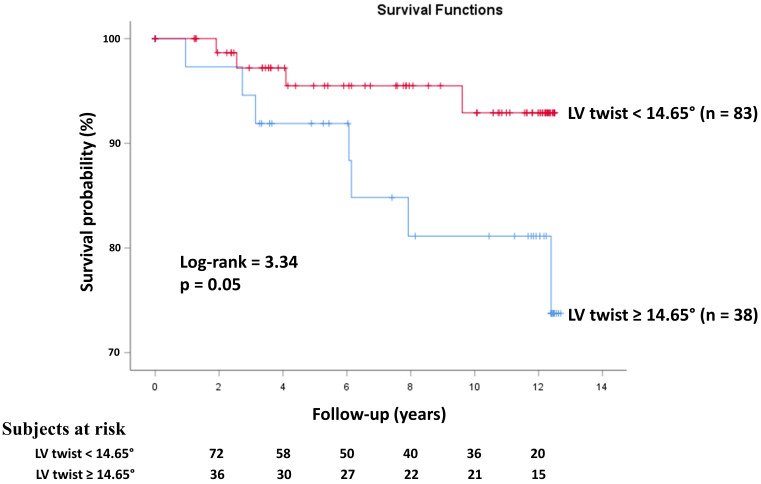
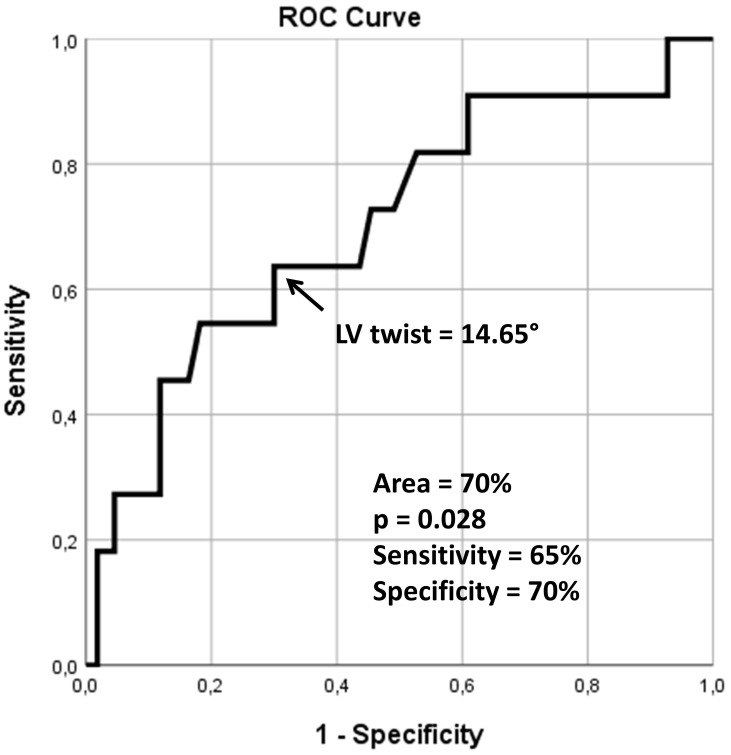
During a mean follow-up of 7.93 ± 4.21 years, 11 healthy adults suffered a cardiovascular event including 2 cardiac deaths. Using receiver operating characteristic analysis, LV twist ≥14.65 degrees as assessed by 3D-STE proved to be significantly predictive regarding the cardiovascular event-free survival (area under the curve 0.70, specificity 70%, sensitivity 65%, = 0.028). Subjects with LV twist ≥14.65 degrees had higher basal and apical rotations and a significantly higher ratio of these individuals developed cardiovascular events compared to cases with LV twist <14.65 degrees. Subjects with cardiovascular events had lower LV global longitudinal strain, higher basal LV rotation and twist and the ratio of subjects with LV twist ≥14.65 degrees was elevated as compared to cases without events.
3D-STE-derived LV twist independently predicts future cardiovascular events in healthy adults.
左心室(LV)旋转力学在左心室功能中尤为重要。旋转运动是心外膜下和心内膜下肌纤维排列的结果。这些肌纤维相互垂直,它们的收缩产生一种特征性运动。本研究的目的是在健康情况下,通过三维斑点追踪超声心动图(3D-STE)评估左心室扭转的预后影响。
302名健康成年人参与了该研究,181名受试者因某些原因被排除(3D-STE检查期间无法分析左心室、受试者身份不明或失访)。121名受试者参与了最终分析(平均年龄33.1±12.3岁,男性75名),他们自愿接受检查。
在平均7.93±4.21年的随访期间,11名健康成年人发生了心血管事件,包括2例心源性死亡。使用受试者工作特征分析,3D-STE评估左心室扭转≥14.65度被证明对无心血管事件生存具有显著预测性(曲线下面积0.70,特异性70%,敏感性65%,P = 0.028)。与左心室扭转<14.65度的病例相比;左心室扭转≥14.65度的受试者具有更高的基底和心尖旋转,且这些个体发生心血管事件的比例显著更高。发生心血管事件的受试者左心室整体纵向应变较低,基底左心室旋转和扭转较高,与无事件的病例相比,左心室扭转≥14.65度的受试者比例升高。
3D-STE得出左心室扭转可独立预测健康成年人未来的心血管事件