Graziano Francesca, Zorzi Alessandro, Ungaro Simone, Bauce Barbara, Rigato Ilaria, Cipriani Alberto, Perazzolo Marra Martina, Pilichou Kalliopi, Basso Cristina, Corrado Domenico
Department of Cardiac, Thoracic and Vascular Sciences and Public Health, University of Padova, 35128 Padova, Italy.
Department of Sports Medicine, Semmelweis University, 1085 Budapest, Hungary.
Rev Cardiovasc Med. 2024 Sep 24;25(9):348. doi: 10.31083/j.rcm2509348. eCollection 2024 Sep.
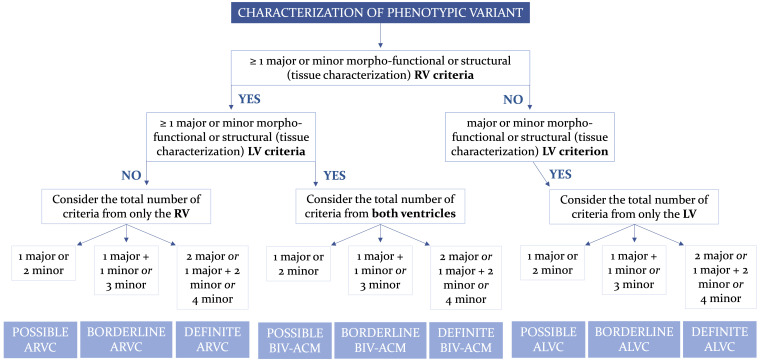
Arrhythmogenic cardiomyopathy (ACM) is a cardiac disease featured by non-ischemic myocardial scarring linked to ventricular electrical instability. As there is no single gold-standard test, diagnosing ACM remains challenging and a combination of specific criteria is needed. The diagnostic criteria were first defined and widespread in 1994 and then revised in 2010, approaching and focusing primarily on right ventricular involvement without considering any kind of left ventricular variant or phenotype. Years later, in 2020, with the purpose of overcoming previous limitations, the Padua Criteria were introduced by an international expert report. The main novel elements were the introduction of specific criteria for left ventricular variants as well as the use of cardiac magnetic resonance for tissue characterization and scar detection. The last modifications and refinement of these criteria were published at the end of 2023 as the European Task Force criteria, by a "head-quarter" of ACM international experts, proving the emerging relevance of this condition besides its difficult diagnosis. In this review, emphasizing the progress in understanding the aetiology of the cardiomyopathy, an analysis of the new criteria is presented. The introduction of the term "scarring/arrhythmogenic cardiomyopathy" sets an important milestone in this field, underlying how non-ischemic myocardial scarring-typical of ACM-and arrhythmic susceptibility could be the main pillars of numerous different phenotypic variants regardless of etiology.
致心律失常性心肌病(ACM)是一种以非缺血性心肌瘢痕形成并伴有心室电不稳定为特征的心脏病。由于没有单一的金标准检测方法,ACM的诊断仍然具有挑战性,需要结合特定标准。诊断标准于1994年首次定义并广泛应用,随后在2010年进行了修订,主要针对右心室受累情况,未考虑任何左心室变异或表型。多年后的2020年,为克服先前的局限性,一份国际专家报告引入了帕多瓦标准。主要的新内容包括引入了左心室变异的特定标准以及使用心脏磁共振进行组织特征分析和瘢痕检测。这些标准的最新修订和完善于2023年底作为欧洲工作组标准发布,由ACM国际专家“总部”发布,证明了这种疾病除诊断困难外,其重要性日益凸显。在本综述中,强调了在理解心肌病病因方面的进展,并对新标准进行了分析。“瘢痕形成/致心律失常性心肌病”这一术语的引入在该领域树立了一个重要的里程碑,强调了ACM典型的非缺血性心肌瘢痕形成和心律失常易感性如何可能是众多不同表型变异的主要支柱,而不论其病因如何。