Skevington Suzanne M, Schick-Makaroff Kara, Rowland Christine, Molzahn Anita
Division of Psychology and Mental Health, Manchester Centre for Health Psychology, University of Manchester, Manchester, United Kingdom.
Faculty of Nursing, College of Health Sciences, University of Alberta, Edmonton, Alberta, Canada.
PLoS One. 2024 Oct 2;19(10):e0310445. doi: 10.1371/journal.pone.0310445. eCollection 2024.
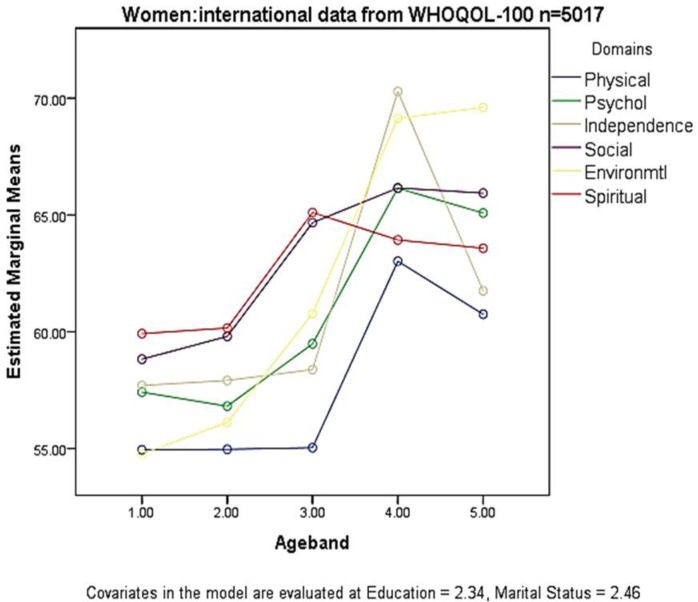
Gender inequalities in health-related quality of life (QoL) are generally few and small, even in large surveys. Many generic measures limit assessment to QoL overall and its physical and psychological dimensions, while overlooking internationally important environmental, social, and spiritual QoL domains. Unique cross-cultural legacy data was collected using four WHOQOL-100 surveys of adults living in 43 cultures world-wide (17,608 adults; ages 15-101). It was first used to examined gender profiles of its five QoL international domains, and their component facets. Few significant gender differences (p < .001) were found. Women reported higher spiritual QoL than men on faith, and spiritual connection facets specifically. Men reported higher physical and psychological QoL domains than women. We aimed to identify those QoL dimensions that contribute to women's overall QoL in health, as this information could inform gender inequalities interventions in health. Environmental QoL explained a substantial 46% of women's overall QoL and health (n = 5,017; 17 cultures) (stepwise multiple regression adjusted for age, education, and marital status covariates). Five environmental QoL facets contributed significantly to this result; home environment offered most explanation. Age band analysis was conducted to understand when interventions might be best timed in the lifespan to improve women's QoL. Younger women (< 45 years) reported the poorest QoL across the lifetime, and on every domain. After 45, all domains except physical QoL increased to very good at about 60, and high levels were sustained beyond 75, especially environmental QoL. Global findings show that assessing environmental, social, and spiritual QoL domains are key to fully understanding women's QoL and health. These assessments should be prioritized in surveys that aim to improve international conservation, and public health policies.
即便在大规模调查中,健康相关生活质量(QoL)方面的性别不平等现象总体上也较少且程度较轻。许多通用测量方法将评估局限于整体生活质量及其身体和心理维度,却忽视了在国际上具有重要意义的环境、社会和精神生活质量领域。我们利用世界卫生组织生活质量量表简表(WHOQOL-100)对全球43种文化背景下的成年人(17608名成年人;年龄在15至101岁之间)进行了四次调查,收集了独特的跨文化遗留数据。该数据首先用于研究其五个生活质量国际领域及其组成方面的性别特征。发现几乎没有显著的性别差异(p <.001)。在信仰以及具体的精神联系方面,女性报告称其精神生活质量高于男性。男性报告的身体和心理生活质量领域高于女性。我们旨在确定那些有助于女性整体健康生活质量的生活质量维度,因为这些信息可为健康领域的性别不平等干预措施提供参考。环境生活质量在很大程度上解释了女性整体生活质量和健康状况的46%(n = 5017;17种文化)(逐步多元回归,对年龄、教育程度和婚姻状况协变量进行了调整)。五个环境生活质量方面对这一结果有显著贡献;家庭环境的解释力最强。我们进行了年龄组分析,以了解在生命周期中何时进行干预可能最有助于改善女性的生活质量。较年轻的女性(<45岁)在整个生命周期以及各个领域的生活质量报告最差。45岁之后,除身体生活质量外,所有领域在约60岁时提升至非常好的水平,并且在75岁之后保持在较高水平,尤其是环境生活质量。全球研究结果表明,评估环境、社会和精神生活质量领域是全面理解女性生活质量和健康状况的关键。在旨在改善国际健康保护和公共卫生政策的调查中,应优先进行这些评估。