
确定雌激素受体α介导的神经元快速兴奋的离子机制。
Identification of an ionic mechanism for ERα-mediated rapid excitation in neurons.
作者信息
Yu Meng, Yin Na, Feng Bing, Gao Peiyu, Yu Kaifan, Liu Hesong, Liu Hailan, Li Yongxiang, Ginnard Olivia Z, Conde Kristine M, Wang Mengjie, Fang Xing, Tu Longlong, Bean Jonathan C, Liu Qingzhuo, Deng Yue, Yang Yuxue, Han Junying, Jossy Sanika V, Burt Megan L, Wong Huey Zhong, Yang Yongjie, Arenkiel Benjamin R, He Yang, Guo Shaodong, Gourdy Pierre, Arnal Jean-Francois, Lenfant Francoise, Wang Zhao, Wang Chunmei, He Yanlin, Xu Yong
机构信息
USDA/ARS Children's Nutrition Research Center, Department of Pediatrics, Baylor College of Medicine, One Baylor Plaza, Houston, TX 77030, USA.
Brain Glycemic and Metabolism Control Department, Pennington Biomedical Research Center, Louisiana State University, Baton Rouge, Louisiana, USA.
出版信息
Sci Adv. 2024 Oct 4;10(40):eadp0696. doi: 10.1126/sciadv.adp0696. Epub 2024 Oct 2.
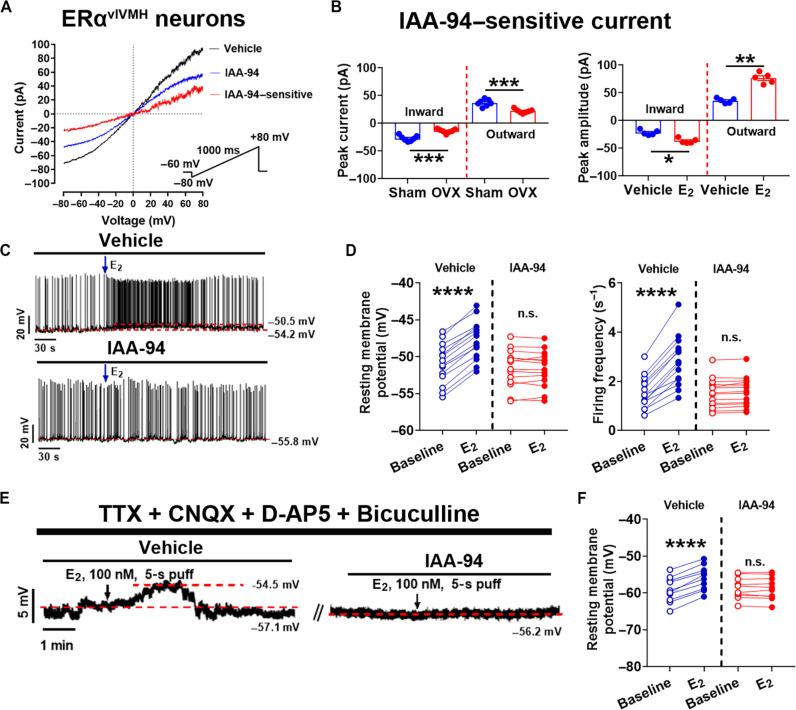
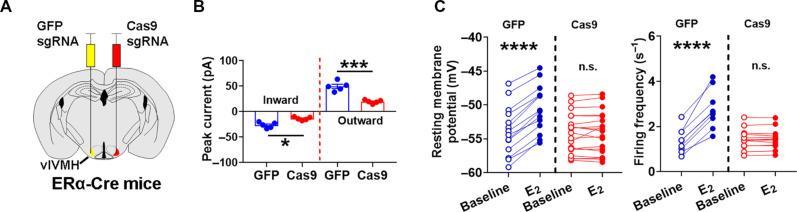
The major female ovarian hormone, 17β-estradiol (E), can alter neuronal excitability within milliseconds to regulate a variety of physiological processes. Estrogen receptor-α (ERα), classically known as a nuclear receptor, exists as a membrane-bound receptor to mediate this rapid action of E, but the ionic mechanisms remain unclear. Here, we show that a membrane channel protein, chloride intracellular channel protein-1 (Clic1), can physically interact with ERα with a preference to the membrane-bound ERα. Clic1-mediated currents can be enhanced by E and reduced by its depletion. In addition, Clic1 currents are required to mediate the E-induced rapid excitations in multiple brain ERα populations. Further, genetic disruption of Clic1 in hypothalamic ERα neurons blunts the regulations of E on female body weight balance. In conclusion, we identified the Clic1 chloride channel as a key mediator for E-induced rapid neuronal excitation, which may have a broad impact on multiple neurobiological processes regulated by E.
主要的女性卵巢激素17β-雌二醇(E)可在数毫秒内改变神经元兴奋性,以调节多种生理过程。雌激素受体-α(ERα),传统上被认为是一种核受体,也以膜结合受体的形式存在,介导E的这种快速作用,但其离子机制仍不清楚。在这里,我们表明,一种膜通道蛋白,氯离子细胞内通道蛋白-1(Clic1),可以与ERα发生物理相互作用,且更倾向于与膜结合的ERα相互作用。Clic1介导的电流可被E增强,而在E缺失时减弱。此外,Clic1电流是介导E在多个脑ERα群体中诱导的快速兴奋所必需的。进一步的研究表明,下丘脑ERα神经元中Clic1的基因破坏会削弱E对雌性体重平衡的调节作用。总之,我们确定Clic1氯离子通道是E诱导的快速神经元兴奋的关键介质,这可能对E调节的多个神经生物学过程产生广泛影响。



 Zotero 插件